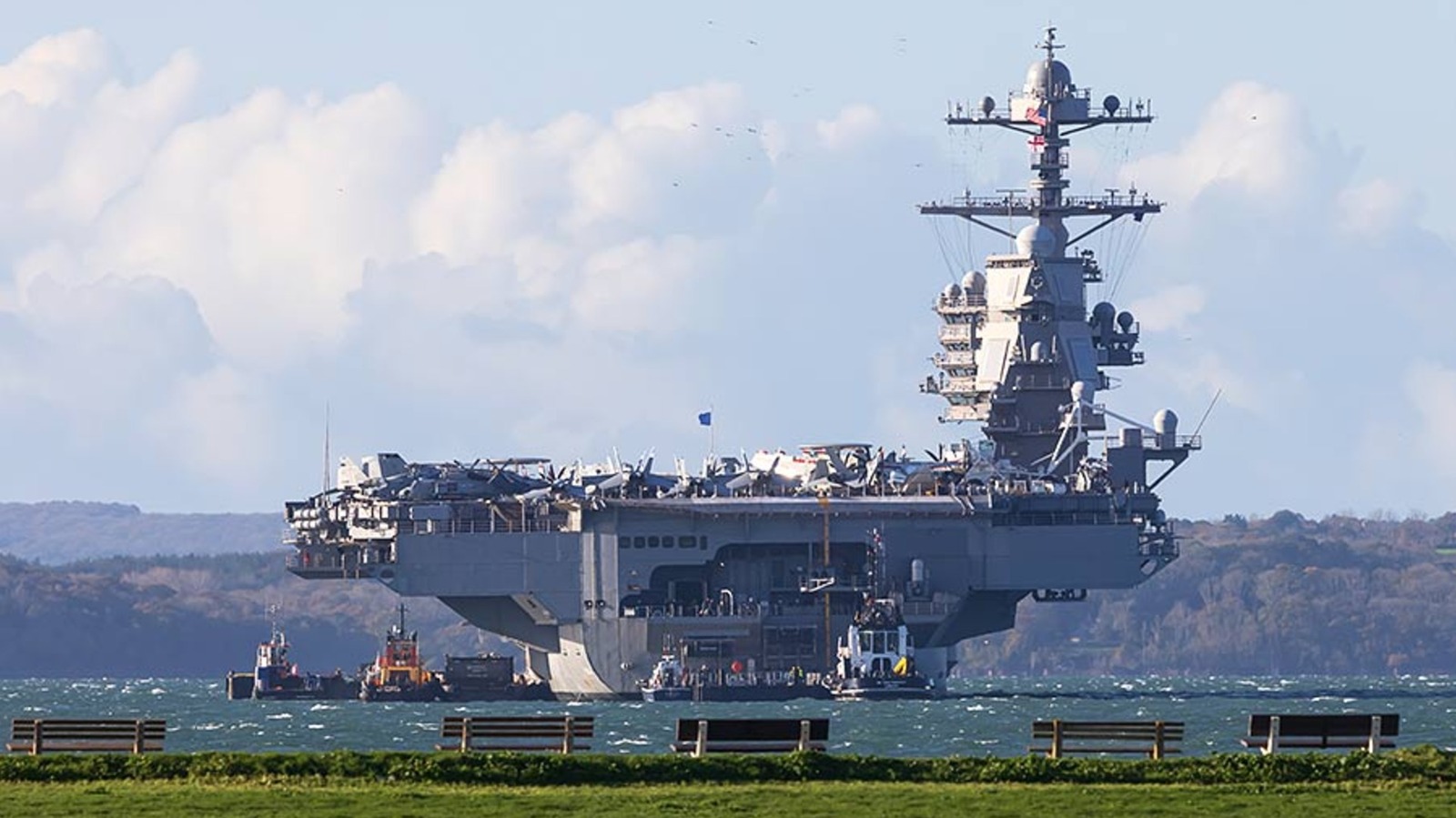
АНУ-ын тэнгисийн цэргийн хүчин сүүлийн зуун жилийн хугацаанд ашигласан онгоц тээгч хөлөг онгоцнуудынхаа ангилал, технологийн хувьслыг танилцууллаа.
АНУ-ын тэнгисийн цэргийн хүчин 1922 онд анхны онгоц тээгч USS Langley (CV-1) хөлөг онгоцыг ашиглалтад оруулснаас хойш нийт 66 хөлөг онгоцыг үүрэг гүйцэтгүүлжээ. Эдгээр хөлгүүд нь Дэлхийн хоёрдугаар дайны үеийн Yorktown, Essex, Independence зэрэг ангиллаас эхлээд хүйтэн дайны үеийн Forrestal, Kitty Hawk, мөн дэлхийн анхны цөмийн хөдөлгүүрт онгоц тээгч Enterprise (CVN-65) хүртэл өргөн хүрээг хамардаг. Технологийн хөгжлийг даган эдгээр хөлөг онгоцнуудын хэмжээ, хүчин чадал болон агаарын хөлөг тээвэрлэх чадвар нь эрс нэмэгдсэн байна.
Одоогоор АНУ-ын тэнгисийн цэргийн хүчний гол тулгуур нь 1975 оноос хойш ашиглагдаж буй Nimitz ангиллын цөмийн хөдөлгүүрт 10 хөлөг онгоц юм. Гэсэн хэдий ч USS Nimitz (CVN-68) хөлөг онгоцыг 2027 оны гуравдугаар сард ашиглалтаас гаргахаар төлөвлөж байгаа бөгөөд түүнийг орлох шинэ үеийн Gerald R. Ford ангиллын хөлөг онгоцнууд ашиглалтад орж эхлээд байна. Энэхүү шинэ ангиллын хөлөг онгоцнууд нь цахилгаан соронзон онгоц хөөргөх систем (EMALS) зэрэг хамгийн сүүлийн үеийн технологиор тоноглогдсон юм.
Түүхийн туршид зарим хөлөг онгоцнуудыг байлдааны зориулалтаар, заримыг нь сургалтын зорилгоор ашиглаж ирсэн бөгөөд олон хөлөг онгоцны ангилал нь зөвхөн нэг эсвэл цөөн хэдэн хөлөгт хамаардаг байв. Өнөөг хүртэл ашиглагдаж байгаа хөлөг онгоцнуудын ихэнх нь музейн зориулалтаар хадгалагдан үлдсэн бол зарим нь байлдааны ажиллагаа болон туршилтын явцад ашиглагдаж дуусжээ. АНУ-ын тэнгисийн цэргийн хүчин одоо ч гэсэн хуучин хөлөг онгоцнуудаа шинэчлэх, солих бодлогыг үргэлжлүүлэн хэрэгжүүлсээр байна.
Дэлгэрэнгүйг эх сурвалжаас харах
Эх сурвалжийг нээх ↓
The first aircraft carrier arrived in 1918 when the HMS Argus set sail, earning that distinction by having a purpose-built flight deck, elevators, and a hangar below. It started life as an unfinished ocean liner and was converted as the need for carriers became paramount during World War I. The United States’ first aircraft carrier arrived in 1922, though the nation had launched an aircraft from a ship as early as November 14, 1910,using a platform built onto a cruiser.
When the U.S. entered World War II, it had many aircraft carriers in service, and Congress had already funded the construction of many more. As time passed, America’s aircraft carriers became larger and more technologically advanced, capable of launching a variety of fixed-wing aircraft and helicopters.
Modern aircraft carriers are exponentially larger and more powerful than anything that came before, and still, the U.S. is building more carriers to replace its older ships. As of this writing, the U.S. Navy has employed 66 aircraft carriers, many of which are in the same class. Some classes were one-offs, while most featured multiple ships. These classes include some of the greatest naval vessels the U.S. has sailed, and all operated within the last century or so.
Langley
In 1922, the U.S. Navy commissioned the USS Langley (CV-1), which is the nation’s first aircraft carrier. There was only ever one ship in the class, and it started out as a cargo vessel called the USS Jupiter (AC-3), which was commissioned in 1913 and decommissioned in 1920. At that time, work began to convert the cargo vessel into the nation’s first aircraft carrier, which was a big job, seeing as it lacked a key feature of an aircraft carrier: a flight deck.
While the Langley class began in 1922, which falls outside of the past 100 years, the USS Langley remained operational for two decades. After entering the fleet in 1922, it went in for conversion in 1936 and emerged in 1937 as a seaplane tender, ending the vessel’s time as a true aircraft carrier. One interesting detail about the Langley is that it had a carrier pigeon loft, which wasn’t all that unusual at the time.
The Langley took a great deal of damage from Japanese bombers and was scuttled on February 27, 1942. The Langley was the Navy’s first electrically propelled ship, capable of reaching a speed of 17 mph. It displaced 15,150 tons of seawater, measured 542 feet, 2.5 inches long, and had a crew of 468 personnel, which included the air group. While not the biggest or fastest, the Langley class brought carrier-based naval aviation to the U.S.
Yorktown
The U.S. began construction of its Yorktown-class carriers in 1934, and they were completed in time for the nation to enter WWII. The class consisted of three vessels: the USS Yorktown (CV-5), USS Enterprise (CV-6), and USS Hornet (CV-8), all of which participated in WWII. While all were historical, the USS Enterprise is one of the most legendary aircraft carriers ever built, though all three had notable careers during the global conflict while operating in the Pacific Theater against Imperial Japanese forces.
Yorktown-class carriers displaced 25,484 tons of seawater when fully loaded, making them considerably larger than the USS Langley and most other contemporary carrier classes. They measured 809 feet in overall length, could travel up to 36.8 mph, and boasted a complement of 2,217 personnel. Like most ships built before and during WWII, Yorktown-class carriers featured armor plating and defensive weapon systems. They also carried 90 aircraft serviced by two catapults on the flight deck.
When Yorktown and Enterprise entered service in 1937 and ’38, the Yorktown-class carrier air wings consisted of a mix of biplanes and monoplanes of different varieties, including torpedo and dive bombers. Both the Yorktown and Hornet were lost in combat operations, leaving the Enterprise as the class’s only survivor. The Enterprise, or “Big E,” was the most decorated Navy ship of WWII, but it never became a museum ship and was ultimately scrapped in 1958.
Essex
With the looming threat of war on the horizon, the U.S. Navy put a lot of effort into producing the Essex class, which ultimately became the most-produced fleet aircraft carrier class and capital ship in the 20th century. Essex-class carriers formed the core of Navy strength throughout WWII, and the Navy ordered 32 of them. Only 24 were completed before the end of the war, and they all served with distinction, with one serving into the 1990s.
Essex-class carriers came in short- and long-hull configurations, and while 14 saw combat during WWII, none were sunk by enemy action. The class featured significant upgrades in its design, allowing for larger air groups and extended flight decks. They also had better armor and armament than previous classes. This was especially true of their anti-air defenses and radar systems, which helped keep the carriers afloat and in the fight.
The USS Essex (CV-9) was the first in its class, and it displaced 30,000 tons of seawater. The carrier was about 870 feet long, had two fire-control radars, and tons of cannons for defense. Of the 24 ships in the class, only four survive to this day: the USS Yorktown (CV-10, not to be confused with the Yorktown class), USS Intrepid (CV-11), USS Hornet (CV-12), and USS Lexington (CV-16), all of which continue to serve as museum ships.
Independence
While most aircraft carriers that the U.S. Navy operated over the past 100 years were purpose-built from the keel up, the Independence class featured only converted ships. They all started as Cleveland-class light cruisers, which were still under construction when the Independence class entered production. Instead of completing the Cleveland-class light cruisers, the Navy converted them into a new class of light aircraft carriers. In total, the Navy sailed nine Independence-class carriers during WWII.
The fleet of Independence-class carriers operated almost entirely in the Pacific Theater, taking part in pivotal operations designed to weaken Japan’s carrier capabilities. Eight of the nine fought in the Battle of the Philippine Sea, which ended Japan’s carrier air power, further driving the nation’s forces back toward Japan’s home islands and their surrounding territories. Independence-class carriers were comparatively light, displacing 14,750 tons of seawater when fully loaded.
They stretched to 622 feet, 6 inches in length and supported around 35 aircraft. They were manned by 1,569 personnel and could travel up to 36.3 mph. Speed was the class’s greatest advantage, and the carriers proved their worth in numerous engagements. Of the nine, only the USS Princeton (CVL-23) was lost to enemy action. The remaining carriers were either scrapped or transferred to allied nations, though one, the USS Independence (CVL-22), served as a target ship for Operation Crossroads to test its survivability during nuclear attack.
Wolverine and Sable
Of the many aircraft carriers used by the U.S. Navy over the past century or so, the Wolverine and Sable classes make up two of the weirdest ships. There was only ever one of each class, and each class was named after its sole ship: the USS Wolverine (IX-64) and the USS Sable (IX-81). What made them particularly weird was how they were built and where they operated because, while they were active during WWII, they remained in the Great Lakes to train naval aviators in carrier operations.
Both vessels began as excursion steamers built decades earlier, so the carriers the ships became looked nothing like their original form. The USS Sable displaced 6,690 tons of freshwater and measured 535 feet in length. It was initially built in 1923 and was later commissioned into the Navy in 1943 after a rebuild as a training carrier. The Wolverine started out as a Great Lakes excursion steamer in 1912, which was then named the Seeandbee.
It entered active service with the Navy in 1942 after it was rebuilt. The Wolverine displaced more water at 7,300 tons, despite measuring only 500 feet in length. Standard carrier flight decks of the era measured closer to 800 feet, but that didn’t stop the Navy from training its aviators on those ships. During the conflict, the two freshwater carriers qualified nearly 18,000 aviators in carrier landings, which aided the overall war effort.
Midway
After WWII, the U.S. continued to produce aircraft carriers, and the first to be commissioned in the post-war period was the USS Midway (CV-41), the first of three in its class. The initial plan was to produce six, but with the war over, the number was cut in half, resulting in the USS Franklin D. Roosevelt (CV-42) and the USS Coral Sea (CV-43). Their design included armored decks and an increase in size that gave each carrier a larger air wing than the Essex-class ships.
This larger size accommodated up to 120 aircraft, projecting naval aviation further than any previous class of carrier. That said, too many aircraft became challenging to manage, so the numbers were cut down to promote better and more efficient aircraft operations. The class had other issues, including an inability to transit the Panama Canal, and the ships’ quarters were cramped, leaving little room for the vessels’ 4,104-person complements.
While none of the Midway-class carriers fought in the Korean War, all three took part in the Vietnam War. Despite the ships’ larger size, they couldn’t accommodate the F-14 Tomcat, leaving the F-4 Phantom II to continue to serve in their air wings. The ships displaced 45,000 tons of seawater and stretched 985.9 feet long. All three were decommissioned by the early 1990s, with the USS Midway being the only one functioning as a museum.
Saipan
The USS Saipan (CVL-48) and USS Wright (CVL-49) are the only two ships that the U.S. Navy sailed in the Saipan class. The light carriers were designed and built from the keel up, using cruiser hulls as their base. Unlike the Independence-class ships, Saipan-class carriers weren’t converted from cruisers. Instead, they were based on heavier Baltimore-class cruisersand were slightly larger and faster than Independence-class carriers, moving up to 38 mph while displacing 19,000 tons of seawater when fully loaded.
They stretched 684 feet long and accommodated 48 aircraft of different types. The Saipan was commissioned on July 14, 1946, but it didn’t serve for very long and was decommissioned on October 3, 1957. It was later reclassified and converted into a communications relay ship. During its time in service, the Saipan recovered NASA astronauts and served in the Vietnam War in 1967 and ’68.
While the Saipan was renamed the Arlington after being reclassified, the Wright maintained its name throughout its service life. The Wright had a similarly short career, beginning with its commissioning on February 9, 1947. It served until March 15, 1956, and was later reclassified as an auxiliary aircraft transport ship. Eventually, the Wright was reclassified as a command ship and ended its service on May 27, 1970, long after it had stopped functioning as an operational aircraft carrier. Both Saipan-class ships were scrapped.
Forrestal
When the USS Forrestal (CV-59) entered the fleet in 1955, it was the first ship called a supercarrier. Unlike previous carriers, the four ships in the Forrestal class featured significantly higher displacement, accommodated larger crews, and maintained considerably larger air wings. Whereas earlier ships were built during or soon after WWII, the Forrestal-class ships were the product of the Cold War, so bigger and better was the name of the game in an ongoing effort to outperform the Soviet Union.
Forrestal-class ships were the first built with angled decks, allowing for takeoff and landing operations at the same time, which was a significant innovation in carrier flight deck design. Other carriers received these upgrades over time, including Essex- and Midway-class ships, but the Forrestal class was the first to enter the water with a fully redesigned flight deck. The class remained in operation from 1955 until 1998, having participated in the Vietnam War and Operation Desert Storm.
The class’s ships measured 1,039 feet long and 252 feet wide. They could travel at over 34.5 mph, had four steam catapults and four elevators to service their 100 aircraft of various types used between the 1950s and ’90s. The four ships in the Forrestal class included the aforementioned namesake, the USS Saratoga (CV-60), USS Ranger (CV-61), and the USS Independence (CV-62). Each of the Forrestal-class aircraft carriers was retired and ultimately scrapped after decades of service.
Kitty Hawk
After using Forrestal-class aircraft carriers for a few years, the U.S. Navy took the lessons learned from those vessels and designed its next three ships, the Kitty Hawk class. The two classes were similar, though Kitty Hawk-class carriers were improved upon in several areas, including moving the elevators to better accommodate flight deck and hangar operations. The massive ships displaced up to 84,914 tons of seawater when fully loaded and had a crew complement of about 5,186 personnel.
Kitty Hawk-class vessels also had a longer deck when compared to their predecessors. The ships measured about 1,048 feet long, and the shipsaccommodated 100 aircraft and could speed along the water at 39 mph. Moving the aircraft elevators improved flight operations with an increase in the ships’ sortie generation rate, so while the design was largely incremental over the Forrestal class, the Kitty Hawk-class ships were considerably more efficient in their design.
All three ships in the class, the USS Kitty Hawk (CV-63), USS Constellation (CV-64), and the USS America (CV-66), operated for decades, participating in numerous conflicts from the early 1960s into the late 2000s. The ships received several upgrades and modernization efforts during their service lives, and by 2009, all three Kitty Hawk-class aircraft carriers were retired. The Kitty Hawk and Constellation were both scrapped, while the America served as a target ship during a classified SinkEx and sank in 2005.
Enterprise
The USS Enterprise (CVN-65) entered service in 1961 as the only ship in its class, and it holds the important distinction of being the world’s first nuclear-powered aircraft carrier. All previous classes of carriers built by the U.S. and every other nation used conventional power to move around, but the Enterprise broke that longstanding tradition. Every U.S. aircraft carrier built after the Enterprise has been nuclear-powered, so the ship represents a drastic change in carrier construction.
Like its WWII namesake, the Enterprise was dubbed “Big E” by the sailors who crewed it, and the ship accommodated a complement of 4,600 personnel. The Enterprise displaced 85,600 tons of seawater, featured an air wing of 75+ aircraft, and launched them via four steam catapults. It had four elevators like some of its predecessors and could move at 34.5+ mph. The ship measured 1,123 feet long, and its flight deck area covered 4.5 acres, so it was massive when compared to other carriers of its era.
The Enterprise was commissioned on November 25, 1961, and it remained in service for decades, taking part in multiple combat operations. It served during the Cuban Missile Crisis, the Vietnam War, Operation Joint Endeavor, Operation Desert Fox, Operation Enduring Freedom, and Operation Iraqi Freedom. Throughout its service, the Enterprise received multiple upgrades, and it was finally decommissioned in 2017. As of this writing, it remains in a holding pattern awaiting nuclear recycling before it can be safely scrapped.
Nimitz
Throughout the latter quarter of the 20th century, Nimitz-class aircraft carriers ruled the seas. The U.S. Navy commissioned 10 Nimitz-class aircraft carriers beginning in 1975, and as of this writing, they all remain on active duty in the Navy. The Nimitz-class carriers were named to honor Admiral Chester Nimitz, and they represent the first nuclear-powered class with more than one ship. Each one is massive when compared to some of the carriers developed 20 to 30 years earlier.
A Nimitz-class aircraft carrier displaces 100,000 tons of seawater and has a length of 1,092 feet. They’re powered by two Westinghouse A4W nuclear reactors that are used to produce steam to generate enough power to push the carriers up to 35 mph. They feature a crew complement of 3,200 ship and 2,480 air wing personnel for a total of 5,680, and for decades, Nimitz-class carriers have made up the backbone of U.S. Navy might.
The 10 active Nimitz carriers routinely fly the F/A-18 Super Hornet, E-2C Hawkeye, EA-6B Prowler, several helicopters, and the F-35C Lightning II, though each ship’s inventory differs, depending on the mission. Because the USS Nimitz (CVN-68) has been in service since 1975, it’s due for retirement. The ship completed its final journey in July 2026 and will be deactivated in March 2027 before it’s ultimately dismantled in 2030. After this, the other Nimitz-class carriers will begin retiring to make room for their replacements.
Gerald R. Ford
The U.S. Navy’s newest carrier is the lead ship in the Gerald R. Ford class, which is set to incrementally replace the fleet of Nimitz-class carriers still in service. The USS Gerald R. Ford (CVN-78) is the largest aircraft carrier in the world and the largest warship ever built, and it features numerous modern improvements over legacy vessels. Most notable is its use of a new type of launch system, the Electromagnetic Aircraft Launch System (EMALS).
EMALS replaces steam-powered catapults and launches aircraft more efficiently and at greater speed than previous methods. It took a lot of innovations in aircraft carrier design to lead to the Ford, and it’s an impressive ship. The Ford displaces 100,000 tons, can move at 34.5 mph, and is 1,106 feet long. It was commissioned on July 22, 2017, and has remained in operation since. Because of its design and use of two nuclear reactors, it won’t need refueling until well into the 2030s.
The Ford’s air wing typically operates 75 aircraft of different types. As of this writing, its primary aircraft remains the F/A-18 Super Hornet, though it also flies the F-35C and other aircraft. The Navy plans to commission 10 more Ford-class carriers, though they take considerable time to construct, so it will be a while before all of the Nimitz-class carriers are replaced.

