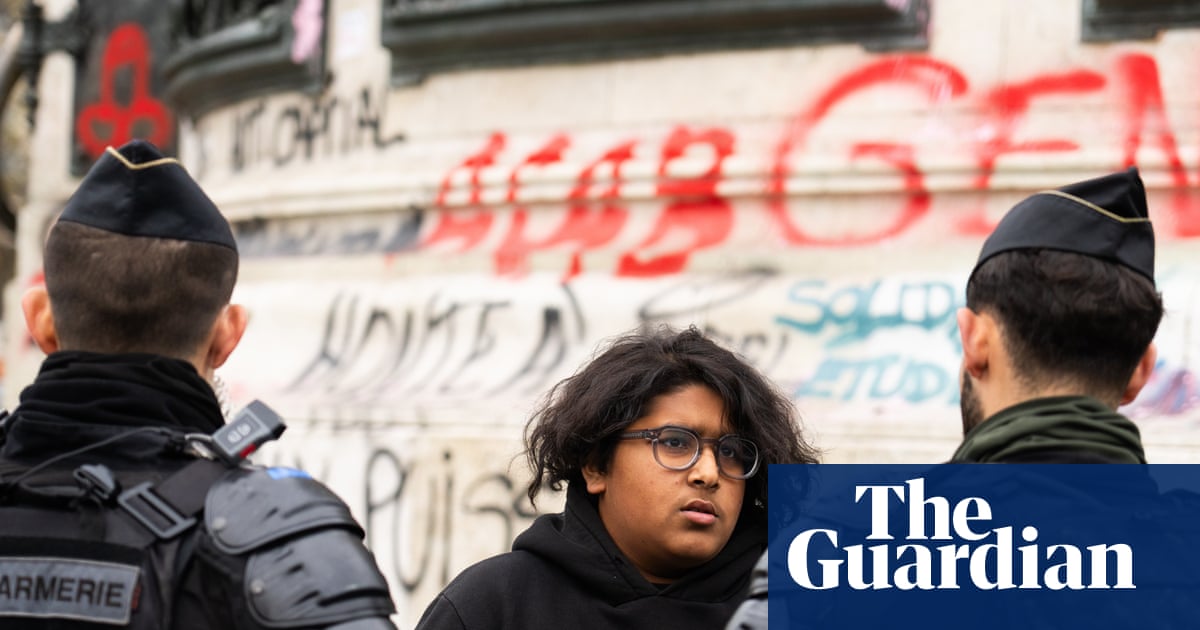
In France, it was the piles of wheelie bins stacked up against school entrances that first hinted at the scale of student anger over crumbling classrooms and teacher shortages. In Spain, it was a tent camp that steadily grew in the heart of the capital as residents railed against soaring housing costs.
Similar scenes have since sprung up in Belgium, Italy and Portugal, and clashes have convulsed Albania’s capital of Tirana, hinting at an autumn of protests across Europe.
Much of the news coverage in recent days has focused on the violence that played out on the fringes of the protests in France and Italy. The protests themselves, however, point to what seems to be a diverse response to a common crisis: the growing perception, particularly among younger generations, that governments are unable, or unwilling, to deliver when it comes to affordable housing, social equality and robust public services.
graphic
“This is the most powerful warning from Europe’s angry youth today, in France and across the continent,” the policy analyst Alberto Alemanno said.
The framing stands in sharp contrast to the many rightwing and far-right voices who have sought to exploit the violence in France and Italy, linking it without evidence to migration while brushing over protesters’ wider demands.
Officials in France have dismissed any link between the violence and immigration. The country’s president, Emmanuel Macron, said on Sunday that the “unbridled violence” had been carried out by French people.
France protests escalate with riots, looting and 2,400 arrests – The Latest
Alemanno, a professor of EU law at the HEC business school in Paris, said he had received an unprecedented number of calls from right-wing, xenophobic outlets in recent days, many of them seeking to fuel the idea of the protests as some sort of “pan-European revolt”.
It is a narrative that he describes as misleading. “The demonstrations have different causes and do not necessarily share political objectives,” he wrote this week. “Yet their rapid spread hints at a common weak point: too many young Europeans doubt that existing institutions can deliver the security, opportunity and voice they expect.”
The head of the Paris office of the European Council on Foreign Relations, Célia Belin, said some of those doubts were currently being reinforced in France.
“Faced with the high discontent of young people in high school, the government has no answer for them,” she said, citing an administration squeezed financially by a high deficit and debt-to-GDP ratio and limited politically by the country’s deadlocked parliament. “Basically the answer is: ‘There’s no money, there is nothing we can do.’ And that’s a huge problem.”
graphic
The view echoes that of the secretary general of France’s CGT union, Sophie Binet, after Saturday’s protests in which about half a million people turned up to rail against the rising cost of living and deteriorating public services.
Binet condemned the violence, but she noted that the government had little choice when it came to quelling the protests. “Today’s mobilisation confirms the depth of the anger,” she said. “To get out of the crisis, there is only one way. Respond to the demands.”
Albania has also been shaken by mass student demonstrations for the past week after protests initially prompted by a proposal to build a resort backed by Donald Trump’s family.
In Milan, people took to the streets to protest against the rising cost of living, giving voice to the deep inequalities that now course through a city where an estimated one in 12 people is reportedly a millionaire.
skip past newsletter promotion
after newsletter promotion
graphic
In Lisbon’s Rossio Square, housing campaigners set up camp on Saturday surrounded by banners that read “homeless generation” and “I just want a home to live in” and vowing to stay on as long as possible. It was an echo of the protests that have sprung up in Porto in recent weeks as residents push back against housing prices that more than doubled between 2015 and 2024, rising roughly twice as fast as the EU average.
The managing director for Europe at the consulting firm Eurasia Group, Mujtaba Rahman, said what had burst into public view was not a single, coordinated European movement. Instead the events of recent days had laid bare a “convergence of distinct national protest movements”, each with substantially different triggers.
Protesters camp out in Lisbon’s Rossio Square. Photograph: Horacio Villalobos/Corbis/Getty Images
“What links them is a growing perception that European governments are unable to deliver affordable housing, functioning public services and economic security, particularly for younger generations,” he said, citing a growing gap between public expectations and governments’ fiscal capacity.
“This mismatch between political demands and economic reality is likely to remain and grow over time, which suggests further discontent and protests are likely over the medium term,” he said.
Arancha González, the dean of the Paris School of International Affairs and a former Spanish foreign minister, went a step further when asked this month about the similarities between the housing protests in Spain and the school protests in France.
“The reasons are different, but they share the same spark: the breakdown of the social contract,” she told the Italian newspaper Corriere della Sera. “Young French people are protesting for education, young Spanish people for housing, but in Europe, the idea that economies generate wellbeing and social equality has been shattered.”
In Portugal, the campers were dislodged on Tuesday, leading to a fresh call for more housing protests. Similar calls for protests in the coming days have been heard across France, Spain and Italy, hinting at the tremendous task that lies ahead for officials across Europe, said Alemanno.
“They must protect peaceful demonstrators, hold those responsible for criminal acts accountable, and address the underlying pressures, from housing costs and insecure work to strained public services and an uncertain technological future,” he said.
“Europe’s democratic institutions will be judged not by how forcefully they condemn disorder, but by whether they can turn generational anger into tangible political change.”