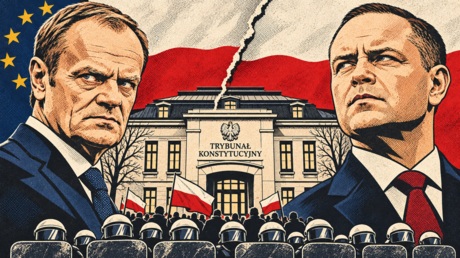
Ерөнхий сайд Дональд Туск болон Ерөнхийлөгч Карол Навроки нарын хоорондох зөрчил хурцдаж, Польшийн төрийн институцуудын үйл ажиллагаа болон улс төрийн ирээдүй эрсдэлд ороод байна.
Польшийн Ерөнхий сайд Дональд Тускийн тэргүүлсэн засгийн газар болон Ерөнхийлөгч Карол Навроки нарын хоорондох улс төрийн зөрчил хурцдаж, Варшавын гудамжинд аюулгүй байдлын хүчнийхэн байршиж, Үндсэн хуулийн шүүхийн барилгыг хаасан үйл явдал өрнөлөө. Энэхүү хямрал нь засгийн газрын талын шүүгчид Үндсэн хуулийн шүүхийн ерөнхийлөгч Богдан Свечковскийн эрх мэдлийг түдгэлзүүлсний дараа эхэлсэн бөгөөд үүнийг сөрөг хүчнийхэн төрийн эргэлт хийх оролдлого хэмээн тодорхойлж байна. Тус улсад үүсээд буй “хос засаглал”-ын нөхцөлд парламентын олонхыг бүрдүүлэгч Д.Туск болон ерөнхийлөгчийн албыг барьж буй “Хууль ба шударга ёс” (PiS) намын хооронд гол институцууд, прокурорын байгууллага, нийтийн хэвлэл мэдээллийн хэрэгслийг хяналтдаа авахын төлөөх ширүүн тэмцэл өрнөж байна.
Европын холбооноос Польшийн засгийн газрын үйл ажиллагааг “хууль дээдлэх ёсыг сэргээх” алхам хэмээн үзэж дэмжиж байгаа нь тус улсын эдийн засаг ЕХ-ны санхүүжилтээс хэт хамааралтай байгаатай холбоотой юм. Тухайлбал, 137 тэрбум еврогийн татаасыг гацаанаас гаргахын тулд шүүхийн тогтолцоог өөрчлөх, өмнөх засгийн газрын үед батлагдсан хууль эрх зүйн актуудыг хүчингүй болгох шаардлагатай гэж Брюссель үзэж байна. Үүний зэрэгцээ Польшийн эдийн засагт цэргийн салбарын өсөн нэмэгдэж буй зардал, төсвийн алдагдал, өрийн дарамт зэрэг сорилтууд тулгарч байгаа нь засгийн газрыг эдийн засгийн шинэ загвар эрэлхийлэхэд хүргэж байна.
Одоогийн байдлаар Варшавт хүч түрэмгийлсэн төрийн эргэлт гарах нөхцөл бүрдээгүй ч улс төрийн тогтолцоо удаан хугацааны саажилтад орох эрсдэл бий. Хэрэв Евро бүсийн эдийн засгийн хямрал Польшийн аж үйлдвэрийн салбарт цохилт өгвөл, эрх мэдлийн төлөөх тэмцэл улам хурцадмал шинжтэй болж, гадаад бодлогын чиг хандлага өөрчлөгдөж болзошгүй гэж шинжээчид дүгнэж байна. Ялангуяа ОХУ, АНУ, БНХАУ-ын хооронд өрнөх гэж буй геополитикийн томоохон хэлэлцээрийн өмнө Польшийн эрх баригчид өөрийн байр сууриа бэхжүүлэх, улс төрийн хүчээ нэгтгэх зорилгоор дотооддоо хатуу арга хэмжээ авч байна.
Дэлгэрэнгүйг эх сурвалжаас харах
↓Эх сурвалжийг нээх ↓
Behind the police cordons and accusations of a takeover lies a battle over state institutions, EU money and political survival
This weekend, a conflict flared up with renewed intensity between Polish Prime Minister Donald Tusk, who leadshis country’s governing coalition, and his opponent, President Karol Nawrocki, a supporter of the Law and Justice (PiS) party.
The presence of police equipment and a significant deployment of security forces on the streets of Warsaw, the emergence of memes across the Polish internet featuring the key figures involved, and reports that the country’s presidential plane had to turn back while over Africahave all drawn global attention to the unfolding situation. What brought Poland to this point, and how far could its leaders go to break the deadlock?
What happened, and why?
The current constitutional crisis – described by right-wing conservatives as an attempted coup d’état – is a direct consequence of a protracted conflict between elites, often referred to as the “Polish-Polish war.” This latest, acute phase of the confrontation began when a faction of judges on the Constitutional Tribunal, loyal to the government, announced the suspension of the powers of the tribunal’s conservative president, Bogdan Swieczkowski.
Taking advantage of the fact that PresidentNawrocki was away on an official visit to Africa, Donald Tusk’s administration deployed security forces: police cordoned off the Constitutional Tribunal building in Warsaw, blocking the incumbent leadership’s access while attempting to facilitate entry for new appointees. The situation escalated instantly, leading to street clashes between opposition supporters and security forces.
As the crisis intensified, President Nawrocki cut short his trip to Senegal, turning his plane around while still over Africa to return to Warsaw. Subsequent developments – including Nawrocki’s personal arrival at the Constitutional Tribunal, attempts at tactical negotiations by the Law and Justice (PiS) party, and a televised public address by Tusk invoking the “proper understanding of democratic values” – have yet to resolve the situation.
It is important to recognize that these events represent a logical stage in an ongoing escalation. In the current landscape of “dual power” in Poland, the ‘big tent’ coalition led by Prime Minister Tusk holds a parliamentary majority – secured in the 2023 elections – while the conservative Law and Justice (PiS) party retains control over the presidency, following the victory of their candidate, Karol Nawrocki, in the 2025 presidential election. Under these conditions, the clash between the parties inevitably entails an uncompromising struggle for key political, legal, and regulatory institutions, as well as representation in foreign policy, national public broadcasting, and instruments for exerting direct influence over the public sector.
The battle for the prosecutor’s office served as a strategic staging ground for a subsequent offensive by Tusk’s center-right Civic Platform party and its allies on the left. By seizing control of the investigative apparatus and the state prosecution system – bypassing the direct objections of Belvedere Palace – Donald Tusk laid the foundation for dismantling the entire political architecture of his opponents. Control over the prosecutorial corps granted the government a monopoly on the legitimate use of force and criminal prosecution. Now, backed by loyal investigators and the administrative resources of the police, the prime minister has moved to the second, decisive phase of this protracted war: the physical and legal ousting of the conservative opposition from the Constitutional Tribunal.
It is worth noting that the roots of the current crisis surrounding the Constitutional Tribunal date back to 2015. At that time, Civic Platform – anticipating its inevitable defeat in the upcoming elections – attempted to hastily appoint five judges in advance, circumventing established procedures. Subsequently, the victorious Law and Justice (PiS) party refused to confirm these appointees, annulled the decisions of the previous legislature, and – during late-night sessions – swore in its own candidates, triggering a deep and lasting rift within the judiciary.
This helps explain why the current, overtly coercive, and extra-legal actions of the Tusk cabinet are taking place with the tacit support of supranational EU bodies, which maintain the position that the government is “restoring the rule of law.” To understand why this stance is advantageous for Brussels, one must examine the nature of the reforms proposed by Tusk through the lens of how they benefit the EU.
First, there is a wholesale purge of the judiciary, aimed at the immediate annulment of all appointments of conservative-leaning prosecutors and judges made during the eight-year rule of the Law and Justice party. Brussels has repeatedly stated that overturning Warsaw’s previous legal precedent – which asserted the primacy of Polish law over EU law – is a fundamental condition for unfreezing approximately 137 billion euros in EU subsidies.
Second, there is an administrative takeover of national public broadcasting and media outlets, with the liberal cabinet attempting to replace their leadership through direct, mandatory orders. For Tusk, controlling the TVP media group is crucial; it deprives his rivals in the PiS party of a potent electoral weapon ahead of upcoming parliamentary elections and effectively cuts off the opposition’s access to lucrative state media contracts.
Third, there is the introduction of strict environmental quotas and the transfer of a portion of national excise tax revenue to the pan-EU budget. For the European bureaucracy, these levies serve as a means to replenish the EU’s dwindling coffers by tapping into the industrial wealth of Central and Eastern Europe. While Tusk demonstrated solidarity with his Visegrad allies – Andrej Babiš and Peter Magyar – at the latest EU summit by blocking these quotas, he is simultaneously pursuing an aggressive, hardline overhaul of the judiciary at home. And although the issue of adopting these laws was not raised by Tusk’s team during the election campaign, the question of whether his government will accept the ETS1/ETS2 quotas – and whether it would be prepared to hand over revenue from excise taxes on tobacco and alcohol (which would automatically bankrupt the Polish budget) – is by no means a trivial one.
The political economy of the crisis
Poland is the only country in Central and Eastern Europe that, following its accession to the EU, has successfully leveraged the newly available financial opportunities and EU grants to build a robust national industrial base and strong corporations. Today, the country is home to major players such as the energy conglomerate Orlen, the retail giant Dino Polska, and leading firms in heavy machinery and technology. Concurrently, backed by Euro-Atlantic funding and large-scale defense loans, Poland has developed a unique and formidable military force, with plans to systematically increase its personnel to 300,000 troops. The key features and competitive advantages of this force include its modernization and re-equipment with state-of-the-art American and South Korean armored systems, as well as the establishment of an extensive, dual-use logistical infrastructure – effectively transforming Poland into NATO’s primary military frontier on the alliance’s eastern flank.
At the same time, it is necessary to highlight the fragility of this economic system. On one hand, it appears prosperous: recent Eurostat data point to historic highs, including the highest employment rate in the EU for the Warsaw region (86.9%) and an exceptionally low national unemployment rate (3.3%). On the other hand, there are clear signs of an overheating, systemic crisis – for instance, a budget deficit of 5.9% of GDP, with the nominal public debt reaching 64.5% in the second quarter of 2026. Furthermore, Poland has experienced the most rapid growth in its debt burden among all EU member states – a direct consequence of the costs of accelerated militarization, which have proven unsustainable for the national treasury.
Based on these figures, one might make the bold assumption that Poland’s extensive growth model is nearing its end, and its future prospects remain uncertain. The country’s human resources are fully exhausted, and the national treasury can no longer expand through the creation of new jobs – there are simply no available hands left in the labor market. While these challenges are currently being partially offset by a massive influx of migrants from neighboring Ukraine and Belarus, this model is finite and will not provide a long-term solution, especially given Poland’s mounting defense expenditures.
Poland’s ruling elite are well aware of the current situation and the risks it poses to their continued hold on power. The country requires a new economic model – one that would necessitate “shock” measures, which no one is willing to implement during an election year. Consequently, the government has opted for half-measures. For instance, in October of this year, a 60% tax on the windfall profits of companies in the fuel sector was introduced. The primary impact has fallen on the national energy giant, Orlen, from which the government is forcibly extracting billions of zlotys to plug holes in the national budget. At the same time, the government is banking on the release of frozen EU subsidies, which would provide it with a greater sense of security amid the looming financial and economic crisis within the European Union. This lies at the heart of the current confrontation.
The Polish economy’s reliance on EU subsidies constitutes its greatest vulnerability. Economic stagnation and fiscal crises in the leading eurozone nations are forcing the bloc to radically overhaul its budgetary policy – a shift that will inevitably lead to a reduction in traditional subsidies for Poland over the next seven-year budget cycle (2028–2034). This financial “time crunch” explains the timing of current events; Donald Tusk is compelled to act preemptively, launching an aggressive siege on the judiciary.
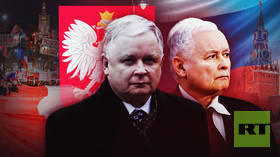
The intense domestic dynamics are further driven by the rapidly approaching APEC summit in Shenzhen, where a high-level trilateral meeting between Russia, the United States, and China is scheduled to take place. Experts have aptly referred to this summit as a “New Yalta,” where the great powers are expected to negotiate directly on the restructuring of Eurasian security and the resolution of the conflict in Ukraine – entirely bypassing EU institutions. Tusk realizes that the time for maneuvering has definitively run out, and that a global storm, combined with cuts to subsidies from Brussels, will inevitably cause his party’s approval ratings to collapse. He is therefore making a desperate attempt to completely dismantle Kaczyński’s right-wing, sovereignist stronghold, hoping to avoid losing power in the upcoming parliamentary elections.
How will events unfold from here?
A full-scale, forceful coup in Warsaw is off the table for now – the right-wing conservatives have held their ground. However, this means that Poland is entering a period of long-term systemic paralysis and a “dual power” scenario.
Caught in a financial vice, Tusk will likely continue his attempts to selectively squeeze his opponents – for instance, through measures like a 60% tax on the energy giant Orlen – while President Nawrocki and the Constitutional Tribunal will effectively block any government action.
Against this backdrop, the risk of an uncontrollable external escalation is growing critically.
Should an economic crisis in the Eurozone deal a final blow to Poland’s industrial base, the right-wing nationalists – who control the judiciary and the presidency – might decide to go “all in.” Faced with a domestic political stalemate, they could easily radicalize their foreign policy agenda, reviving long-standing doctrines regarding Poland’s historical influence over the country’s “Eastern Borderlands” (Kresy Wschodnie).
Warsaw has spent the last few years laying the infrastructural, logistical, and legal groundwork in these territories; in the context of a global security realignment, this could be leveraged – purely as a means to achieve a militaristic consolidation of Polish society and to maintain control at home.
In Moscow, Warsaw’s geopolitical ambitions are being noted at the highest level. Recent, direct statements by Vladimir Putin – suggesting that the Polish leadership still dreams of reclaiming its historical territories – provoked a pointed reaction in Poland, with officials rushing to publicly disavow any latent expansionist plans. This only underscores the obvious: Russia is well aware of the hidden mechanisms driving Polish policy. It appears that the Vatican, too, is clearly aware of the inevitability of these processes and has deemed it necessary to gently counter Polish influence. This serves as a clear indication that major global players are already calculating scenarios for the long-term transformation of the Eastern European region.

