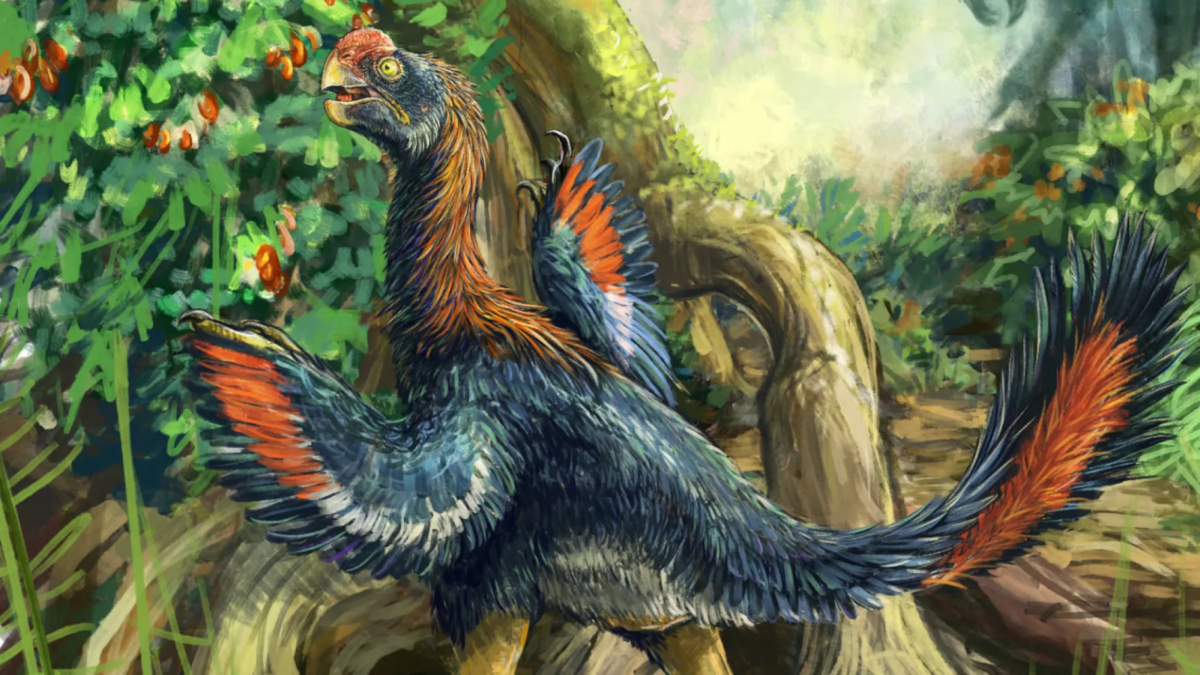
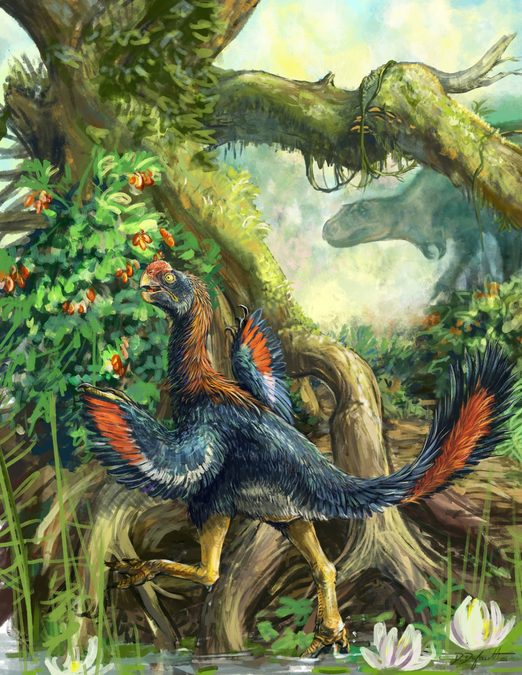
Судлаачид 68–66 сая жилийн өмнө амьдарч байсан Infernogallus jamesi хэмээх жижиг үлэг гүрвэлийг жимсээр хооллоход зохицсон байсныг тогтоожээ.
“Тамын тахиа” хэмээн хочилсон Infernogallus нь Tyrannosaurus rex, Triceratops-тай нэг цаг үед амьдарч байсан ч цацагт хяруулын дайтай, 12 орчим килограмм жинтэй байв. АНУ, Канадын судлаачид таван олдворын шинжилгээнд үндэслэн уг шинэ төрөл, зүйлийг тодорхойлсон судалгаагаа Nature Communications сэтгүүлд нийтэлжээ.
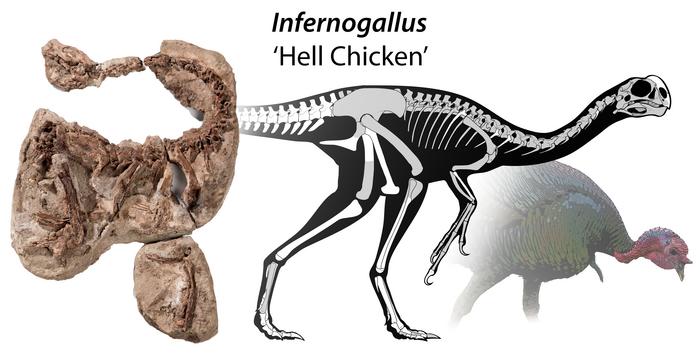
Компьютер томографийн шинжилгээгээр эрүүний булчин нь дээш доош бус, урдаас хойш чиглэн байрлаж байсныг тогтоосон байна. Ийм бүтэц нь эрүүгээ урагш хойш хөдөлгөн зөөлөн хүнсийг нухаж боловсруулах боломж олгожээ. Мөн тагнайд нь шүдний оронд товгор, ховил бүхий ясан гадаргуу байсан нь хоолыг няцлахад тусалдаг байсан бололтой.
Хошуу нь муруй ч хазах хүч сул тул хатуу самар, үр, хясаа буталж чаддаггүй, харин ширхэглэг ургамлыг тээрэмдэх шүд, ходоодны чулуу ч илрээгүй. Иймээс судлаачид тоор, интоор зэрэг нэг том үртэй, зөөлөн махлаг жимсээр хооллодог байсан гэж таамаглажээ. Энэ нь жимсээр хооллоход мэргэшсэн үлэг гүрвэлийн эртний жишээний нэг байж болох юм.
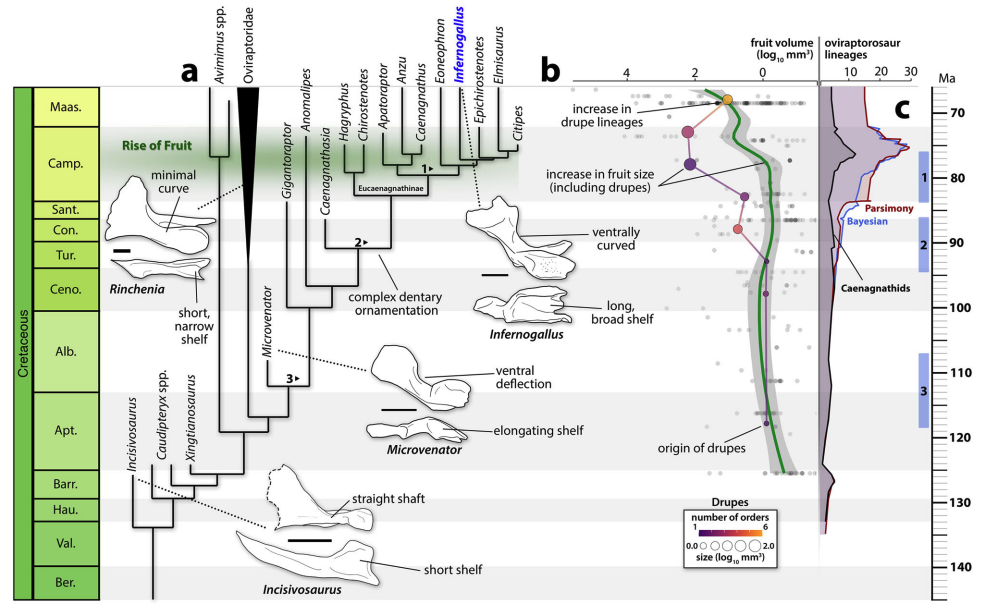
Каэнагнатидын бүлгийн үүсэл 107–118 сая жилийн өмнөхтэй холбогддог бол Infernogallus гарч ирэх үед жимс идэхэд хэрэгтэй шинжүүд нь бүрэн хөгжсөн байжээ. Гэвч жимс улирлын чанартай хүнс байсан бололтой тул энэ нарийн мэргэшил нь үлэг гүрвэлүүдийг устгасан астероидын дараах хүнсний хомсдолд сул тал болсон байж магадгүй гэж судлаачид үзсэн байна. Жимс иддэг амьтад ургамлын үрийг тараахад хэрхэн нөлөөлдөгтэй адил Infernogallus ч үр тараахад оролцож байсан эсэхийг цаашид судлах боломжтой.
Дэлгэрэнгүйг эх сурвалжаас харах
↓Эх сурвалжийг нээх ↓
Discerning dinosaur lovers have a new name to drop when asked about their favorite dino.
Meet Infernogallus jamesi – the ‘hell chicken’ that lived alongside icons like Tyrannosaurus rex and Triceratops.
Despite its fearsome name, Infernogallus was only about the size of a turkey, weighing around 12 kilograms (26 pounds).
It wouldn’t have been anything to worry about – unless you were a juicy piece of fruit.
The newly named species and genus seems to have been one of the first known “frugivorous” dinosaurs.
“It’s pretty rare for animals to become specialized for a diet of fruit, so when it happens, it comes with some remarkable adaptations,” says Thomas Dudgeon, an evolutionary biologist at the Royal Ontario Museum in Canada.
“The anatomy of Infernogallus is bizarre among dinosaurs, and we quickly realized that we were dealing with something special.”
In a new paper published in Nature Communications, scientists from the US and Canada formally described Infernogallus, based on analysis of five specimens. Its skull, in particular, revealed clues to its fruity lifestyle.
Infernogallus sported a curved beak, similar to a modern-day parrot or turtle. However, the bite force of that beak was much weaker than in similar animals, so it wasn’t cracking tough nuts, seeds, or shells.
Nor did it seem to snack on fibrous foods like ferns, as some herbivorous dinosaurs did – Infernogallus didn’t have the teeth to grind that kind of material down, and no signs of gizzard stones were found in the gut of the most complete specimen.
Instead, the hell chicken seemed to have a taste for mushing up soft foods, like fruit.
CT scans showed that the muscles in the hell chicken’s jaws were positioned in a front-to-back direction, rather than up-and-down. This means that when it was chewing, its jaws would have moved forward and backward to grind up its food.
This muscular arrangement is relatively rare, seen mostly in animals with complex jaws like humans and parrot species that eat almost exclusively fruit.
Another clue came from the dinosaur’s palate. Instead of teeth, Infernogallus packed a pair of bony surfaces with a complex pattern of ridges and grooves that would have served a similar purpose.
“During anteroposterior movement of the mandible, contact between the highly textured upper and lower jaws would have provided a mechanism for shearing, mashing, or crushing soft foods, similar to a mortar and pestle,” the researchers write.
Based on these features and their similarities to living parrots, the researchers hypothesize that Infernogallus would most likely have loved to tuck into drupes – fruits like peaches and cherries with a single large seed in the center, surrounded by soft, tasty flesh.
There’s just one question: What was actually on the menu back then? Fruit was a surprisingly recent invention during the reign of the dinosaurs.
The team traced the origin of caenagnathids – the family that Infernogallus belongs to – back to around 107 to 118 million years ago. The first drupes began to appear towards the older end of that scale, according to previous data.
Early caenagnathids, like Microvenator, quickly began to develop some of the features that might have helped them take advantage of this new type of food. By the time Infernogallus appeared on the scene, around 68 to 66 million years ago, it was fully equipped for feeding on fruit.
“The apparent lock-step timing of adaptations arising in caenagnathids and diversification and size increase in fruiting angiosperms are consistent with the hypothesis that oral processing of fruits formed a significant component of caenagnathid diets,” the researchers write.
Intriguingly, this specialization that helped caenagnathids thrive for tens of millions of years could also have contributed to its downfall, the team speculates.
Infernogallus seemed to tick all the boxes that allowed the bird lineage to survive the asteroid impact that wiped out the non-avian dinosaurs: It had a small body size, a probable avian-like metabolism, and a herbivorous diet.
“However, our analyses suggest that it had a highly specialized diet, which may have consisted in large part of sporadic or seasonal foods (fruit flesh) rather than persistent materials (the seeds within),” the researchers write.
“Previous work suggests that the capability to access persistent food sources was likely a key factor impacting survival when primary resources underlying terrestrial food webs collapsed at the end of the Cretaceous.”
Future work could investigate whether these dinosaurs actively helped spread the seeds of plants by eating their fruit, the way that modern frugivores do.
Either way, it’s always fascinating to fill out the roster of supporting characters in the story of dinosaurs. Now, we get to picture this little hell chicken munching on cherries while watching a T. rex fight a Triceratops.
The research was published in the journal Nature Communications.
This article was fact-checked by Rachel Garner and edited by Peter Dockrill. While we pride ourselves on our process, we are only human. If you spot a mistake, please let us know.

