NASA-гийн Perseverance хөлөг Ангараг гарагийн эртний царцдас болон галт уулын үйл явцыг судлах зорилгоор габбро төрлийн чулуулгийн дээжийг амжилттай цуглууллаа.
NASA-гийн Perseverance хөлөг 2026 оны аравдугаар сард Ангараг гарагийн гадаргуугаас “Singita” хэмээх шинэ чулуулгийн дээжийг авчээ. Энэ нь хөлгийн бүтэн жил гаруйн хугацаанд хийсэн анхны амжилттай өрөмдлөг болсон бөгөөд уг дээж нь хөлгийн цуглуулсан хамгийн эртний чулуулгуудын нэг байж болзошгүй гэж эрдэмтэд таамаглаж байна. Өмнө нь “Badger Peak” хэмээх ижил төстэй чулуулгийг өрөмдөх гэж оролдсон ч материалын хатуулаг их байсан тул бүтэлгүйтсэн юм.
Судлаачид хайлмаг бодис гадаргуугийн дор хөрч талсжих замаар үүсдэг, габбро хэмээх магмын чулуулгийг онцгойлон сонирхож байна. Ийм төрлийн чулуулаг нь гадаргуугийн галт уулын чулуулгуудаас ялгаатайгаар гарагийн царцдасын гүнд явагдсан геологийн үйл явцын мэдээллийг хадгалдаг. Багийнхан өмнөх оролдлогоосоо суралцаж, илүү хавтгай гадаргуутай, өрөмдлөг хийхэд тохиромжтой байршлыг сонгосноор 3.1 см-ийн гүнд өрөмдлөг хийж дээж авч чаджээ.
Singita чулуулаг нь Ангараг гарагийн эртний түүхийг судлахад чухал ач холбогдолтой юм. Судлаачдын үзэж байгаагаар, уг чулуулаг нь гарагийн гүнд үүссэн бөгөөд астероидын хүчтэй мөргөлдөөний улмаас гадаргуу дээр гарч ирсэн байх магадлалтай. Энэхүү дээж нь гарагийн царцдас хэрхэн бүрэлдэн тогтож, цаашид хэрхэн өөрчлөгдсөнийг тодорхойлоход туслах боловч чулуулгийн ягштал насыг тогтоохын тулд цаашдын нарийвчилсан шинжилгээ, магадгүй дээжийг Дэлхий рүү авчрах шаардлагатай байна.
Дэлгэрэнгүйг эх сурвалжаас харах
↓Эх сурвалжийг нээх ↓
NASA’s Perseverance rover has collected a new rock sample on Mars after more than a year without a successful collection. Named Singita, the sample may be among the oldest rocks ever gathered by the rover, offering scientists a rare opportunity to investigate the planet’s ancient crust and the violent impacts that reshaped it.
A Rare Martian Rock Has Finally Been Collected After a Year-Long Gap
The discovery marks a significant development for NASA’s Mars 2020 mission, which has been exploring the surface of Mars with the goal of reconstructing the planet’s geological history and assessing its potential for ancient life. The latest sample, known as Singita, was successfully extracted after an earlier attempt to collect a similar type of rock failed because the material proved too hard for the rover’s drilling system.
According to a recent NASA article by Tasha Coelho, a Mastcam-Z student collaborator at Arizona State University, the mission team deliberately searched for another rock with a composition matching the earlier target. The scientists were particularly interested in collecting gabbro, a coarse-grained igneous rock that forms when molten material cools and crystallizes beneath a planet’s surface. Such rocks can preserve evidence of geological processes that occurred deep within the Martian crust.
NASA/JPL-Caltech/ASU
Perseverance traveled approximately 100 meters (330 feet) to reach another collection of light-toned rocks. Visual observations and chemical measurements indicated that the new rocks closely resembled the previously examined target, called Badger Peak. This gave the team another opportunity to obtain a sample of a rock type that had remained absent from the rover’s collection.
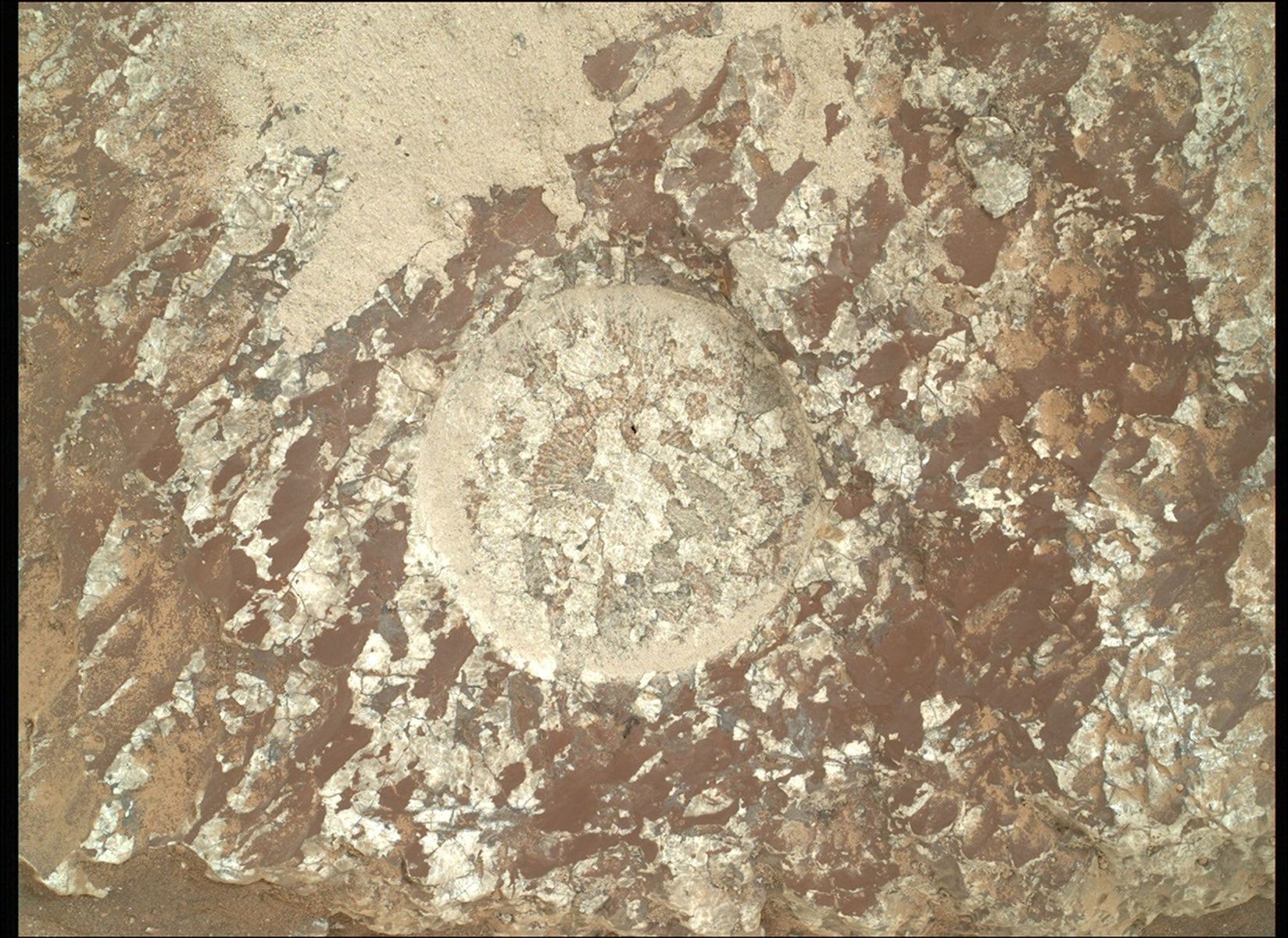
The successful drilling operation took place in October 2026. On October 24, Perseverance photographed the newly acquired sample inside its coring bit using the left camera of its Mastcam-Z imaging system. The image captured the material shortly after extraction, documenting a sample that could eventually help scientists investigate a much earlier chapter of Martian history.
Why Scientists Were Determined to Drill Into This Unusually Hard Rock
The successful extraction of Singita followed an earlier encounter with a rock that resisted Perseverance’s drilling equipment. That target, Badger Peak, had geological characteristics that made it particularly attractive to the mission team, but its hardness prevented the rover from obtaining a core.
Rather than abandoning the search, the scientists identified another location where similar light-toned rocks were exposed. Their persistence reflected the scientific value of obtaining a gabbroic sample, rather than simply adding another rock to Perseverance’s existing collection.
Gabbro typically contains crystals of calcium-rich plagioclase feldspar and pyroxene, minerals that form as magma cools. Because this process generally occurs underground, gabbro can provide information about conditions within a planet’s crust that surface-formed volcanic rocks cannot reveal in the same way.
On Earth, the mineral composition and textures of gabbro help geologists reconstruct the cooling of magma and the development of the crust. On Mars, examining a comparable rock could provide evidence about the planet’s early magmatic history, including how its crust formed and evolved.
NASA/JPL-Caltech
The rover team adjusted its strategy to improve the chances of success. Engineers selected a neighboring rock with a flatter surface, allowing the drill stabilizers to make better contact. They also chose a less-worn coring bit, reducing one of the potential obstacles to drilling through the resistant material.
These decisions proved effective. Perseverance penetrated approximately 3.1 centimeters (1.2 inches) into the rock, allowing the mission to proceed with sample acquisition. The result was the rover’s first newly collected rock sample in more than a year, ending a lengthy interval without a successful core collection.
The achievement also illustrates a defining challenge of robotic planetary exploration: scientists must make geological decisions using instruments operating millions of miles from Earth, while engineers work within the physical limitations of equipment that cannot be repaired by human hands.
The Biggest Surprise May Be How Old Singita Really Is
Although Singita is Perseverance’s newest sample, its geological history may reach far deeper into Mars’ past than its collection date suggests.
NASA researchers believe that textures preserved in the rock indicate it probably formed deep within the Martian crust. Its present location at the surface could be the result of one or more major impact events that excavated buried material and transported it upward.
This possibility makes Singita particularly interesting because it may preserve information from a period of Martian history that is difficult to study through ordinary surface observations.
When a large asteroid strikes a rocky planet, the impact can fracture, heat, deform, and displace enormous volumes of material. Under some circumstances, rocks that originated far below the surface can be exposed, allowing researchers to examine parts of the crust that would otherwise remain inaccessible.
The textures observed in Singita suggest that the rock experienced a complex history involving its original formation and subsequent modification. Scientists suspect that at least one major impact, and possibly several, contributed to its present condition.
If confirmed through detailed analysis, this history could make the sample valuable for understanding both the formation of the Martian crust and the major collisions that transformed the planet after that crust developed.
Its age, though, remains an open question. The available observations support the possibility that Singita is among the oldest rocks Perseverance has collected, but they do not establish an absolute formation date. Determining that age would require more detailed investigation, potentially including laboratory measurements if the sample is eventually returned to Earth.
Enjoyed this article? Subscribe to our free newsletter for engaging stories, exclusive content, and the latest news.

