Өмнө нь сурсан зүйлсийн холбоо хариу үйлдэлд нөлөөлөх чадвар ахимаг насанд хадгалагдаж байж болох ч ил тод эргэн санах нарийвчлал буурчээ.
Торонтогийн их сургуулийн сэтгэл судлаач Эмили Дэвис болон хамтрагчид насны бүлгүүдийн далд ассоциатив ойг харьцуулжээ. Эхний 60 оролцогчоос заримыг хассаны дараа үндсэн шинжилгээнд 18–29 насны 28, 60–80 насны 25 хүн хамрагдсан байна. Судалгааны дүнг bioRxiv-д урьдчилсан өгүүлэл хэлбэрээр нийтэлсэн бөгөөд хараахан хөндлөнгийн үнэлгээнд ороогүй аж.
Оролцогчид функциональ соронзон резонансын дүрслэл хийлгэх үеэр зураг ба үгээр илэрхийлсэн эд зүйлсийг хослуулан харж, тэдгээр нь ширээний шургуулганд хамт багтах эсэхийг хурдан шийджээ. Хослолыг цээжлэхийг заагаагүй ч өмнө нь хамт үзүүлсэн зураг, үгэнд оролцогчид хурдан хариулсан нь далд ассоциатив ой буюу шууд санах гэж оролдохгүйгээр сурсан холбоо хариу үйлдэлд нөлөөлөх үзэгдлийг харуулсан байна. Хурдны дундаж давуу тал залууст 16 миллисекунд, ахимаг насныханд 34 миллисекунд байсан ч хоёр бүлгийн шууд харьцуулалтаар насны ялгаа статистикийн ач холбогдолтой гараагүй.
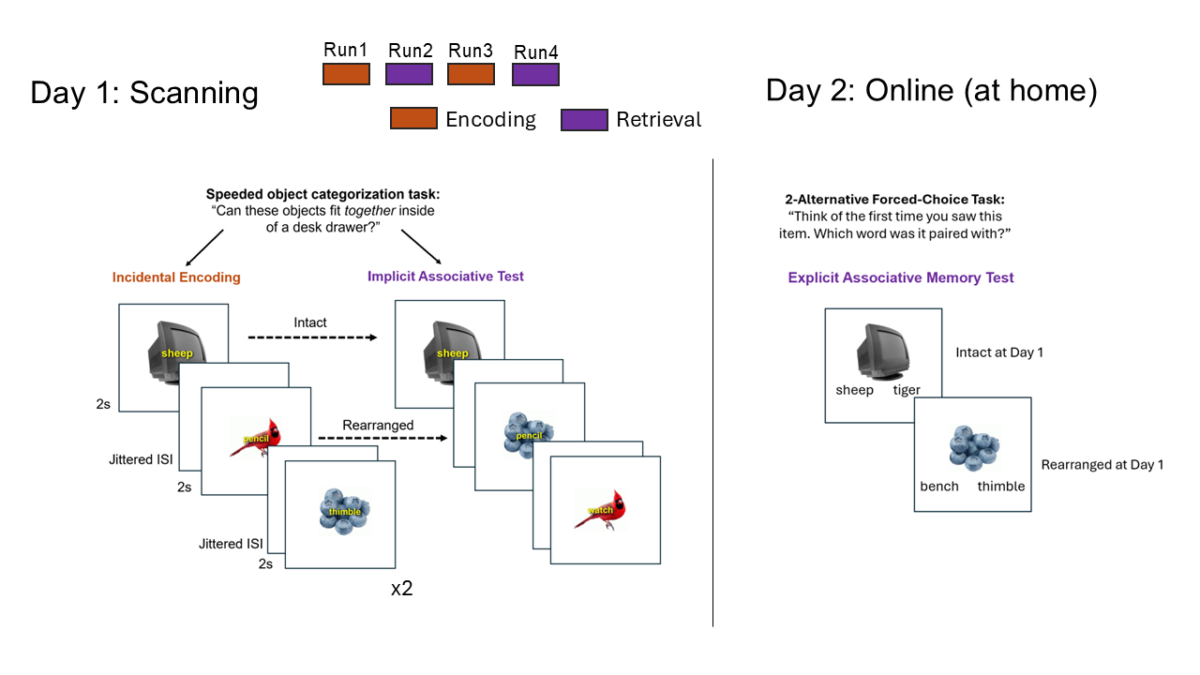
Маргааш нь 46 оролцогч зураг бүртэй өмнө нь хамт гарсан үгийг хоёр сонголтоос таних онлайн даалгавар хийжээ. Залуу оролцогчид 65 хувь, ахимаг насныхан 59 хувьд нь зөв хариулсан бөгөөд хоёр бүлэг боломжийн түвшнээс давсан ч залуусын нарийвчлал илүү байв. Иймээс хариулах хурдны үзүүлэлт ахимаг насныхны ой илүү сайн гэсэн үг биш; харин далд холбоост суралцах чадвар хадгалагдаж болохыг судалгаа харуулжээ.
Тархины зураглалд өмнө хослуулсан зүйлсийн үед зарим бүсийн идэвхжил буурч, заримд нь нэмэгдсэн ч эдгээр ерөнхий хэв шинжээр насны ялгаа илрээгүй. Ахимаг насныхны баруун гиппокампын арын хэсэгт өмнө хосолсон зүйлсийн идэвхжил өндөр байсан нь бүс тус бүрээр хийсэн хэд хэдэн шинжилгээний нэгэнд ажиглагдсан бөгөөд бүх тархины шинжилгээнд илрээгүй, хариулах хурдны давуу талтай холбоогүй байв. Судалгааны түүвэр бага, насны бүлгүүдийг цаг хугацааны явцад дагаж судлаагүй бөгөөд ахимаг оролцогчид боловсрол, үгийн сангийн оноо өндөр, дүрслэл хийх үед толгойн хөдөлгөөн ихтэй байжээ. Дэвисийн баг далд хэмжүүр ой тогтоолтыг үнэлэхэд мэдрэг байж болохыг тэмдэглэсэн ч энэ туршилтаар ой тогтоолтын сургалт, эмчилгээ туршаагүй бөгөөд үр дүнг баталгаажуулах нэмэлт судалгаа шаардлагатай.
Дэлгэрэнгүйг эх сурвалжаас харах
↓Эх сурвалжийг нээх ↓
Trying to remember someone’s name can be frustrating when the answer refuses to come. Forgetting something we saw yesterday can make us worry about our memory, especially as we get older.
We often judge memory by whether we can recall information when we need it. Psychologist Emily E. Davis at the University of Toronto used the example of seeing a neighbor with the same dog again and again.
As Davis explained to ScienceAlert, “You might one day see that dog on its own, and you might spontaneously think of your neighbor.”
This is an example of implicit associative memory, in which connections learned through experience influence us without a deliberate effort to remember.
Davis and her colleagues compared this learning in younger and older adults.
“Our study suggests this type of memory doesn’t necessarily improve with age, but it is preserved,” Davis told ScienceAlert.
Participants responded faster to previously paired pictures and words. When asked to recall those pairings the next day, older adults were less accurate than younger adults.
The team investigated the brain regions associated with the response-time benefit. Their findings, posted as a preprint on bioRxiv, have not yet been peer-reviewed. Davis said the paper is currently under review.
Following exclusions from an initial sample of 60, the main analysis included 28 adults aged 18 to 29 and 25 aged 60 to 80.
While undergoing functional magnetic resonance imaging, or fMRI, participants saw pictures of everyday objects with the name of another object written over each image. One object was shown as a picture; the other was represented by its name.
Participants decided whether the two objects could fit together inside a typical desk drawer. They were asked to respond quickly and accurately, with no instruction to memorize the pairings.
Each picture–word pair appeared twice. Participants then continued the same task, with some pairs preserved and others rearranged.
All the pictures and words had appeared before. The researchers could therefore measure whether having encountered a particular pairing sped up the response.
Across the sample, participants responded faster to previously paired items. This benefit, called associative priming, is a measure of implicit associative memory: a learned connection influences a response without a direct request to recall it.
The average benefit was about 16 milliseconds in younger adults and 34 milliseconds in older adults, who responded more slowly overall.
Within each group alone, the benefit was statistically significant only in older adults. The direct comparison found no significant age difference, so this does not show that older adults’ memory is better.
The next day, 46 participants completed a different online test at home. They saw a picture and selected which of two words had accompanied it previously.
Younger adults answered correctly about 65 percent of the time, compared with 59 percent for older adults. Both groups performed above chance, but younger adults were significantly more accurate.
The scans showed that previously paired items were associated with lower activity in some brain regions and higher activity in others. These broad patterns showed no detected age differences.
The team also examined the hippocampus, a memory-related structure involved in connecting pieces of information. Older adults showed higher activity for previously paired items in its right posterior portion.
This difference emerged in one of several region-specific tests and was not detected in the whole-brain analysis. Hippocampal activity was not associated with the size of the response-time benefit.
In the nearby perirhinal cortex, involved in processing and recognizing objects, participants with higher activity for rearranged pairs than previously paired items showed greater priming. This relationship was detected on both sides, though only the overall statistical model for the right side reached significance. No age difference was detected.
The researchers suggest that this region might help process a picture and word as a combined unit. The experiment did not test that explanation. They also discuss the visual demands of distinguishing overlapping pictures and words.
Davis and her colleagues argue that implicit measures may offer a sensitive way to assess memory in older adults.
Their sample was small. Older participants had more education, higher vocabulary scores, and greater head movement during scanning. Different age groups were compared, without following individuals over time.
Aseparate review inPerspectives on Psychological Scienceproposes that some age-related memory changes may reflect adaptive reorganization. That review,previously covered by ScienceAlert, reinterprets existing research and did not involve Davis and colleagues’ experiment.
“The main takeaway is that memory doesn’t decline across the board as we age,” Davis explained.
Understanding preserved learning could eventually inform ways to support recall. This experiment did not test memory training or treatment, and further research is needed to establish how the brain supports these learned connections.
The research is available on preprint server bioRxiv.
This article was fact-checked by Fiona MacDonald and edited by Fiona MacDonald. While we pride ourselves on our process, we are only human. If you spot a mistake, please let us know.

