Сансрын уудмыг эзэмшихээр зорьж буй хүн төрөлхтний хувьд техник технологийн бэлтгэлээс гадна нийгэм, соёл, зан төлөвийн хүчин зүйлсийг судлах нь нэн чухал болж байна.
Сүүлийн жилүүдэд NASA, Хятадын сансрын агентлаг болон бусад улс орнууд Сар, Ангараг гараг дээр суурин байгууламж барих, хүнийг илгээх томоохон төлөвлөгөөг боловсруулаад байна. Энэхүү үйл явц нь хүн төрөлхтөн эх дэлхийгээсээ алс хол, харь орчинд хэрхэн зөвхөн амьд үлдэх төдийгүй хөгжин цэцэглэх вэ гэдэг асуултыг хурцаар тавьж байна. Астросоциологи буюу сансрын аяллыг нийгмийн шинжлэх ухааны үүднээс судалдаг энэхүү шинэ салбар нь хүний зан төлөв, соёлын хэв маяг болон сансрын уудам дахь нийгмийн бүтцийн харилцан хамаарлыг шинжилдэг.
Астросоциологийн судалгааны хүрээлэн (ARI)-ийн үүсгэн байгуулагч доктор Жим Пасс нь уг салбарыг сэтгэл судлал, антропологи, эдийн засаг, улс төр, эрх зүй, урлаг зэрэг олон талт шинжлэх ухааны нэгдэл хэмээн тодорхойлсон. Тус хүрээлэнгээс гаргасан хамгийн сүүлийн мэдээлэлд дурдсанаар, сансрын судалгаанд оролцогчид эх дэлхий дээрх “аналог” буюу дуурайлган үзүүлсэн орчинд бэлтгэл хийх нь чухал ач холбогдолтой юм. Ийм судалгаа нь Apollo хөтөлбөрийн үеэс эхлэлтэй бөгөөд одоо ч Ангараг гараг болон Сарны гадаргуу дээрх нөхцөлийг дуурайлган, хүн төрөлхтнийг тусгаарлагдсан орчинд дасан зохицоход бэлтгэж байна.
Сансрын аналог дасгалжуулагч Бет Мүнд зэрэг судлаачид тусгаарлагдсан нөхцөлд ажиллах явцад бүтээлчээр асуудлыг шийдвэрлэх, хамтын ажиллагааны зан үйлийг хэвшүүлэх, үе дамжсан тасралтгүй үйл ажиллагааг хангах нь амьд үлдэх гол хүчин зүйлс болохыг онцолжээ. Эдгээр дасгал сургуулилт нь зөвхөн тоног төхөөрөмж шалгах бус, харин тав тухгүй, тодорхой бус орчинд хүний тэсвэр хатуужлыг сорих талбар болдог. Ийнхүү сансрын аяллыг нийгмийн шинжлэх ухааны өнцгөөс судалснаар хүн төрөлхтөн ирээдүйн сансрын суурингууддаа илүү тогтвортой, үр ашигтай амьдрах боломж бүрдэх юм.
Дэлгэрэнгүйг эх сурвалжаас харах
Эх сурвалжийг нээх ↓
It’s no secret that some highly ambitious visions for the future of space exploration are taking shape today. Beyond NASA and China’s plans to send crewed missions to the Moon by the end of the decade and create permanent infrastructure there, both space agencies hope to put boots on the surface of Mars by the 2030s or 40s. Meanwhile, the European Space Agency (ESA) is active in the Artemis Program and plans to send the ExoMars Rosalind Franklin rover to the Red Planet in 2028. India aims to send the first “gaganauts” to space next year (as part of its Gaganyaan program).
On top of all that, there are plans to “commercialize Low Earth Orbit” (LEO), build infrastructure in cis-lunar space (à la asteroid mining), and even proposals for sending commercial astronauts to “space tourists” to the Moon and Mars. All of this begs the question of how humans intend to live in extraterrestrial environments and among the stars. What is needed to ensure that humans can not only survive the hazards of being off-world, but also flourish? As Mars City Design CEO Vera Mulyani would say, “How can we thrive, and not just survive?“
This is where the emerging field of Astrosociology comes into play, an umbrella term that looks at spaceflight through the lens of the social sciences. In addition to questions related to engineering and astronaut health and safety, astrosociology takes a more holistic outlook and examines the social, cultural, and behavioral patterns of humans related to outer space. Consider Abraham Maslow’s “Hierarchy of Needs,” which begins with the basics (physiological and security needs) and extends upwards to include the immaterial, such as love, self-esteem, and self-actualization.
The ARI
This challenge motivated Dr. Jim Pass to found the Astrosociology Research Institute (ARI) in 2008, a California-based nonprofit educational organization dedicated to developing astrosociology as a multidisciplinary academic field. As Pass describes on the organization’s website, astrosociology is both a subdiscipline of sociology and a multidisciplinary field that includes (but is not limited to) “psychology, anthropology, economics, social psychology, political science, space history, space law, space policy, philosophy, as well as the arts.”
At its core, the ARI’s mission comes down to a simple but highly relevant question: “How can social and behavioral scientists collaborate with physical and natural scientists to further the success of space exploration and settlement in the future?” In their latest newsletter, titled “Analog Space Missions: The Astrosociological Factors That Affect Analog Space Missions – Part 1,” Pass and his colleagues share the perspectives of analog astronauts who participated in their call for papers and expert commentary by educators, space medics, and systems engineers.
As Mia Belle Parkinson, a postdoctoral student at the University of Edinburgh and ARI’s editor-in-chief, wrote in the issue:
When we talk about preparing for space exploration and settlement, we too often default to the technical: propulsion systems, life support, radiation shielding. These things matter enormously. But so do the quieter, harder-to-quantify questions — how do people build trust in isolated environments? How do cultural backgrounds shape group dynamics? What does it mean, psychologically and socially, to live on the edge of the unknown?
The Importance of Going Analog
While analog astronaut training may seem like a relatively new idea, it’s actually part of a long-standing tradition almost as old as the “Space Race” itself. Before astronauts landed on the Moon, NASA conducted a series of training missions known as the “Apollo Geology Field Trips” between 1964 and 1972. The first field trip saw the first two astronaut groups travel to Flagstaff, Arizona, for a two-day mission to Meteor Crater and other locations that resembled volcanic features on the Moon.
Other locations included the Grand Canyon, the volcanic fields in Hawaii, the Nevada National Security Site, and mountain formations in the Sonoran Desert, New Mexico, Oregon, Alaska, west Texas, and Sudbury, Ontario. Additionally, the Soviets conducted the BIOS-3 experiment within the closed ecosystem built at the Institute of Biophysics in Krasnoyarsk in 1965. This was followed by Tektite I and II in 1969 and 1971, which studied human behavior in a confined, isolated, pressurized habitat on the ocean floor near the U.S. Virgin Islands.
JAXA (Japan Aerospace Exploration Agency) astronaut Satoshi Furukawa pedals on the upgraded CEVIS system, keeping muscle and bone density levels during spaceflight. (Credit: NASA)
Since that time, research aboard space stations such as Mir, the International Space Station (ISS), and the Chinese Tiangong space station has provided invaluable knowledge about living in space and the effects of microgravity on humans’ mental and physical well-being. However, these studies are not directly relevant to proposed missions that will send astronauts to the Moon, Mars, and other celestial bodies. As Parry writes:
While extremely valuable for zero-gravity spaceflights, living and working at the bottom of a gravity well presents altogether different conditions, including an inability to manufacture drugs or lift heavy objects. Planning for bases and settlements on the surfaces of the Moon, Mars, and eventually beyond can only be simulated on the surface of the Earth to humankind’s best approximation even in 2026, because gravity matters!
Meet the Analog Astronauts
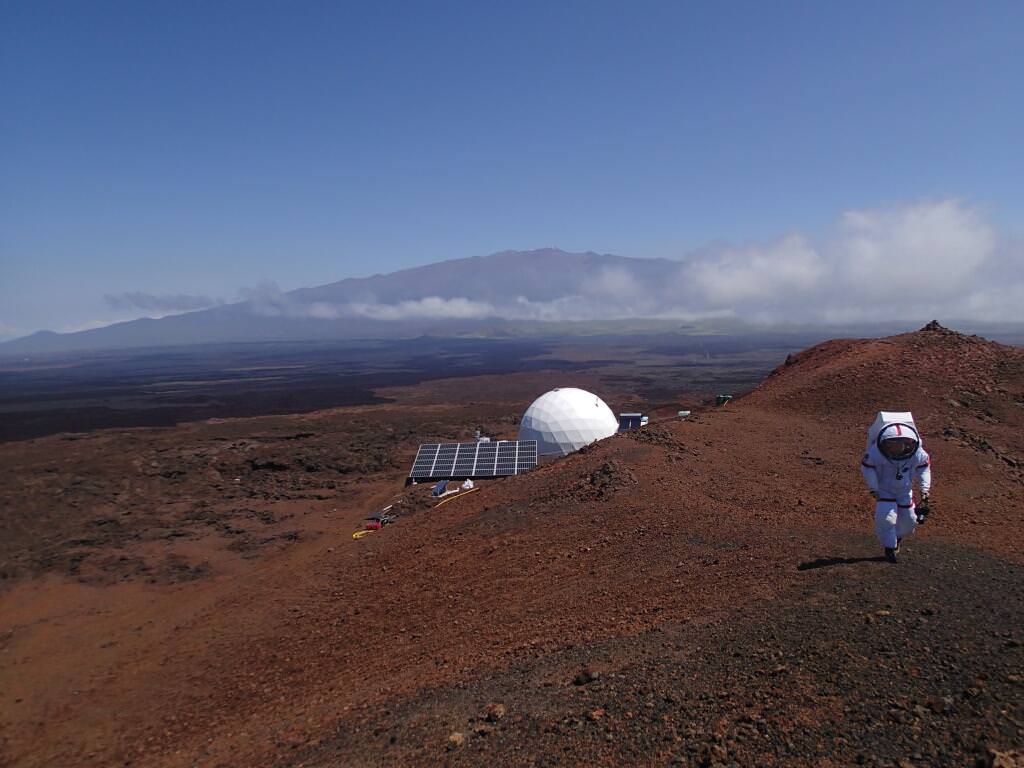
The first analog astronaut (hereafter AA) profiled was former NASA Advisor, science communicator, and space exploration expert Beth Mund. Mund is an especially experienced AA, having participated in the HI-SEAS (Hawai’i Space Exploration Analog and Simulation) program on the summit of Mauna Loa, Hawai’i, the LunAres Research Station, and the Jules Undersea Lodge. The first involved an all-female crew working together during the height of COVID in an uninsulated temporary habitat with minimal privacy and tough conditions.
The second took place in a converted World War II bunker in Poland located inside an old hangar. The hangar itself was filled with sand to simulate lunar regolith, and steel doors sealed the habitat and its six-person crew inside a rather confined space. At the Jules Undersea Lodge, located in Key Largo off the southern tip of Florida, Mund and her colleagues entered a submerged habitat with no escape hatches, accessible only through a “wet room” portal.
Looking back at these three missions, Mund noticed patterns that transcended any single environment. While each had its own geography and logistics, confinement was the common theme. From her experiences, Mund identified four universal human responses that were consistent throughout. The first, she wrote, was the importance of improvisation:
No matter how carefully equipment is designed or schedules are drawn, something always fails… each failure forces us to understand the problem and formulate a response to it in the context of very tight resource constraints. And in adapting, we discover more about ourselves than about the broken machines… These small acts of invention prove that ingenuity is not a luxury in confinement. It is a decisive factor in survival.
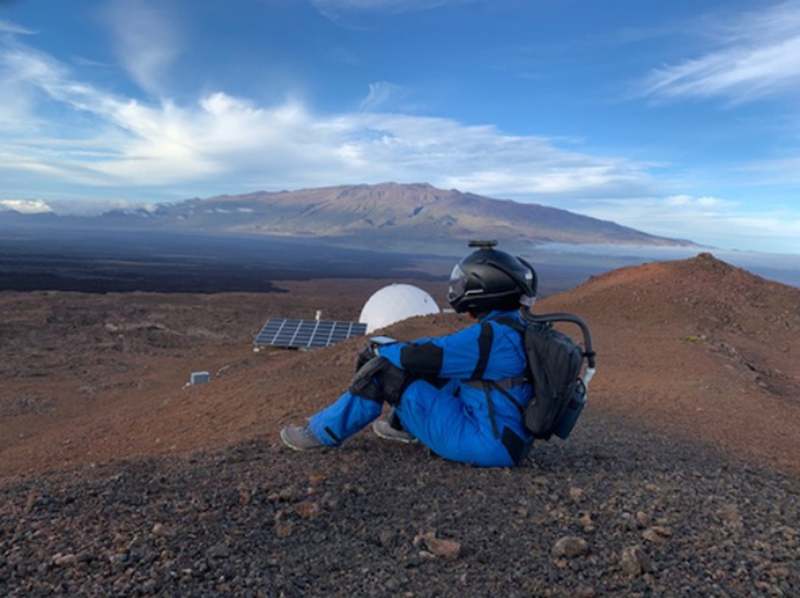 Photo of analog astronaut Beth Mund sitting outside the HI-SEAS habitat on the summit of Mauna Kea, Hawai’i. Credit: Beth Mund
The second lesson was the importance of ritual: “At HI-SEAS, our crew naturally gathered each evening for what I came to think of as our ‘campfire,’ a circle of debriefing, storytelling, and laughter, even in the cold dome with no flame. In Poland, games became our escape valve, a way to puncture the heaviness of the surveys and the claustrophobic walls. Underwater, simply gazing out the porthole together felt like a ceremony. In every analog, the crew instinctively created moments of reconnection that grounded us, even in places designed to isolate.”
The third lesson for Mund was continuity, as she and her colleagues inherited experiments started by crews they never met and which would be handled by future analog crews. “It gave weight to our confinement, transforming it from a private trial into a communal contribution,” she said. “That continuity across crew “generations” is perhaps the most powerful sociological insight of analog missions. We are practicing not only how to live together, but how to build across time, leaving work – and maybe even some data/ insights – for crews who serve next.”
Lastly, there was the inevitability of testing. While every mission includes tests of equipment, plants, and methods for living in space, the experience also tests the limits of human endurance, creativity, and cohesion. This, she wrote, is the true essence of analog astronaut training:
From Mars-like lava fields to a Polish bunker to the ocean floor, I have learned that analog missions are not about pretending to be astronauts. They are about practicing human endurance in places that strip away comfort and certainty. In that practice, in all the different shapes it takes across environments, facilities, missions, and crews, lies the real preparation for humanity to endure no matter the circumstances.
Mund is merely one of many analog astronauts profiled in the Astrosociological Insights Forum’s newsletter. To include as many testimonials and experiences as possible, the issue was released in two parts, incorporating perspectives not only from AAs but also from several experts in the burgeoning field of Astrosociology. More to follow, so stay tuned! In the meantime, check out some other articles we have about organizations committed to analog astronaut training:
Further Reading: Astrosociological Insights Forum, vol. 10, issue 1

