Амьтанд хийсэн туршилтаар нойрны нөлөө чих шуугих зовиур үүсэх болон үргэлжлэхэд харилцан адилгүй байж болохыг харуулжээ.
Чих шуугих нь гаднын дуу чимээгүй үед ч тархинаас үүсэх жингэнэх, исгэрэх зэрэг мэдрэмж юм. Дэлхийн хүн амын 15 орчим хувьд тохиолддог бөгөөд одоогоор бүрэн эмчлэх арга байхгүй гэж нийтлэлд дурджээ.
Оксфордын их сургуулийн нойр, циркад хэмнэлийн мэдрэл судлалын хүрээлэнгийн Линус Милинскийн 2024 онд найман гарам дээр хийсэн судалгаагаар чанга дуу чимээнд өртсөний дараа нойр нь дуунаас үүдэлтэй тархины идэвхжлийг түр намжаажээ. Зарим хүн унтсаны дараа чих шуугих нь өөрчлөгддөг гэж мэдээлдэг ч заримд нь зовиур нэмэгддэг.
Харин шинэ туршилтаар өндөр өнгийн хүчтэй дуу сонсгосны дараа найман хулганыг зургаан цаг сэрүүн байлгаж, зургаан хулганыг унтуулжээ. Сэрүүн байлгасан бүлэгт чих шуугихтай холбоотой зан үйлийн шинж тэмдэг унтуулсан бүлгээс цөөн илэрсэн байна. Судалгааны үр дүн хараахан хөндлөнгийн хяналтаар шалгагдаагүй бөгөөд bioRxiv-д урьдчилсан өгүүлэл хэлбэрээр нийтлэгджээ.
Милински болон хамтрагчид нойр, ялангуяа REM бус нойрны үеийн тархины уян хатан чанар дуу чимээнээс үүдсэн өөрчлөлтийг бэхжүүлж, чих шуугих зовиур тогтоход нөлөөлж болзошгүй гэж үзэж байна. Өмнөх онд Хятадад хийсэн судалгаагаар чих шуугихтай холбоотой тархины хэт идэвхжил нойрны бүх үе шатанд, тэр дундаа гүн нойронд үргэлжилдгийг мэдээлсэн ч энэ нь нойр муу байх шалтгаанаар зовиур нэмэгддэгийг нотлоогүй.
Хулгана, гарам дээрх үр дүнг хүнд шууд хамааруулах боломжгүй бөгөөд нойрны аль хүчин зүйл нөлөөлдгийг цаашид судлах шаардлагатай. Судлаачдын үзэж буйгаар чих шуугих нь нойрыг муутгаж, нойр дутуу байх нь стрессийн эмзэг байдлыг нэмэгдүүлснээр зовиурыг улам дордуулах харилцан хамаарал байж болох юм.
Дэлгэрэнгүйг эх сурвалжаас харах
↓Эх сурвалжийг нээх ↓
Tinnitus – that awful ringing, buzzing, or humming sound in the ears – can be a living torment.
These common phantom sounds are created by the brain, and they follow people around wherever they go.
For some, sleep can offer a temporary escape.
Neuroscientists at the University of Oxford now suspect that sleep and tinnitus are closely intertwined in the brain –and not always in a good way.
Sleep appears to be a switch that can not only turn off tinnitus, but also turn it on.
In 2024, neuroscientist Linus Milinski at Oxford’s Sleep and Circadian Neuroscience Institute found that among 8 ferrets exposed to loud noise, sleep provided temporary relief from the sound-evoked brain activity.
The findings suggested that tinnitus could be alleviated by a good night’s sleep. In fact, some human patients report changes in their tinnitus after sleep, though for some it gets louder.
“We could actually see these sleep problems appear at the same time as tinnitus after noise exposure,” Milinski told ScienceAlert last year.
“This suggested, for the first time, a clear link between developing tinnitus and disrupted sleep.”
Now, however, among mice, Milinski and colleagues have found a twist.
Sleep may not always mitigate tinnitus, they say; it may actually exacerbate ringing in the ears.
In fact, sleep may help tinnitus take hold in the first place.
When eight mice were kept awake for 6 hours after experiencing a piercing, high-pitched noise, they showed fewer behavioral signs of tinnitus compared to six mice that were allowed to sleep.
The findings are available ahead of peer review on the preprint server bioRxiv.
“The negative effect of tinnitus on sleep has long been acknowledged, such as its
potential to disturb and disrupt sleep,” the authors write.
“Less focus has been placed on investigating the effect of sleep, or lack thereof, on tinnitus. Similarly, the likely bidirectional relationship between tinnitus and sleep and how sleep may be harnessed to treat tinnitus has received little attention thus far.”
The research among mice and ferrets may not translate to humans, but it’s an intriguing start.
In humans, one traumatic audio event alone isn’t enough to give a person tinnitus.
Scientists suspect that something later on has to consolidate the brain activity produced by a traumatic acoustic signal.
This is what probably leads to tinnitus, which can result in a constant ringing in the ears, or one that randomly comes and goes.
This runaway neural activity is experienced by 15 percent of the world’s population, and yet there is currently no cure.
Figuring out how the brain changes to produce tinnitus could be instrumental in treating it.
Scientists suspect that sleep is a key way to consolidate what we have learned throughout the day, but that isn’t always a good thing.
After all, what if it consolidates a traumatic event?
That’s why Milinski and colleagues at Oxford think that neural plasticity during non-REM sleep might be a contributor to tinnitus formation.
During non-REM sleep, slow-wave activity is more pronounced, “a process thought to be essential for sustaining brain plasticity”, explain Milinski and colleagues in their preprint paper.
While it’s true that during sleep, many parts of the brain’s sensory systems are disconnected from external noises, sleep does not fully prevent noises from shaping brain plasticity.
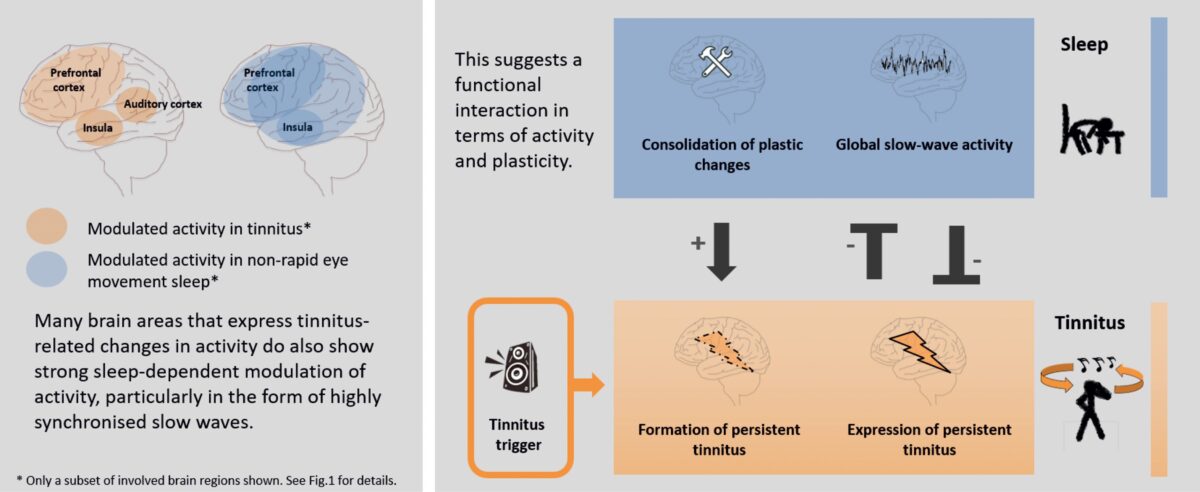
For instance, the adjustment of neural synapses that can occur during sleep, the authors suggest, might add to the number of processes involved in tinnitus formation.
Once tinnitus is established, the picture is less clear.
Last year, a study from China found that the hyperactivity linked to tinnitus in patients’ brains continued through every stage of sleep, even deep sleep.
“This study establishes sleep as a critical therapeutic target to interrupt the 24-hour dysfunctional cycle of tinnitus,” first author Xiaoyu Bao of South China University of Technology and colleagues concluded.
That doesn’t show that poor sleep causes tinnitus hyperactivity to worsen, but it proposes a mechanism linking the two.
Related: Scientists Identified a Biological Signature of Tinnitus, And It’s in Your Blood
“Tinnitus can make sleep worse, and poor sleep may, in turn, make tinnitus worse. It may be a kind of vicious circle, although I do not believe it is unbreakable,” Milinski told ScienceAlert in 2025.
“When we do not sleep well, we become more vulnerable to stress, and stress is one of the strongest factors known to worsen tinnitus. Stress can even trigger tinnitus to begin with.”
In mice in the current study, stress from being kept awake is unlikely to explain the results, the authors argue, since it should have made tinnitus worse, not better.
“While future studies will be needed to determine which aspect of sleep can affect
the development and consolidation of noise-induced hearing impairments and tinnitus,” Milinski and colleagues write in their preprint.
“The results of this study suggest that modulation of natural brain state dynamics provides fruitful ground for mitigating the consequences of noise overexposure.”
The new research is awaiting peer review, and a preprint is available on bioRxiv.
The research has been published in biorXiv.
This article was fact-checked by Rebecca Dyer and edited by Rebecca Dyer. While we pride ourselves on our process, we are only human. If you spot a mistake, please let us know.

