Иво Жимагийн тулаанд оролцсон ахмад дайчин 100 насандаа тухайн үед жолоодож байсан M4 Sherman танктайгаа АНУ-ын Тэнгисийн явган цэргийн үндэсний музейд уулзлаа.
Дэлхийн хоёрдугаар дайны үеийн АНУ-ын гол байлдааны машин болох M4 Sherman танкийг Иво Жимагийн тулаанд оролцсон 5-р танкийн батальоны бүрэлдэхүүнд байсныг музейн судлаачид архивын баримтад тулгуурлан тогтоожээ. “Lucky” хэмээн нэрлэгдсэн уг танк нь Японы соронзон минийн эсрэг бэхэлсэн хадаас болон бусад нэмэлт хамгаалалтын ул мөрийг хадгалж үлдсэн байна. Тухайн үед 18 настай байсан, Бронзын одонгоор шагнагдсан ахмад дайчин Лейтон Уиллхайт байлдааны талбарт гаргасан эр зоригоороо алдартай юм.
Иво Жимагийн тулаанд M4 Sherman танкийн гүйцэтгэх үүрэг өндөр байсан ч галт уулын элэрхэг хөрстэй нөхцөлд дамжуулах ангиуд нь эвдрэх зэрэг хүндрэлүүд гарч байв. Японы тал танкийн хуяг нимгэн хэсэг рүү чиглэсэн тэсрэх бөмбөг болон соронзон мина ашиглан довтолдог байсан тул Америкийн цэргүүд танк дээрээ модон хавтан, нэмэлт гинж гагнах зэргээр хамгаалалтаа сайжруулж байжээ.
Дайны дараа “Lucky” танкийг гал цогт (flamethrower) танк болгон өөрчилж, Япон руу довтлох ажиллагаанд бэлтгэж байсан ч дайн дууссанаар энэ нь цуцлагдсан юм. Уг танк сүүлд Хойд Каролина дахь Кэмп Лежюн баазад сургалтын зориулалтаар ашиглагдаж байгаад 2002 онд олдсон бөгөөд өдгөө түүхэн үзмэр болон хадгалагдаж байна.
Дэлгэрэнгүйг эх сурвалжаас харах
Эх сурвалжийг нээх ↓
A 100-year-old World War II veteran was recently reunited with the tank he drove during the Battle of Iwo Jima. The tank was an M4 Sherman, and the veteran was Marine CorporalLeighton Willhite. The M4 Shermanwas America’s most common tank during that war, with about 50,000 produced before the war’s end. It dominated the battlefield long after WWII.
The detective work behind the reunion ofthe soldier and the tank wasperformedby Jonathan Bernstein, Arms and Armor Curator at the National Museum of the Marine Corps.Bernstein did extensive research at the National Archives into the unique aspects of the tanks of the 5th Tank Battalion that served on Iwo Jima. It turns out that this specific tank, named “Lucky,” had countermeasures designed to minimize the effects of Japanese magnetic anti-tank mines. This included nails welded point-up onto its upper surfaces to prevent the mines from being placed flush against its upper body, where they would cause major armor damage. While the nails were gone, the weld scarring remained from where they’d been attached. Photographs shot during the battle confirmed that “Lucky” was present there on March 1, 1945. According to Bernstein, it is very rare to be able to put a specific crew together with the tank they operated, but it definitely happened here.
Corporal Willhite, who was 18 at the time, alsodemonstrated immense braverywhen he and his commander left the tank to rescue another tank crew who became trapped. Willhite received theBronze Star with Valor.
What role did Sherman tanks play in the Battle of Iwo Jima?
Wirestock/Getty Images
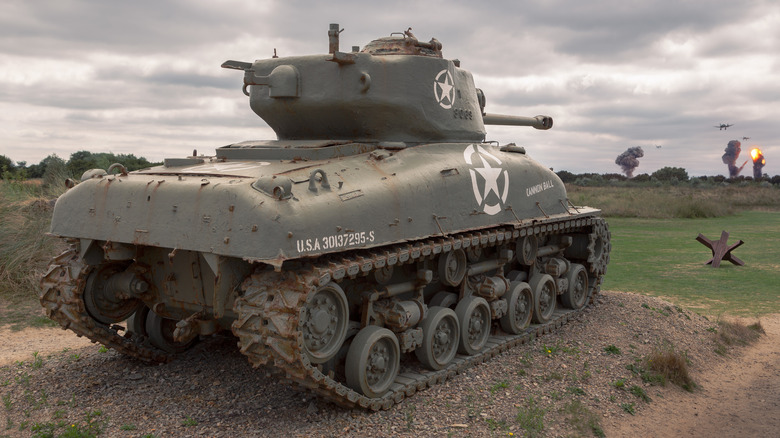
The M4 Sherman tanks, as exemplified by “Lucky,” played a key role inthe Battle of Iwo Jima, where their biggest strengths and weaknesses were displayed. The volcanic sand terrain was difficult for the tanks to negotiate, causing many transmission failures for the Shermans. It’s alsowhere three U.S. Marine divisions went up against a heavily fortified Japanese force that had no qualms about sacrificing itself to slow the Marines’ advance.
A favorite Japanese tactic was to attack the Marines’ tanks with satchel charges strapped to their backs, detonating their charges after sliding underneath the tanks, where the armor was not as strong. Magnetic mines that stuck to the tanks’ bodies were also used by the Japanese. This led to a variety of “adaptations” made to the Sherman tanks.
These included the welded-on nails, plus wooden planks along the sides of the tanks that protected the tanks’ suspensions and reduced the effects of shaped charges. In addition, there were other adaptations, including spraying sand onto freshly painted areas of the tank to prevent Japanese magnetic mines from adhering to it. Sections of the tanks’ tread, known as track blocks, were also spot-welded onto vulnerable parts of the tanks, such as the front and the turret, where they offered additional protection and could be accessed if spare parts were needed. According to a report from the5th Tank Battalion on the subject of Iwo Jima,”The all-around performance of the M4A3 tank was exceptionally good.” During the five-week battle that ended in victory, 7,000 Marines died, and 20,000 were injured.
What happened to Lucky between Iwo Jima and its recovery at Camp Lejeune in 2002?
PHILIPIMAGE/Shutterstock
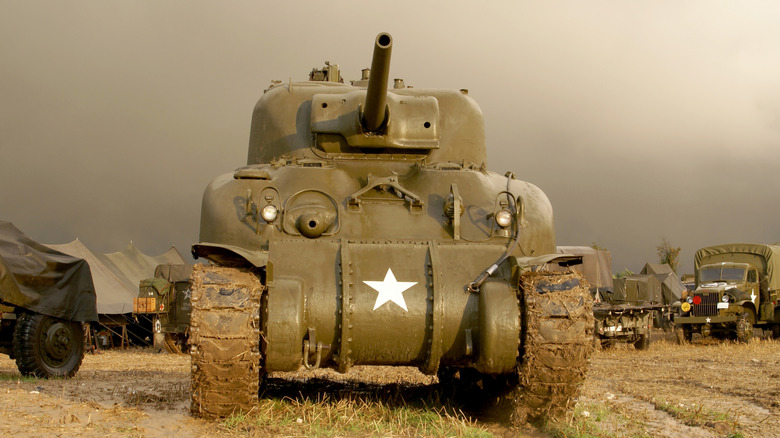
Following the victory at the Battle of Iwo Jima, “Lucky” went back to Hawaii, where it was refitted for its next planned role, showinghow tanks shaped the course of WWII. Along with 71 other tanks,”Lucky” was converted into a flame-thrower tank, which replaced around 60% of its ammunition storage capacity with tanks capable of holding 300 gallons of napalm. The event that these 72 tanks were being prepared for was the invasion of Japan, which ended up not happening, thanks to the atomic bombs “Little Boy” and “Fat Man” being dropped on Hiroshima and Nagasaki, Japan, in August of 1945. This, combined with the concurrent Soviet invasion of Manchuria, led to Japan’s formal surrender in September of that year.
Later, “Lucky” was used as a training tank for an indeterminate period, after which it was sent to Camp Lejeune, the Marine base in North Carolina. It was left in a wooded area of the base until it was discovered by some Marines in 2002, who sent it to theNational Museum of the Marine Corps. And the rest is history.
The story of “Lucky” and Corporal Willhite is just one small piece of the vast World War II panorama of events that stretched across the entire world by the time it ended. It exemplifies how millions of American and other Allied soldiers were engaged in bloody battles across many different locations, fighting for a cause they truly believed in. There’s areason that this cohort is known as “The Greatest Generation.”