Энэхүү шинэ ажиглалтын төв нь өмнөд хагасын тэнгэрийг бүхэлд нь тасралтгүй дүрсэнд буулгах замаар орчлон ертөнцийн нууцыг тайлах томоохон судалгааг эхлүүлж байна.
Өмнө нь “Том синоптик судалгааны телескоп” нэртэй байсан Вера Рубины нэрэмжит ажиглалтын төв (VRO) сансар огторгуйн “Legacy Survey of Space and Time” (LSST) хэмээх 10 жилийн хугацаатай томоохон судалгааны ажлаа албан ёсоор эхлүүллээ. Тус төв нь харанхуй материйн бодит байдлыг баталсан Америкийн одон орон судлаач Вера Рубины нэрээр нэрлэгдсэн юм. 8.4 метрийн голчтой Симонийн судалгааны телескоп болон 3.2 гигапикселийн хүчин чадалтай дижитал камерын тусламжтайгаар өмнөд тэнгэрийн хэсгийг 30 секундын давтамжтайгаар тасралтгүй дүрсжүүлж, сансрын өөрчлөлтийг кино мэт баримтжуулах юм.
Энэхүү төсөл нь харанхуй энерги, харанхуй матери, супернова дэлбэрэлт зэрэг сансар огторгуйн суурь үзэгдлүүдийг судлахаас гадна манай нарны аймгийн жижиг астероидуудыг илрүүлэхэд чухал үүрэг гүйцэтгэнэ. Ажиглалтын төвийн удирдлагууд болох Брайан Стоун, Дарио Гил, Боб Блум болон Желько Ивезич нар энэхүү ажил нь орчин үеийн сансар судлал, астрофизикийг цоо шинэ түвшинд гаргаж, хүн төрөлхтөнд орчлон ертөнцийн үндсэн хуулиудыг танин мэдэх боломж олгоно гэдгийг онцолжээ.
Судалгааны ажлын бэлтгэл үе шатанд хийсэн 1.5 сарын ажиглалтаар л гэхэд 11,000 орчим шинэ астероид, түүний дотор дэлхийд аюул учруулж болзошгүй 33 биетийг илрүүлээд байна. Хэрэв судалгааг 12 жил хүртэл сунгавал АНУ-ын Конгрессоос тавьсан дэлхийд ойр орших биетүүдийн 90 хувийг илрүүлэх зорилтыг биелүүлэх боломжтой юм. Энэхүү бүтээн байгуулалт нь шинжлэх ухааны нээлт хийхээс гадна дэлхийг сансрын аюулаас хамгаалах практик алхам болж байна.
https://www.youtube.com/embed/cNvUF2dZluo
Дэлгэрэнгүйг эх сурвалжаас харах
Эх сурвалжийг нээх ↓
Nine years ago, Universe Today reported on upcoming super telescopes that were set to revolutionize astronomy. The list included telescopes that are now up and running, like the JWST. It included ones that were only beginning construction at the time but are now nearing completion, like the Giant Magellan Telescope. It also included projects that were later cancelled, like the Overwhelmingly Large (OWL) Telescope.
Another one on the list was unlike the others.
It was called the Large Synoptic Survey Telescope, and it was going to be built around the world’s largest digital camera, a wide-angle beast that would capture a movie of the night sky that ran for an entire decade.
The telescope has now been given a different, more befitting name. It’s called the Vera Rubin Observatory (VRO), after the American astronomer who provided evidence that dark matter is a real thing. And now, after so many years, and after being commissioned and tested extensively, the Rubin Observatory is finally beginning its long-awaited, much-anticipated, 10-year survey: the Legacy Survey of Space and Time.
As most Universe Today readers probably know, the LSST is taking a movie of the southern sky, keeping a keen eye out for objects that change brightness, location, or both. Researchers around the world can sign up to receive nightly automated alerts regarding their areas of interest, like supernovae for example, and then other telescopes can be pointed at them for deeper, more focused observations.
During the survey, the VRO and its 8.4 meter Simonyi Survey Telescope and camera will repeatedly image the entire southern sky. The 3.2 gigapixel camera will capture 30 second exposures, which will be stitched together into an ongoing movie of the sky. The effort will study everything from cosmos-defining things like dark energy and dark matter, down to small asteroids in our own Solar System.
“Today, we begin filming the greatest cosmic movie ever made,” says Brian Stone, performing the duties of the NSF Director. “This moment reflects decades of vision, innovation, and the power of federal investment in science through the U.S. National Science Foundation and the Department of Energy. Every night, NSF–DOE Rubin Observatory will expand the frontiers of knowledge and strengthen America’s global leadership in science and innovation.”
If initial images released a year ago, like the “Cosmic Treasure Chest,” are any indication, then not only are professional astronomers in for a treat, so are the rest of us. The expanse and detail captured in that image of the Virgo Cluster is astounding. That image can be explored in great detail here.
*The VRO’s image of the Virgo Cluster is titled Cosmic Treasure Chest. This image can be downloaded and explored in extreme detail. What are dark, empty pockets of space in other telescope images are revealed to be teeming with stars and galaxies in this one. Image Credit: NSF–DOE Vera C. Rubin Observatory/NOIRLab/SLAC/AURA*
It’s not an overstatement to say the entire global astronomical and astrophysical research communities have been anticipating this moment. For people close to the observatory, their excitement can’t be contained.
“With the launch of the ten-year Legacy Survey of Space and Time, NSF–DOE Rubin Observatory is opening a new window on the Universe. It is embarking on a mission that will redefine modern cosmology and astrophysics,” says Darío Gil, Under Secretary for Science at the U.S. Department of Energy. “With its world-class design and tools, Rubin Observatory will capture the dynamic nature of our cosmos and reveal unimagined insights into our Universe’s biggest mysteries, from our own Solar System to the very structure of the Universe. By seeking to understand the enigmatic phenomena of dark energy and dark matter, we are not just observing the stars; we are striving to grasp the fundamental laws that govern our existence.”
Not everyone cares or can relate to ‘the fundamental laws that govern our existence’ but many of us can. As we grapple with our personal lives, we keep one part of our minds engaged with bigger issues, including the fundamental nature of the Universe we find ourselves in. We’re also aware that existence is tenuous, and extinction is the norm. So while we follow along as our understanding of fundamental things grows, we’re also concerned about death by asteroid. That may not be as grandiose a topic as the basic nature of existence, but it’s awfully important.
In only 1.5 months of observation during early optimization work, the telescope detected 11,000 new asteroids, including 33 near-Earth objects. The LSST is our most powerful tool for detecting these objects, and if the survey is extended to 12 years, it could complete the mandate given by the US Congress to find 90% of NEOs.
People in charge of the VRO and the LSST may not want to address things like potential extinction by asteroid in their press releases, even though deeper documents show it’s on their minds. They like to stick with inspiring language, which is understandable.
“It is amazing and humbling to be here at this time and place as we start the Legacy Survey of Space and Time, after more than two decades of incredible work by our dedicated team,” says Bob Blum, Director of Rubin Observatory at NSF NOIRLab. “Rubin Observatory is for everyone; the LSST will change how we do astronomy and astrophysics, allowing researchers anywhere to participate in cutting-edge science.”
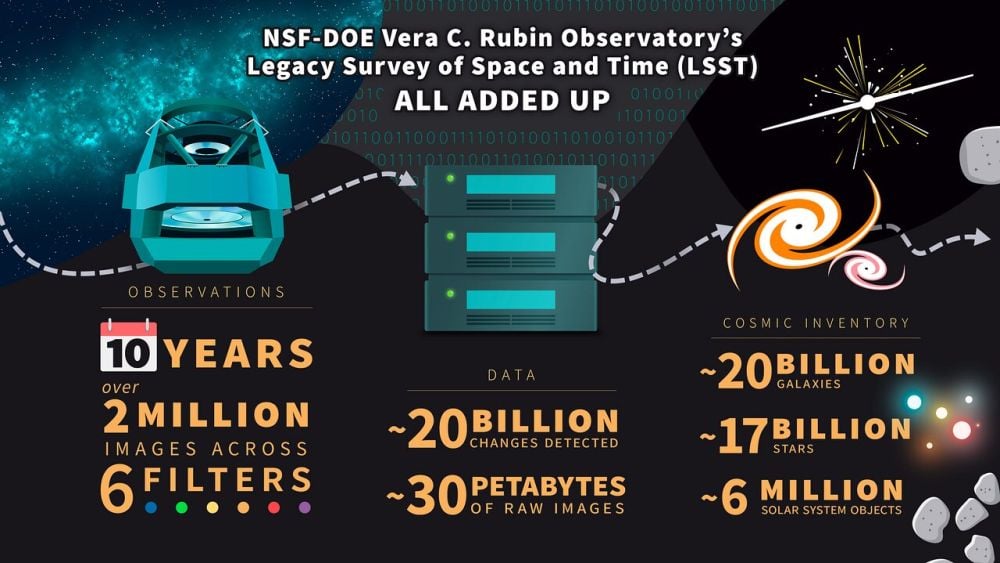 *This graphic shows some of the things that the LSST will discover. Image Credit: NSF–DOE Vera C. Rubin Observatory/NOIRLab/SLAC/AURA*
“It’s taken 20 years of hard science, engineering, and more to get to the point where we can call ‘action’ as we start rolling on this blockbuster movie of the Universe,” says Phil Marshall, Deputy Director of Rubin Operations for SLAC. “Millions of alerts in just the last couple of months show that Rubin is up and running as a discovery machine. Now we’re putting it all together.”
The LSST could only begin once everyone was satisfied with the observatory’s performance. Image quality was an overarching factor, and other things like system reliability were also scrutinized before the survey began. Once they get going, they don’t want to stop.
“The decision to officially begin the LSST was made after a period of system optimization and a careful operational review of technical readiness, data system performance, and scientific validation,” says Željko Ivezić, Head of LSST.
Those that have followed space and astronomy for long enough are likely feeling very pleased with this announcement. When the JWST finally began observing, after a much longer, torturous journey to completion and launch, there was an exhalation and release of pent-up energy.
Those who’ve been waiting for the LSST for a long time are feeling something similar. Not only are we getting a new, detailed look at the cosmos, we’re taking another practical step to protecting Earth from hazards.
That’s worth a sigh of relief among all the excitement around new knowledge to come.