
Аюултай хэмжээнд хүрэх халуун давалгааны үеэр гадаа аялал, явган аялал хийхдээ биеийн дулаан зохицуулалтаа хянаж, болзошгүй эрсдэлээс сэргийлэхийг эмч нар зөвлөж байна.
АНУ-ын төв, зүүн болон зүүн өмнөд бүс нутгуудад Arizona, Texas, Colorado, Florida, Tennessee, Virginia, Mississippi зэрэг мужуудад агаарын хэм 90-100 гаруй градус хүрч халах төлөвтэй байна. Ийм үед агаарын чийгшил өндөр байх нь биеийн хөлс уурших үйл явцыг саатуулж, “feels like” буюу хүний биед мэдрэгдэх халууныг 110 градус хүртэл өсгөдөг. Ялангуяа шөнийн цагаар агаарын хэм буурахгүй байх нь бие махбодод ачаалал өгч, ядаргаанд оруулах эрсдэлтэй.
Аялагчид зөвхөн агаарын хэмийг бус, чийгшилтэй харьцуулсан “heat index” буюу биед мэдрэгдэх халууны үзүүлэлтийг заавал хянах шаардлагатай. Хэрэв энэ үзүүлэлт 103 градусаас давбал явган аялал, уулын аялал зэрэг биеийн хүчний ачаалалтай үйл ажиллагаанаас татгалзаж, сэрүүн орчинд байх нь зүйтэй. Энэ нь дулааны цохилт авах, ухаан санаа балартах зэрэг эрүүл мэндийн хүндрэлээс сэргийлэх гол алхам юм.
Гадаа аялахдаа тогтмол сүүдэрлэх, хүйтэн усаар гараа норгох, хөнгөн хувцаслах болон шингэнээ сайн нөхөх нь чухал. Шинэ орчинд аялахаар төлөвлөж буй бол бие махбодоо халуунд дасгахын тулд 10 хоногийн хугацаанд ачааллаа аажмаар нэмэгдүүлэхийг зөвлөж байна. Хэрэв толгой эргэх, дотор муухайрах, булчин татах шинж тэмдэг илэрвэл аяллаа даруй зогсоож, сэрүүн газар хоргодох хэрэгтэй.
Дэлгэрэнгүйг эх сурвалжаас харах
↓Эх сурвалжийг нээх ↓
As a practicing internal medicine physician, I field some version of the same question every summer: Is it safe to be outside right now? This week,the answer leans toward a hard no. The National Integrated Heat Health Information System (NIHHIS) has flagged a dangerous heat wave building across much of the U.S., with major to extreme heat expected through the Fourth of July weekend and beyond.
The temperature on your phone is only half the story. Without also checking the heat index, you are missing the number that actually predicts how hard your body has to work to stay cool, which could be the difference between a good day out and a trip to the emergency room. Here’s how it works, when to worry, and what cools you down.
The U.S. Regions and States Expected to Hit Dangerously High Temperatures
According to the NIHHIS interactive heat map, the central, eastern, and southeastern states are bearing the brunt of this heat wave. Some of the most affected states include: Arizona (particularly in the southwestern part of the state), Texas, southeastern Colorado, Florida, Tennessee, Virginia, and Mississippi. Temperatures are expected to range from the high 90s to the low 100s.
The reason this heat wave is especially brutal: humidity is stacking on top of already-high temperatures, driving the heat index up quickly. This means that elevated temperatures paired with thick, oppressive humidity will push heat indices past 110 degrees Fahrenheit in some spots.
What’s worse, the detail we often miss is what happens overnight. When the lowest temperature for the day stays in the 70s, your body never fully cools off, and a few days of that compounds fast.
What Is the Heat Index?
The heat index is the “feels like” temperature. It combines air temperature and relative humidity to estimate how hot the air feels. Humidity drives it because our main cooling system is sweat evaporating off the skin. When the air is already saturated, that sweat has nowhere to go, which forces our core body temperature to climb. That is why a mild-sounding number can still feel sweltering when we step outside.
How to Read a Heat Index Chart
On the National Weather Service (NWS) heat index chart below, the temperature values (in Fahrenheit) are plotted along the top. The left side of the chart indicates the relative humidity percentage.
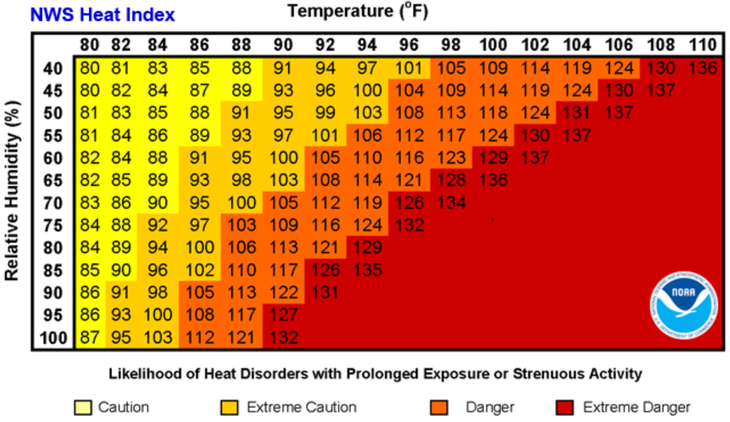
Let’s take a 90-degree afternoon with 70 percent humidity, for example. Look for 90 degrees at the top, then look for 70 percent on the left side of the chart. Where those two numbers intersect on the chart is the heat index, which in this case would be 105 degrees Fahrenheit. In other words, the 90-degree weather may feel tolerable until you add 70 percent humidity, and suddenly the air feels sticky and more than unpleasant to be in. This is because a heat index of 105 degrees lands in the orange block of the chart, aka the danger zone. (We’ll get into what that means in the next section.)
Keep in mind that the chart also assumes shade and light wind. But if we step into an open field with the sun beaming down, an additional 15 degrees might get tacked on. So, a 90-degree day can easily feel like triple digits on an exposed trail.
At What Heat Index Should I Worry?
The NWS breaks the heat index into four zones. Each zone indicates the severity of heat-related health risks. The danger zone—orange or red on the chart—indicates heat that poses significant risks to overall health.
Here is a breakdown of each heat index zone (all degrees are in Fahrenheit and the colors refer to the corresponding color zone on the heat index chart):
- Caution (light yellow): 80–90 degrees; fatigue shows up with sustained effort during physical activity
- Extreme caution (dark yellow): 90 to 103 degrees; heat cramps and heat exhaustion set in
- Danger (orange): a heat index of 103–124 degrees; heat exhaustion is likely, and heat stroke becomes possible
- Extreme Danger (red): above 125 degrees; heat stroke is highly likely
Once the heat index crosses 103, hard efforts (long climbs, speed work, big mileage) become a bad bet. Heat stroke is more than overheating: once your core pushes past 104 degrees, you may experience confusion or altered thinking; this is true emergency territory, and requires urgent medical care.
How to Stay Safe Outdoors During a Heat Wave
Leaning on my expertise as a doctor, here are my best pieces of advice for staying safe when recreating or exercising outdoors in extreme temperatures.
Cool Early and Often
Regular breaks in air conditioning or in the shade reduce heat strain more effectively than waiting until you feel overheated. Duck into the shade, a pool, or a nearby safe body of water, or air conditioning before you feel cooked.
Use Fast-Cooling Zones
Hands, forearms, face, and neck shed heat quickly because of their high blood flow. Placing your forearms in cold water for a few minutes drops your core faster than you expect.
Remove Excess Clothing
Fabric traps warmth and blocks sweat from evaporating, the body’s main cooling routes; bare skin sheds heat faster.
Treat Fans as Backup, Not a Solution
Moving air helps if the skin is damp, but once the air itself is hot, a fan alone will be pretty useless. Pair it with mist. Fill a spray bottle with cool water and spritz the face and body when feeling hot.
Respect the Acclimatization Window
If you just got into town or the heat just spiked, your body needs about ten days to adjust. The first few days are when people get into trouble. To get used to hotter temperatures, gradually increase the time spent outside and workout intensity over time.
Drink Water Frequently
For shorter, easier efforts, water is enough. On long, sweaty days, water won’t be enough. Adding electrolytes replaces the sodium you lose in sweat.
When the Index Is In the Orange or Red Zones, Train Indoors
If the map shows “danger” or “extreme danger,” postpone the big hike and hit an air-conditioned gym. Indoor miles still count, and the trail will be there when the heat breaks.
Know When to Stop
Heavy sweating, cramps, nausea, dizziness, or a pounding headache are your exit signs. Get to shade and cool down.
Many of us assume we can get away with drinking less water indoors during a heat wave, but that’s not the case. So, keep drinking water even when you’re at home, because we still lose fluid through breathing and low-level sweating. And don’t forget to check the “feels like” temperature on your weather app to figure out if it’s safe to recreate outside.
Want moreOutsidehealth stories?Sign up for the Bodywork newsletter.
The post I’m an Internal Medicine Doctor. Here’s My Best Advice for Staying Safe (and Cool) During a Heat Wave. appeared first on Outside Online.

