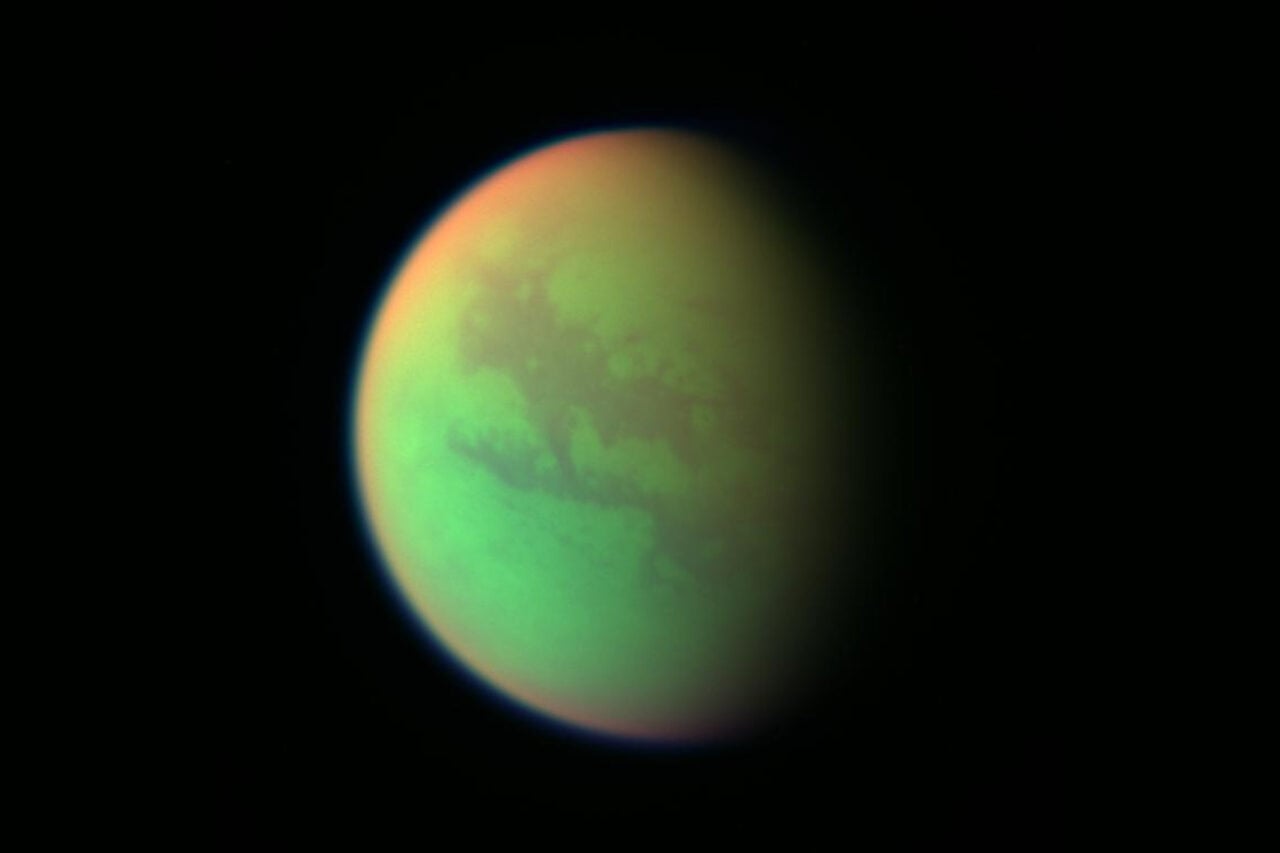
Жэймс Вэбб сансрын дуран авайг ашиглан хийсэн судалгаагаар Плутон болон Санчир гарагийн дагуул Титан дээр урьд өмнө бүртгэгдээгүй химийн нэгдлийн ул мөр илэрчээ.
Судлаачид Плутон болон Титаны гадаргуугийн спектрийн шинжилгээг хийх явцдаа 5.11 микрометрийн долгионы уртад гэрлийн шингээлтийн огцом алдагдал байгааг анзаарсан байна. Одоогийн байдлаар энэхүү үзэгдлийг тайлбарлах химийн нэгдлийг олж тогтоох боломжгүй байгаа бөгөөд энэ нь манай нарны аймагт урьд өмнө тааралддаггүй шинэ бодис байж болзошгүй гэж үзэж байна. Энэхүү судалгааны үр дүнг Astronomy & Astrophysics сэтгүүлд хэвлүүлэхээр хүлээн авсан бөгөөд урьдчилсан байдлаар arXiv санд байршуулжээ.
https://arxiv.org/abs/2606.13350
Плутон болон Титан нь гаднаасаа тэс өөр харагддаг ч хоёулаа азотоор баялаг агаар мандалтай, метаны агууламжтай байдаг. Фотохимийн нөлөөгөөр үүссэн органик манан нь хоёр биетийн гадаргуугийн тогтоцыг бүрдүүлдэг тул эрдэмтэд манангийн нөлөө багатай спектрийн цонхыг ашиглан гадаргууг судалсан байна. Судалгаагаар Плутон дээрх спектрийн шингээлтийн шугам нь Титаныг бодвол гурав дахин зузаан байгаа нь энэхүү үл мэдэгдэх бодисын молекулын төлөв байдалтай холбоотой байж магадгүй гэж дүгнэжээ.
Парисын одон орон судлалын төвийн судлаач Бруно Бэзарын хэлснээр, тэд ален болон бензол, кетен зэрэг хэд хэдэн боломжит хувилбаруудыг авч үзэж байгаа ч энэ нь энгийн нэгдэл биш бололтой. Одоогоор сансрын дуран авай дээрх хэт улаан туяаны спектроскопийн хүчин чадал нь гадаргуугийн материалыг шууд ажиглахад хангалтгүй байна. Иймд эрдэмтэд Жэймс Вэбб дуран авайг ашиглан нэмэлт ажиглалт хийхээр төлөвлөж байгаа бөгөөд 2030-аад оны дунд үед Титан дээр хүрэх NASA-гийн “Dragonfly” номлолоос илүү тодорхой мэдээлэл хүлээж байна.
Дэлгэрэнгүйг эх сурвалжаас харах
Эх сурвалжийг нээх ↓
Every element has a unique set of absorption and emission lines that create spectral signatures. These signals are key information for astronomers studying faraway objects—but what happens when there’s no good match for a particular signature?
While studying Pluto and Saturn’s largest moon Titan, researchers spotted a missing band of light in their spectral signatures, specifically at the 5.11-micrometer line. However, after searching past datasets and literature, they weren’t able to find any suitable matches for whatever molecule was responsible for this phenomenon. In other words, Pluto’s and Titan’s surfaces may harbor an unknown molecule—a substance that we’ve never seen anywhere else in our solar system and beyond.
A paper detailing the results has been accepted for publication in Astronomy & Astrophysics and is currently available as a preprint in arXiv.
“We have a few candidates, but it will not be a simple compound,” Bruno Bézard, the study’s first author and a researcher at the Paris Observatory, told New Scientist. “Whatever it is, it will be a surprise.”
Close but far
Pluto and Titan don’t look much alike externally, but both possess nitrogen-rich atmospheres with some methane. Photochemical effects create a “ubiquitous organic haze” that eventually trickles down to shape the surface morphology of Pluto and Titan, according to the paper. Researchers behind the latest paper selected a narrow spectral window least affected by the haze to investigate the surface beyond the foggy atmosphere.
They probably weren’t expecting to learn of anunidentified substance, however. That Pluto and Titan share the same missing spectral band was fascinating on its own, but the team couldn’t find a good match for the chemical compound responsible for this absorption. According to the data collected by the James Webb Space Telescope (JWST), the absorption line for Pluto is roughly three times thicker than Titan’s, where the molecule causing this gap appears to be more unevenly distributed. This difference likely stems from the “physical state of the unknown compound at the molecular scale,” the study noted.
Waiting for Dragonfly
The researchers scoured the literature to see if anything could be even remotely similar, and, to their credit, they did find some decent fits, such as “allenes and, if mixed with other species, benzene, ketene, or less likely acetylene,” according to the paper. However, there isn’t enough information available to determine whether the mystery compound is one of these candidates or none at all.
“The lack of onboard infrared spectroscopy capabilities prevents any direct observation of the spectral feature itself in surface materials,” the researchers concluded.
That said, the team told New Scientist that it had already secured more JWST data for follow-up investigations. Further down the line, NASA’s Dragonfly mission is slated to reach Titan in the mid-2030s, and the hope is that the spacecraft will send back some new information about Titan’s surface.


