
Нарны салхи сансрын уудамд хэрхэн саатаж байгааг судалснаар эрдэмтэд манай нарны аймаг болон оддын хоорондох огторгуйн заагийг тодорхойлох боломжтой болж байна.
Southwest Research Institute-ийн судлаач Хэзер Эллиоттоор удирдуулсан баг “New Horizons” хөлөг дээрх “Solar Wind Around Pluto” (SWAP) багажийг ашиглан Нарны аймгийн алслагдсан хэсэг дэх нарны салхины хурдыг хэмжжээ. Нарны салхи нь секундэд 400-800 км хурдтайгаар Нарнаас цацагддаг плазмын урсгал юм. Гэвч уг хөлөг Нарнаас 21-58 одон орны нэгж (AU) зайд явах явцад нарны салхины хурд аажмаар буурч байгааг тогтоосон байна.
Судлаачдын тайлбарласнаар, Нарны аймгийн гаднаас ирж буй одод хоорондын төвийг сахисан хийн бөөмс нарны салхины ионуудтай харилцан үйлчлэх явцад масс нэмэгдэж, улмаар салхины хурдыг сааруулдаг аж. Энэхүү үйл явц нь манай Нарны аймгийн нөлөө хаана төгсөж, оддын хоорондох орон зай хаана эхэлж байгааг ойлгоход чухал ач холбогдолтой юм. Ийм судалгаа нь ирээдүйн сансрын аяллыг төлөвлөх болон бусад оддын эргэн тойрон дахь орчныг судлахад үнэтэй мэдээлэл болдог.
“New Horizons” хөлөг 2026 оны долдугаар сарын 6-ны байдлаар Нарнаас 65 AU зайд ажиллаж байна. Өмнө нь “Voyager 2” хөлөг 84 AU зайд нарны салхины хурд 46 хувиар огцом буурах “төгсгөлийн цохилт” (termination shock)-ыг бүртгэж байсан бөгөөд “New Horizons” 2029 он орчимд энэ бүсэд хүрэх төлөвтэй байна. Энэхүү хил хязгаарыг судлах нь сансрын цацраг туяа Дэлхий болон сансрын нисгэгчдэд хэрхэн нөлөөлдгийг ойлгоход нэн чухал юм.
https://iopscience.iop.org/article/10.3847/1538-4357/ae39c6/pdf
Дэлгэрэнгүйг эх сурвалжаас харах
Эх сурвалжийг нээх ↓
Where does the Solar System end and interstellar space begin? That’s a question scientists have been working to answer using spacecraft traveling out beyond the Sun’s influence. A team of researchers from the Southwest Research Institute led by Heather Elliott is using the Solar Wind Around Pluto (SWAP) instrument onboard New Horizons to track the solar wind in the outer reaches of the Solar System.
The instrument measured distinct slowdowns of the solar wind as the spacecraft traveled between 21 and 58 AU. According to Elliott, there’s a good reason for that slowing. “As the solar wind travels away from the Sun at supersonic speeds, roughly 1 million miles per hour, eventually it encounters incominginterstellar neutral gas particlesentering the heliosphere,” she said. “These neutral interstellar atoms become ionized viacharge exchangewith solar wind ions, adding mass to the solar wind by picking up interstellar material that slows the solar wind down.”
Understanding the extent of the solar wind not only gives scientists a greater understanding of our star’s influence, but it also helps them see how winds from other stars play a role in their environments. Astrospheres around distant stars also interact with the interstellar medium. They have many properties in common with our Sun, so whatever we find out from our own solar wind’s influence is important. “Studying the heliosphere is like solving a cosmic puzzle,” said Elliott. “Not only do we learn more about how the Sun’s influence ends, but we also gain a deeper understanding of the boundary between our solar system and interstellar space — a critical step toward planning future interstellar travel.”
Charting the Solar Wind Slowdown
The solar wind is a continuous outflow of plasma from the Sun. It flows from different regions of our star, such as coronal holes. When the wind leaves those areas, it’s moving at around 500 to 800 kilometers per hour (310 to ~500 miles per hour). The average speed that we “feel” here on Earth clocks in at around 400 km (~250 miles) per hour. It makes sense that the wind will slow down as it moves out through the system, and that’s what scientists want to measure. It also makes sense that the point where it’s no longer blowing is the point where interstellar space begins.
*The solar wind emanates from three likely sources on the Sun: dark and cool regions called coronal holes, active regions, which are characterized by strong magnetic fields, and coronal streamers, which extend as long structures in the Sun’s upper atmosphere. Credit: NASA*
New Horizons isn’t the first spacecraft to detect the solar wind. The Ulysses spacecraft, for example, charted all the “regimes” of the solar wind as it did a nearly pole-to-pole orbit around the Sun from 1990 to 2009. Other missions have measured it on their way to the Sun (such as the Parker Solar Probe), Mars, and Jupiter. The twin Voyagers and the Pioneer missions are the only other ones to have also measured the solar wind at distances farther than any other craft.
The best way to understand the slowdowns is to compare them to the speed of the solar wind at Earth (1 AU). The New Horizons and Voyager 2 measurements between 30 and 43 AU showed the solar wind was 5 to 10% slower than at 1 AU near Earth. New Horizons’s measurements at 58 AU show the solar wind is 13 to 15% slower than the wind at 1 AU. These measurements of the gradual slowing of the solar wind align with previous models of how interstellar material enters the heliosphere and affects the solar wind. It also demonstrates how the Sun’s influence decreases over long distances.
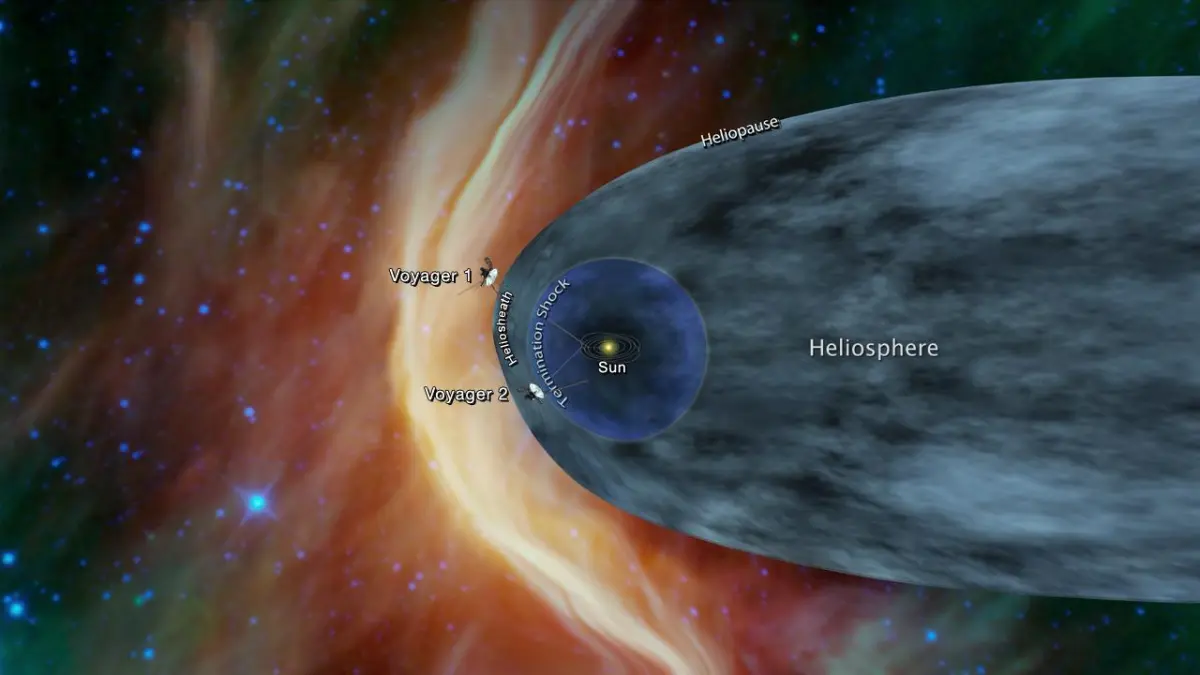 *This shows the position of the Voyager 1 and Voyager 2 probes relative to the heliosphere, the protective bubble created by the Sun that extends well past the orbit of Pluto. Voyager 1 crossed the heliopause, or the edge of the heliosphere, in 2012. Voyager 2 crossed in 2018. Credit: NASA/JPL-Caltech*
What Happens Farther Out?
As New Horizons continues on its trajectory through the Kuiper Belt and beyond, it will eventually run into a point where the solar wind is pushed back by incoming interstellar material. That’s the point where the heliosphere’s influence stops, called the Termination Shock. In that region, some 85 AU from the Sun, the incoming interstellar material heavily affects the properties of the solar wind as it nears the outer boundary of the heliosphere. Voyager 2 measured a sharp 46% drop in speed at the termination shock at a distance of 84 AU. So, it will be interesting to see what New Horizons measures when it reaches that point, which could happen somewhere around the year 2029.
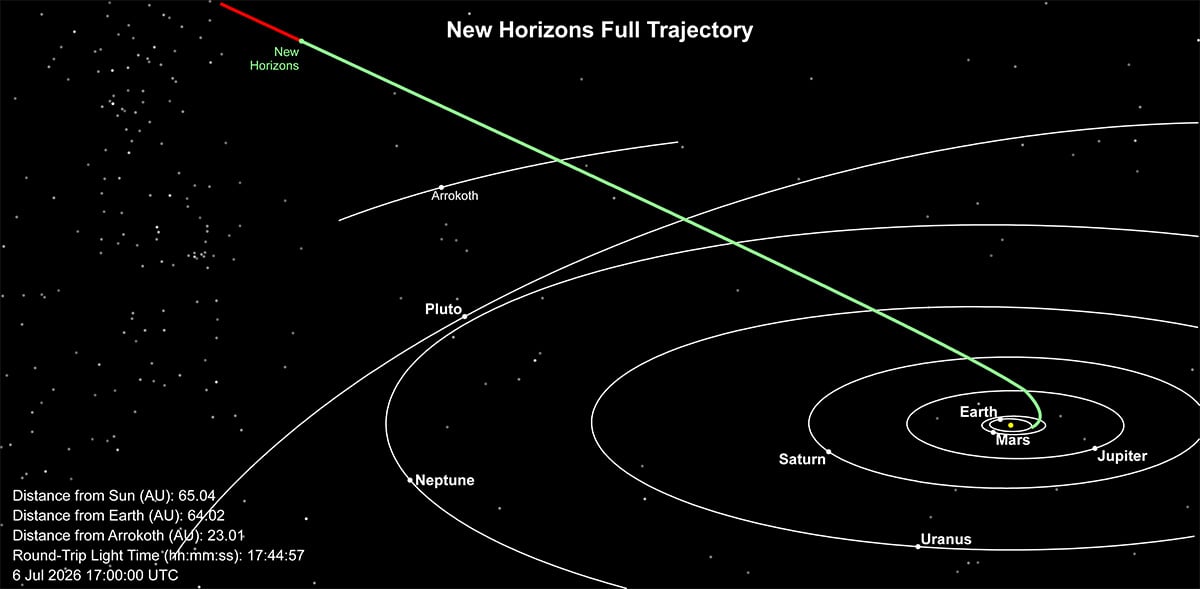 *New Horizons’s position in the Solar System as of July 6, 2026. It is currently 65 AU from the Sun. Credit: NASA/New Horizons mission*
When the solar wind gets to that point, its shape and boundaries change, according to Elliott. “The shape and properties of these heliospheric boundaries control the amount of Galactic Cosmic Rays (GCRs) that can enter our solar system and reach Earth,” she said. “Therefore, the data from New Horizons combined with observations from other missions, such as IBEX, IMAP and Voyager will enhance our understanding of the edge of the solar system.”
Galactic cosmic rays are a concern for astronauts on long-term missions. They are severely lethal, and some do get through the heliosphere. Understanding the boundaries of the solar wind is an important factor in mission planning for trips to the Moon and beyond.
For More Information
The Gradual Slowing of the Solar Wind in the Outer Heliosphere


