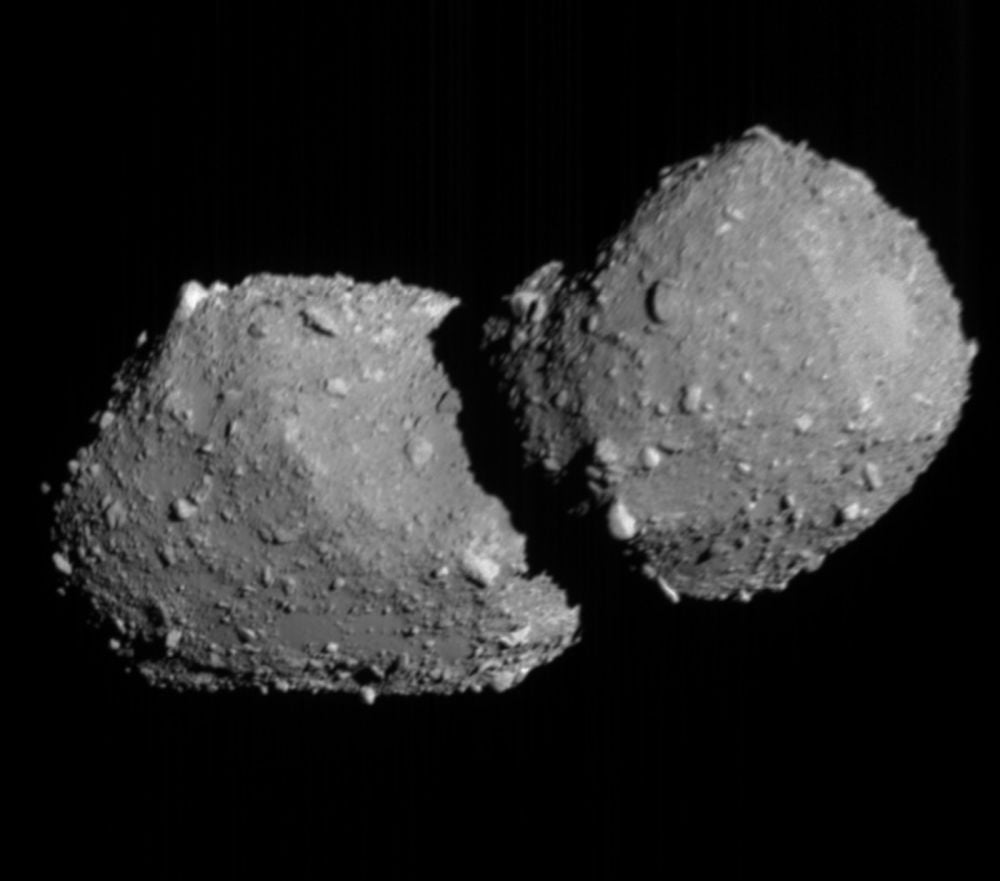
JAXA-гийн Hayabusa 2 хөлөг 98943 Торифүнэ астероидын хажуугаар өнгөрөхдөө түүний гадаргуугийн бүтцийг нарийвчлан тогтоов.
Ryugu астероидаас дээж авч Дэлхий рүү илгээсэн амжилттай даалгаврын дараа JAXA-гийн Hayabusa 2 хөлөг 1998 KY26 хэмээх жижиг астероидыг зорин аялж байна. Энэ аяллынхаа хүрээнд тус хөлөг 450 метр орчим диаметртэй, S-төрлийн (чулуулаг ихтэй) Торифүнэ астероидын хажуугаар өнгөрсөн юм.
Зургадугаар сарын 20-нд хөлгийн удирдлагын камер астероидыг анх дүрсэлсэн бол долдугаар сарын 5-нд 800 метр орчим зайд ойртон гадаргуугийн нарийвчилсан зургийг авчээ. Энэхүү ажиглалтаар Торифүнэ нь хоёр тусдаа биет нэгдэн үүссэн “холбоост хос” (contact binary) бүтэцтэй болох нь батлагдсан байна.
Hayabusa 2 хөлөг 5 км/с хурдтайгаар астероидын хажуугаар өнгөрөхдөө хэт улаан туяаны спектрометр, дулааны дүрслэгч болон LIDAR төхөөрөмжүүдээ ашиглан судалгаа хийжээ. Хөлгийн түлшний нөөц хязгаарлагдмал тул нэмэлт маневр хийх боломжгүй ч 2027 оны арванхоёрдугаар сар болон 2028 оны зургадугаар сард Дэлхийн таталцлыг ашиглан чиглэлээ залруулж, 2031 оны долдугаар сард 1998 KY26 астероидтой уулзахаар төлөвлөж байна.
https://arxiv.org/html/2604.08832v1
https://www.universetoday.com/article_images/20260706-3-02_20260707_194358.jpg
Одоогоор цуглуулсан мэдээллүүд бүрэн ирж дуусаагүй байгаа тул энэ нь урьдчилсан үр дүн юм. 1998 KY26 астероидын хувьд ус ихтэй, хурдан эргэлддэг, нэгдмэл чулуулгийн бүтэцтэй байх магадлалтай гэж эрдэмтэд таамаглаж байна.
Дэлгэрэнгүйг эх сурвалжаас харах
Эх сурвалжийг нээх ↓
Hayabusa 2’s primary mission is well in the past, now. JAXA’s asteroid sampling spacecraft rendezvoused with asteroid Ryugu back in June 2018. It studied the asteroid for 1.5 years and gathered a sample which was returned to Earth in December 2020.
After that successful endeavour, Hayabusa 2 was sent on its way to visit other targets, though another sample-return is not possible. It’s on its way to visit a tiny asteroid called 1998 KY26, a near-Earth object (NEO) only about 11 meters in diameter. But on its way, it also flew past another asteroid named Torifune (98943 Torifune).
Ground-based observations showed that Torifune is a near-Earth asteroid (NEA) measuring about 450 meters in diameter. It’s an S-type asteroid, meaning its a stony-type or siliceous-type. These are high-density objects that make up about 17% of the asteroid population, making them the second most common type after carbonaceous C-type asteroids.
*These are two different top-down ways of envisioning Hayabusa 2 and asteroid Torifune. The left panel shows a view in a frame that rotates with Earth’s orbit. The right panel shows a stationary frame. Image Credit: By Original by Hirabayashi et al. 2026, modified by Nrco0e – Modified from Figure 2 of https://arxiv.org/html/2604.08832v1, CC BY 4.0, https://commons.wikimedia.org/w/index.php?curid=189386318*
Hayabusa 2 began looking at Torifune in June with its Optical Navigation Camera – Telescopic (ONC-T). The ONC-T directly imaged Torifune on June 20th for navigation purposes.
Then on July 5th, Hayabusa 2 came to within about 800 meters of the asteroid. It used ONC-T to capture images of Torifune that revealed details about its surface. While ground-based observations showed the asteroid was elongated, hinting at its contact binary nature, only these images confirm it. In contact binaries, two separate asteroids orbited a common center of mass until they spiralled in towards each other and joined into one. Contact binary asteroids aren’t expected to be rare.
Beginning at about one hour before closest approach, Hayabusa 2 also observed Torifune with its other instruments, the NIRS3 (Near-Infrared Spectrometer), TIR (Thermal InfraRed Imager), and LIDAR (Light Detection and Ranging).
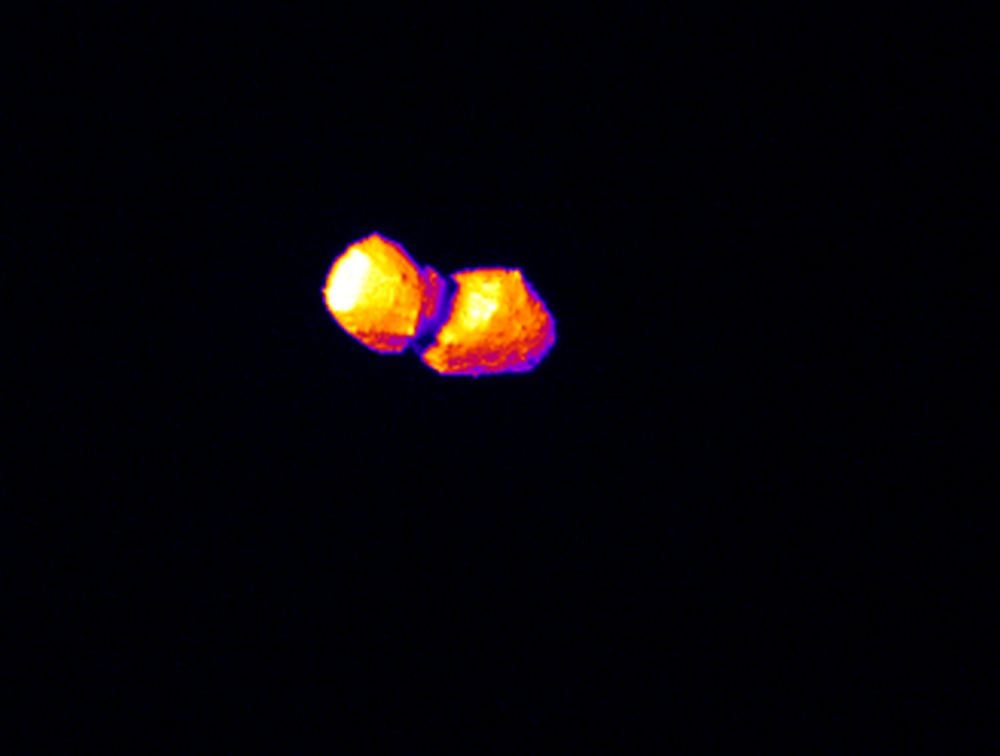 *Hayabusa 2 also imaged asteroid Torifune with its Thermal InfraRed Imager (TIR). This TIR image is from about 10 km away. Image Credit: JAXA, Maebashi Institute of Technology, Chiba Institute of Technology, The University of Aizu, Hokkaido University of Education, AIST*
Hayabusa 2 was travelling very fast during this flyby. Its relative speed was 5 km/s (3.1 mi/s), making navigation and image capturing challenging. It has less than half of its xenon propellant remaining, enough to power its ion thrusters to meet Torifune and 1998 KY26, but not enough for any extra maneuvers.
Hayabusa 2’s next milestone will be in December 2027 when it swings past Earth. Then in June 2028, it will swing by Earth again. That will set it up for its rendezvous with 1998 KY26 in July 2031.
The exact nature of 1998 KY26 isn’t clear. Observations in optical and radar suggest that it’s a water-rich asteroid, and since it’s known to be a fast-rotator, it’s almost certainly one single chunk of rock rather than a rubble pile asteroid. It could also potentially be an X-type asteroid, which is a catch-all term that encapsulates objects that look similar through a telescope but are composed of different materials.
All of Hayabusa 2’s data from its flyby of Torifune has not yet reached Earth, so these are preliminary results. JAXA will release more in the near future.

