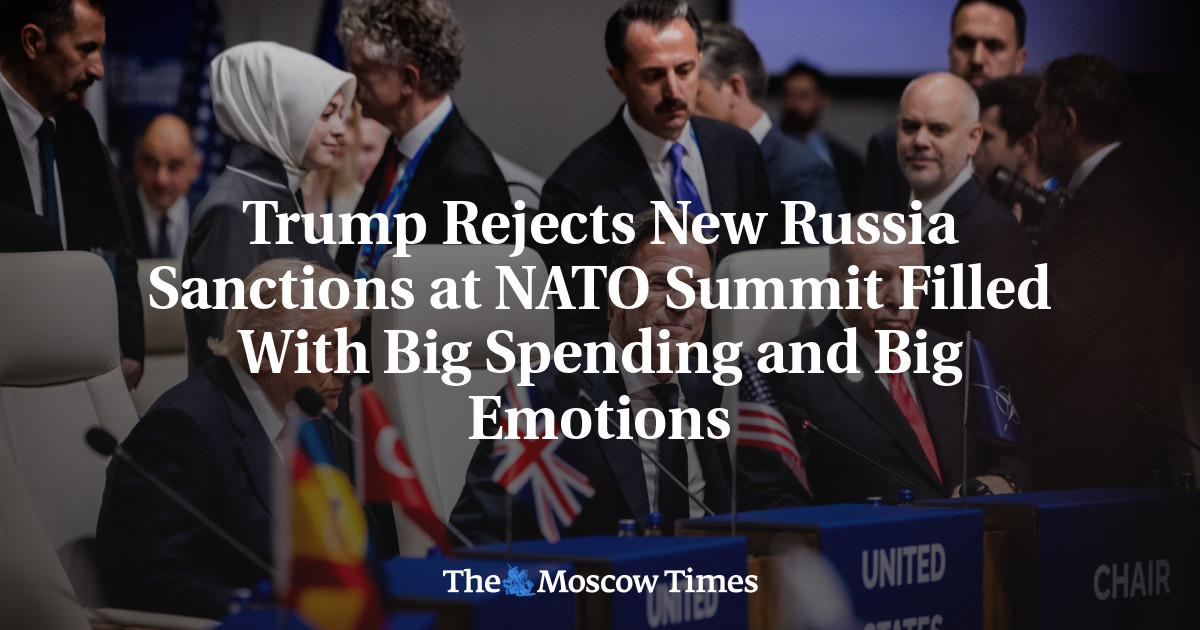
АНУ-ын Ерөнхийлөгч Дональд Трамп НАТО-гийн гишүүн орнуудыг батлан хамгаалах зардлаа нэмэгдүүлж, Америкийн цэргийн хүчин чадлаас хамааралтай байдлаа багасгахыг шаардлаа.
Анкарад болсон НАТО-гийн дээд хэмжээний уулзалтын үеэр гишүүн орнууд 50 тэрбум ам.долларын өртөг бүхий шинэ зэвсэглэл, тэр дундаа Triton тагнуулын дрон, GlobalEye агаарын урьдчилан сэргийлэх систем, пуужингийн эсрэг хамгаалалтын хэрэгслүүд худалдан авахаар төлөвлөж буйгаа зарлав. Энэхүү алхам нь Вашингтоны шаардлагыг биелүүлэхээс гадна Европын холбоотнуудын стратегийн бие даасан байдлыг бэхжүүлэх зорилготой юм. Уулзалтын үеэр АНУ-ын Ерөнхийлөгч Дональд Трамп Испани улсыг батлан хамгаалах төсвөө хангалтгүй гэж үзэн худалдааны хориг тавихаа мэдэгдэж, Дани улсаас Гренланд арлыг шилжүүлэн авах хүсэлтээ дахин илэрхийлэв.
https://x.com/Hancock2001/status/2074151589783208220
Украины Ерөнхийлөгч Володимир Зеленский тус улсыг НАТО-д элсүүлэх асуудлыг хөндөхийн зэрэгцээ агаарын довтолгооноос хамгаалах Patriot систем болон бусад зэвсэглэлийн хангамжийг нэмэгдүүлэхийг уриалав. Дээд хэмжээний уулзалтын хүрээнд НАТО 2026 оны эцэс гэхэд Украинд 70 тэрбум ам.долларын тусламж үзүүлэхээ амласан бөгөөд Трамп Украинд Patriot систем үйлдвэрлэх лиценз олгох боломжтойг дурджээ. Мөн Швед улс Украинд Gripen сөнөөгч онгоц нийлүүлэхээр болсон нь агаарын орон зайг хамгаалахад чухал нөлөө үзүүлнэ хэмээн үзэж байна.
https://x.com/Mylovanov/status/2074867065316323824
ОХУ-ын аюул заналхийлэл хэвээр байгаа хэдий ч НАТО-гийн албаны хүмүүс ойрын хугацаанд шууд халдах магадлал бага хэмээн дүгнэж байна. Гэсэн хэдий ч Европын орнууд батлан хамгаалах зардлаа ДНБ-ий 3.5 хувьд хүргэхээр чармайж байгаа нь эдийн засгийн хувьд сорилт болж байгааг онцлов. Ирэх жилийн дээд хэмжээний уулзалтыг Албани улсад зохион байгуулахаар төлөвлөсөн байна.
Дэлгэрэнгүйг эх сурвалжаас харах
↓Эх сурвалжийг нээх ↓
ANKARA – NATO’s annual leaders’ meetings have become exercises in pleasing U.S. President Donald Trump, or at least to buy time for the alliance’s European members and Canada to prepare for a world in which Washington is no longer the cornerstone of their security.
Watching the final press conferences at this year’s summit in the Turkish capital, one would think it was mission accomplished — and then some.
The alliance reaffirmed its commitment to the Article 5 collective defense mechanism, amid fears that the U.S. may not intervene to defend members against a Russian attack.
Following the meeting, Secretary General Mark Rutte and Trump both gushed to the press about the unity shown at the meeting of 32 assembled leaders.
And in a speech straight out of a campaign rally, the U.S. president rambled about how much love the rest of NATO showed him and his country, boasted of being No. 1 on TikTok and warned about the dangers of Communism, joking that he’d be a better Communist than Bolshevik leader Vladimir Lenin.
Rutte was appointed Secretary General in large part due to his reputation as a Trump whisperer. Thus, the summit agenda seemed set up to speak the language Trump knows best — money — to show that the alliance was taking seriously Washington’s demands that they not rely on American military might for all of their defense.
Trump didn’t make it easy for him. The U.S. president reiterated his demand that Denmark allow Washington to take over Greenland, saying he was “not happy” with NATO for backing Denmark’s refusal to hand it over. He took aim at member states for not doing enough to support Washington’s war against Iran and ordered an end to trade with Spain over Madrid’s low defense spending.
Upon arrival in Ankara, Trump said he only came to the summit because it was being hosted by Turkish President Recep Tayyip Erdoğan, with whom he shares a similar strongman worldview.
The price of trying to convince the U.S. president: billions of dollars in new equipment.
The keynote announcements at the summit’s Defense Industrial Forum included a plan to purchase up to five Triton reconnaissance drones, two transport and tanker aircraft, and up as many as 10 GlobalEye early warning and control aircraft which a promotional video claimed could detect enemy aircraft and incoming missiles from as far as 650 kilometers (400 miles) away.
A NATO official later put the cost of these acquisitions at $50 billion, but not all prices have been set. Micael Johansson, CEO of the Swedish Saab engineering firm behind the GlobalEye, later told reporters that no contract for ordering the systems had even been signed yet.
On top of that comes a commitment to spend $40 billion on counter-drone defenses, $26 billion in missile defense and $1.6 billion in new strike capabilities. Members also announced new mechanisms to make defense spending more efficient.
Notably, while U.S. defense heavyweights like Lockheed Martin and Palantir landed new deals, many of the headline acquisitions came from European companies like Saab and Germany’s Rheinmetall.
While arms deals are important for maintaining ties with Washington, which produces some equipment that other countries cannot currently match, the deals at this summit reflect concern among non-U.S. members about the need for strategic autonomy from Washington, an ally that has placed restrictions on what countries can do with weapons it manufactured to avoid escalation with Russia.
Ukraine’s accession to NATO is not a realistic prospect in the immediate future, with multiple member states opposing it at least while it continues to fight off Russia’s invasion. But Zelensky renewed his calls for his country to be allowed to join, arguing it was a natural member because of the technical and tactical innovations it has made since 2022.
On the first day of the summit, Ukraine signed new deals with Estonia, the Netherlands and Denmark to share its cutting edge expertise in drone warfare in return for royalties, military hardware and investments.
But Zelensky also used the summit to appeal for more air defense deliveries, especially Patriot missiles that are essential for intercepting hypersonic ballistic missiles. Ukraine failed to intercept any ballistic missiles in a deadly overnight Russian attack on Monday, on the eve of the two-day summit.
Alongside the big-ticket purchases, NATO committed to deliver $70 billion in aid to Ukraine by the end of 2026, and to match or exceed that amount the following year.
Kyiv has looked to Europe to source air defense weaponry that is less reliant on American manufacturing timetables and weapons stocks being purposed for conflicts in the Middle East.
In late May, Ukraine struck a deal with Sweden for Kyiv to receive 16 donated Gripen fighter jets and purchase an additional 20 newer models to be delivered in the coming years. Ukraine hopes that these aircraft will bolster its air defenses by forcing Russian aircraft to move too far into Russian airspace to fire glide bombs.
Asked whether Sweden, which manufactures Gripens, would allow Ukraine to shoot Russian jets with the aircraft, Swedish Defense Minister Pål Jonson told The Moscow Times, “Ukraine has the right to defend itself inside and outside its territory, according to international law, of course.”
Speaking alongside Zelensky after the main meeting on Wednesday, Trump floated the possibility of granting Ukraine a license to produce its own Patriot interceptors.
“One of the things we’re going to be talking about is, we’re going to give a license to you to make Patriots,” he said. “That’s pretty cool, right?”
He added that the manufacturer Raytheon had not been informed about such a move.
Trump’s tone toward Ukraine has become more complimentary in recent weeks as Kyiv staged dramatic drone attacks against Russian cities and oil refineries, praising Zelensky’s leadership and Ukraine’s fighting.
So far this year, Trump has shifted his attention from the war in Ukraine to the war in the Middle East, but he has expressed frustration with President Vladimir Putin’s lack of will to find a resolution to his four-year invasion.
“I just think they’re going to make a deal,” Trump told reporters on the sidelines of the summit. “I sometimes think that if you have two kids in a park and they don’t like each other and they start fighting, sometimes you have to let them fight and let them see that fighting is tough.”
U.S. Secretary of State Marco Rubio then said he thought that Ukraine’s deep strike campaign could open a window of opportunity for finding an end to the war.
Beyond Russia’s current war in Ukraine, the NATO leaders’ meeting also came amid warnings from European intelligence agencies that Russia could try to test the alliance’s resolve within the next few years.
Speaking to reporters, a senior NATO official said that he did not expect an imminent attack in the short term despite Russia’s “reckless” recent behavior, saying that Moscow lacks the military capacity and would be concerned about NATO’s response.
The official, who spoke on condition of anonymity, said that it was too early to tell whether Ukraine’s airstrikes against Crimea — an important logistics hub for Russia’s frontline effort — were having an effect on the battlefield, where positional warfare is likely to continue.
Although the final declaration was explicit that Russia posed a long-term threat to Euro-Atlantic stability, Trump rejected the possibility of imposing further sanctions on Russia to pressure the Kremlin into ending the war.
“We have a lot of pressure on President Putin. I don’t think he’s thrilled with what’s happening. There’s a lot of pressure for President Putin to get it done,” he said.
If last year’s summit was about getting member states to commit to spend 5% of GDP on defense and resilience — or find a less expensive way to reach the alliance’s capability goals — this year was about taking stock of the progress that had been made.
Figures released by NATO say that five states are expected to meet their core 3.5% of GDP on defense requirements this year, and 17 to spend 1.5% of GDP on defense and security related investments.
But increasing spending in these areas is controversial in western European countries like Britain, whose publics feel less threatened by Russia compared to their eastern counterparts and are unwilling to cut social programs and loosen up overstretched budgets to fund defense.
Armies take time to recruit and train, and aircraft take years to build. Experts say that U.S. capabilities will be needed to fill that gap for years while Europe and Canada rearm. Rutte told The Moscow Times the day before the summit that “The U.S. nuclear umbrella is the ultimate guarantor of our freedom and security.”
Trump’s criticisms of European countries and Canada for not spending enough on defense are unlikely to go away by next year.
That is, if NATO leaders will meet next year at all. Rutte told reporters that the next leaders’ summit will take place in Albania, but that no date had been set.
The Balkan country is expected to spend just 2.21% of GDP on defense by the end of this year and is currently embroiled by protests over a deal between Trump’s son-in-law and daughter and the Albanian government over the planned transformation of a lagoon and entire Adriatic island into exclusive luxury resorts.
A Message from The Moscow Times:
Dear readers,
We are facing unprecedented challenges. Russia’s Prosecutor General’s Office has designated The Moscow Times as an “undesirable” organization, criminalizing our work and putting our staff at risk of prosecution. This follows our earlier unjust labeling as a “foreign agent.”
These actions are direct attempts to silence independent journalism in Russia. The authorities claim our work “discredits the decisions of the Russian leadership.” We see things differently: we strive to provide accurate, unbiased reporting on Russia.
We, the journalists of The Moscow Times, refuse to be silenced. But to continue our work, we need your help.
Your support, no matter how small, makes a world of difference. If you can, please support us monthly starting from just $2. It’s quick to set up, and every contribution makes a significant impact.
By supporting The Moscow Times, you’re defending open, independent journalism in the face of repression. Thank you for standing with us.
Continue
Not ready to support today?
Remind me later.
×
Remind me next month
Thank you! Your reminder is set.
We will send you one reminder email a month from now. For details on the personal data we collect and how it is used, please see our Privacy Policy.

