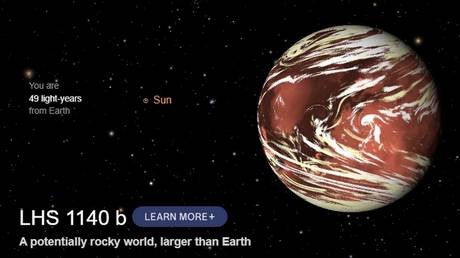
Харвардын их сургуулийн эрдэмтдийн удирдсан баг дэлхийтэй төстэй, амьдрал орших боломжтой бүсэд байрлах LHS 1140b гаригийн агаар мандлыг анх удаа илрүүлснээ зарлав.
Харвардын их сургуулийн эрдэмтдийн баг 49 гэрлийн жилийн зайд орших, улаан одой одны тойрог замд эргэлддэг LHS 1140b гаригийн агаар мандлыг илрүүлснээ Science сэтгүүлд нийтэлжээ. Энэхүү гариг нь шингэн төлөвтэй ус орших боломжтой бүсэд байрладаг бөгөөд судалгааны баг Чили улс дахь Magellan Clay дуран авайг ашиглан гаригийн дээд давхаргын агаар мандлаас гели хий алдагдаж буйг тогтоосон байна.
Судалгааны ахлах зохиогч, Чикагогийн их сургуулийн гариг судлаач Коллин Черубим энэхүү нээлт нь өөр одны тойрог замд эргэлдэх, амьдрах боломжтой бүсэд орших хатуу гадаргуутай гаригийн агаар мандлыг илрүүлсэн анхны тохиолдол болохыг онцлов. Тэрээр LHS 1140b гариг нь дэлхийтэй бүтэц, температурын хувьд төстэй боловч таталцлын хүч нь илүү өндөр, усны нөөц ихтэй байж болзошгүй гэж үзэж байна.
2017 онд анх нээгдсэн энэхүү гариг нь дэлхийгээс 5.6 дахин их масстай бөгөөд гадаргуу дээрх таталцлын хүч нь дэлхийгээс хоёр дахин их юм. Уг гариг нь өөрийн одтойгоо үргэлж нэг талыг харуулан эргэдэг бөгөөд агаар мандлын найрлагад гелигээс гадна азот, усны уур, нүүрстөрөгчийн давхар исэл байж болзошгүй гэсэн таамаглал дэвшүүлжээ.
Хэдийгээр LHS 1140b нь амьдрал оршихуйц бүх гол найрлагатай байж болох ч одоогоор гариг дээр амьдрал байгааг нотлох баримт байхгүй байна. Гэсэн хэдий ч тус гариг нь нарны аймгаас гаднах астробиологи болон гаригийн амьдрах чадварыг судлах хамгийн тохиромжтой “лаборатори” болж байгааг эрдэмтэд тэмдэглэв.
Дэлгэрэнгүйг эх сурвалжаас харах
↓Эх сурвалжийг нээх ↓
Rocky planet LHS 1140b, just 49 light-years away, shows signs of an atmosphere and could have water reserves, a Harvard-led team says
Astronomers have detected an atmosphere on a rocky planet within a potentially habitable zone outside the Solar System for the first time, according to a new report by a Harvard-led team of scientists.
The findings stemmed from analyzing data on the super-Earth LHS 1140b, which circles a red dwarf 49 light-years from Earth in a temperature zone that theoretically allows liquid water to exist. The discovery, published in the journal Science on Thursday, was based on traces of helium escaping the planet.
“An atmosphere is essential for a planet to support life as we know it,” Collin Cherubim, the study’s lead author and a planetary scientist who works at the University of Chicago, said. “This is the first time anyone has found an atmosphere on a rocky planet in the habitable zone of another star.”
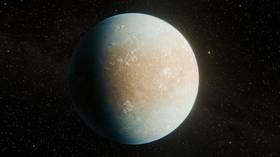
The team first spotted the signal in 2024, watching LHS 1140b with the WINERED spectrograph on the Magellan Clay Telescope in Chile. The instrument caught helium thinning at high altitude, a sign the gas is steadily leaking from the planet’s upper atmosphere.
Cherubim tempered the excitement, saying that “at this point, we have absolutely no evidence for life on the planet,” adding that “we think all of the really important, essential ingredients are there.”

The scientist still called the discovery “really exciting,” stating that “it really puts LHS 1140b at the forefront as the best, most promising, exciting laboratory for studying astrobiology and habitability outside of our solar system.” He noted LHS 1140b resembles Earth in bulk composition and temperature but differs sharply elsewhere, including its tidal lock and likely deeper water reserves.

First discovered in 2017, LHS 1140b is a heavy world, about 5.6 times Earth’s mass and working out to nearly twice Earth’s surface gravity – not deadly enough to kill a human outright, but enough to cause serious joint damage, rapid muscle fatigue, and dangerous cardiovascular strain over time.
One side of the planet is always facing its star, which itself is a red dwarf burning at roughly half the Sun’s surface temperature. Compared to the Sun, red dwarfs are more volatile and tend to blast off flares that typically strip small, close-orbiting worlds bare. The red dwarf near LHS 1140b, however, is unusually calm – which may explain why the planet kept an atmosphere at all.
Apart from helium, the exact make-up of the atmosphere is unclear, but earlier studies suggested the presence of nitrogen, possibly mixed with water vapor and carbon dioxide. Helium isotopes are in high demand but notoriously difficult to obtain on Earth. Helium-4 can be used as a supercoolant in complicated machines while its rarer cousin, helium-3, is prized as a potential fuel for future fusion reactors – one reason companies are eyeing it on the Moon.
In addition, recent studies have shown that some living microorganisms – such as yeast and E. coli bacteria – can survive in an atmosphere of pure helium and hydrogen.
While essentially next door by space standards, LHS 1140b is well beyond the reach of any spacecraft humans have built. NASA’s Voyager 1 – the fastest human-made interstellar object, which reached the speed of 17 km/s by slingshotting past Jupiter’s and Saturn’s gravity and now traveling beyond the Solar System – would need roughly 860,000 years to cross the distance to the planet.

