Улаанбурхан өвчний тохиолдол сүүлийн 30 гаруй жилийн хугацаанд байгаагүй өндөр түвшинд хүрсэн нь тус улс өвчнийг устгасан статусаа алдахад хүргэж болзошгүйг мэргэжилтнүүд анхаарууллаа.
АНУ 2000 онд улаанбурхан өвчнийг устгасан гэж зарлаж, 2011 онд энэ статусаа баталгаажуулсан боловч түүнээс хойш дахин хяналт хийгээгүй байна. Pan American Health Organization байгууллага энэ оны 11 дүгээр сард тус улсын улаанбурхан өвчнийг устгасан статусыг дахин хянан үзэхээр төлөвлөжээ. Johns Hopkins University Bloomberg School of Public Health-ийн мэдээлснээр, энэ онд бүртгэгдсэн 2,295 тохиолдлын дийлэнх нь дотоодод халдварласан байна. Boston Children’s Hospital болон Harvard Medical School-ийн судлаачдын The Lancet сэтгүүлд нийтэлсэн өгүүлэлд АНУ 2026 онд улаанбурхан өвчнийг устгасан статусаа алдах магадлал өндөр байгааг тэмдэглэжээ.
Сүүлийн таван жилийн хугацаанд сургуулийн насны хүүхдүүдийн дунд улаанбурхан, гахайн хавдар, улаануудын (MMR) эсрэг вакцинжуулалтын хамрагдалт буурсан нь гол шалтгаан болж байна. Johns Hopkins University-ийн мэдээллийн шинжээч Лорен Гарднер вакцин хийлгээгүй хүмүүс вакцин хийлгэсэн хүмүүсээс хамаагүй өндөр түвшинд халдвар авч байгааг онцолжээ. Тэрээр вакцинжуулалтын түвшин 95 хувиас доош буусан олон зуун муж, орон нутгийн иргэдийн дунд халдвар дэгдэх эрсдэл өндөр байгааг анхааруулсан байна.
Unbiased Science-ийн үүсгэн байгуулагч Жессика Стейер вакцинжуулалтын хамрагдалт буурч байгаа нь гол хүчин зүйл болохыг дурдаад, үүн дээр нэмэгдээд вакцин хийлгэхээс татгалзах явдал, олон нийтийн дунд тархсан ташаа мэдээлэл болон нийгмийн эрүүл мэндийн байгууллагуудын санхүүжилт, боловсон хүчний дутагдал зэрэг нь нөхцөл байдлыг улам хүндрүүлж байгааг тайлбарлав. Мэргэжилтнүүдийн үзэж байгаагаар, вакцинжуулалтын түвшинг нэмэгдүүлж, халдварыг хянах, хариу арга хэмжээ авах хурдыг сайжруулахад шаардлагатай санхүүжилтийг шийдвэрлэх нь нэн чухал байна.
Дэлгэрэнгүйг эх сурвалжаас харах
↓Эх сурвалжийг нээх ↓
Measles cases in the United States have reached levels not seen in over three decades, raising concerns that the country could soon lose its measles elimination status.
At the start of the century, the country had the virus well under control, even managing to reach what is known as elimination status.
“We eliminated measles in 2000 after decades of hard-won public health work… It was a huge win for public health,” public health expert Jessica Steier, founder of Unbiased Science, told ScienceAlert.
“Now we’re watching that progress erode.”
This status was recertified in 2011, but since then, it has not been reviewed.
When it comes to measles, elimination status doesn’t mean the virus is totally eradicated from a country’s borders.
“It means the virus is not spreading freely,” Steier explained. “Cases will still happen as measles is always a plane flight away, but we shut them down fast.”
Measles elimination is defined as the absence of endemic (consistently locally acquired) virus transmission within a defined geographic area, for more than 12 months, where a reliable surveillance system is in place.
Experts say that is no longer the landscape of the measles virus in the US.
As the measles tracking team at Johns Hopkins University (JHU) Bloomberg School of Public Health reports, the majority of the 2,295 cases reported so far this year have been acquired locally (within the state where the case was reported), with few coming in from outside of either the state or the country.
“A state that sits comfortably above threshold may contain counties and communities well below it, which is where the risk of measles outbreaks really lies.” – data scientist Lauren Gardner.
The Pan American Health Organization, the WHO’s regional office in the Americas, plans to review the area’s measles elimination status in November this year.
“Given the current epidemiological context, it appears highly likely that the USA will lose its measles elimination status in 2026,” a research team from Boston Children’s Hospital and Harvard Medical School wrote in a recent paper published in The Lancet.
In the past five years, there has been a national decline in measles, mumps, and rubella (MMR) vaccine coverage among school-age children.
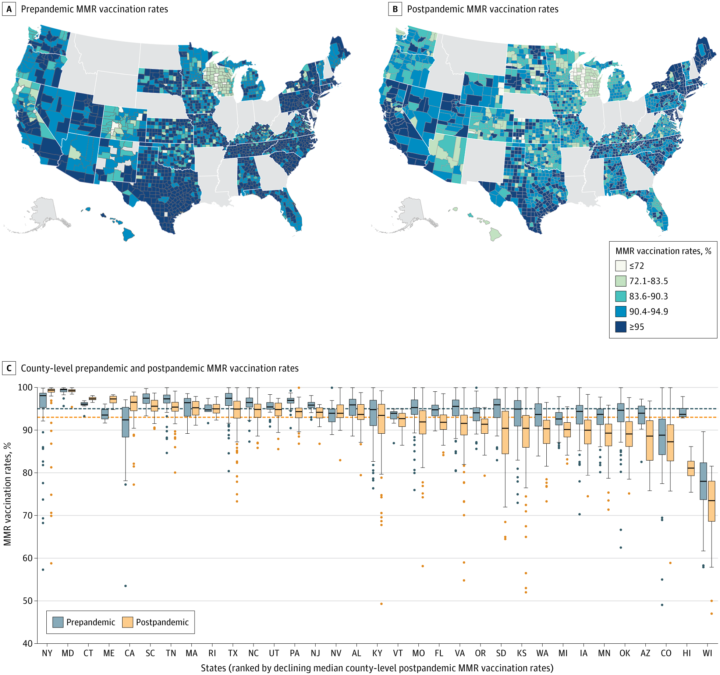
“It is clear from the data that unvaccinated individuals are contracting measles at dramatically higher rates than vaccinated individuals,” data scientist Lauren Gardner, a member of the measles tracking team at JHU, told ScienceAlert.
“More importantly than the national average, the decline is geographically clustered, with hundreds of US counties and communities well below the herd immunity threshold of 95 percent coverage,” explained Gardener, who created the JHU COVID-19 dashboard that became a trusted source for reliable, real-time data about the pandemic.
“[Elimination status] requires getting MMR coverage above 95 percent at the community level, not the state or national level. Averages can be misleading here – a state that sits comfortably above threshold may contain counties and communities well below it, which is where the risk of measles outbreaks really lies.”
If the US is to boost vaccination rates and recertify its measles elimination status, experts agree that hesitancy around the MMR vaccine must be reckoned with – especially as more states expand exemptions and adjust policies around school vaccination requirements.

“Declining MMR coverage is the main driver,” Steier said.
“That’s compounded by more states expanding exemptions, and public health agencies losing the staff and funding needed to track and respond to outbreaks quickly. On top of that, misinformation is circulating in communities and on social media, pushing people away from the one tool that actually prevents this.”
She expects that restoring the United States’ vaccine coverage and measles elimination may take years.
Gardner said funding for public health resources, to increase speed in detection and response, is also a crucial component in tackling the current outbreak, and guaranteeing a future of measles elimination.
Related: US Measles Cases Just Hit a “Grim Milestone”. Here’s What You Need to Know
“Public health (and relevant funding) is reactive rather than proactive, but maintaining elimination status requires sustaining high coverage through the quiet years.”
This article was fact-checked by Clare Watson and edited by Rebecca Dyer. While we pride ourselves on our process, we are only human. If you spot a mistake, please let us know.