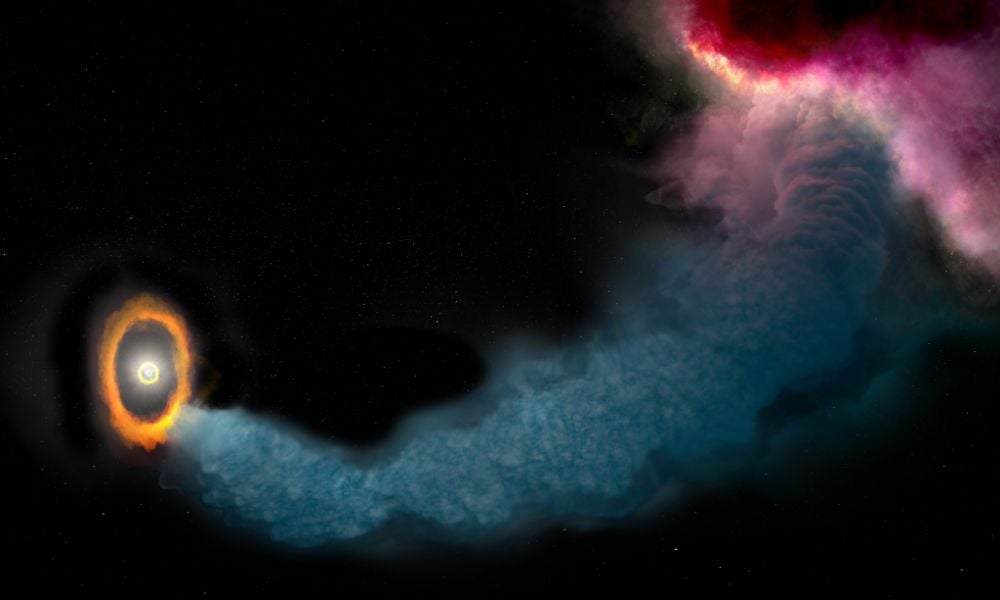
Одон орон судлаачид 1,500 гэрлийн жилийн зайд орших гурвал одны системийн эргэн тойрон дахь тоосны цагиргуудын хазайлт нь аварга том хийн урсгалаас үүдэлтэй болохыг илрүүллээ.
Флоридагийн их сургуулийн судлаач Мария Галлоуэй-Сприетсма тэргүүтэй баг ALMA телескопыг ашиглан GW Orionis системийн хийн урсгалыг нарийвчлан судалжээ. Нэг их наяд миль урттай энэхүү хийн урсгал нь системийн гаднах тоосны цагирагтай бараг ижил өнцгөөр нэгдэж байгаа нь дискийн бүтэц хазайх гол шалтгаан болж байна. Энэхүү судалгааны үр дүн нь одны системийн бүрэлдэхүүн хэсгүүд тусгаарлагдсан байдлаар бус, хүрээлэн буй орчны хийн урсгалтай динамик холбоотой болохыг харуулж байна.
Өмнө нь ашиглаж байсан ESO-ийн VLT болон SPHERE багажууд нь цагиргуудын хазайлтыг илрүүлсэн бол ALMA-гийн өндөр нарийвчлалтай өгөгдөл нь хийн урсгалын бүрэн бүтцийг тодорхойлох боломжийг олгосон юм. Судалгааны багийн дүгнэлтээр, уг хийн урсгалын өнцөг нь дотоод цагирагтай 32 хэмийн, харин гаднах цагирагтай 3 хэмийн зөрүүтэй байгаа нь урсгал гаднах цагирагт шууд нөлөөлж буйг баталж байна.
Энэхүү нээлт нь од эрхэс болон гариг систем үүсэх явцад хийн урсгал хэрхэн чухал үүрэг гүйцэтгэдэг болохыг тайлбарлаж байна. Судлаачдын үзэж байгаагаар, хэрэв ийм хийн урсгал түгээмэл тохиолддог бол энэ нь гаригуудын тойрог зам яагаад эмх цэгцгүй, хазайлттай байдгийг тайлбарлах шинжлэх ухааны үндэслэл болох юм. Одоогоор тус системд хийн урсгал удааширч байгаа нь үүсэл хөгжлийн сүүлийн шатандаа явааг илтгэж байгаа бөгөөд цаашид бусад одны системд ижил төстэй урсгалыг илрүүлэх судалгаа хийх шаардлагатай байна.
Дэлгэрэнгүйг эх сурвалжаас харах
Эх сурвалжийг нээх ↓
In the simplest version of events, stars form when clouds of cold molecular hydrogen collapse into protostars. Over time, those protostars accrete more gas from the surrounding cloud. Eventually, the protostars become so massive that fusion is triggered and main sequence stars are born.
But the better astrophysicists get at observing star formation, and the more powerful their telescopes become, the more details they uncover about the star formation process. This is true of new research into the young triple star system named GW Orionis. The system is about 1,500 light years away in Orion, and is surrounded by a multi-ringed, circumtrinary protoplanetary disk.
New research in The Astronomical Journal shows that a stream of gas a trillion miles long is feeding into GW Orionis, and may be responsible for tilting its disk. The research is titled “A Streamer Driving Misalignment in the Circumtriple Disk of GW Ori.” The lead author is Maria Galloway-Sprietsma, a PhD candidate at the University of Florida.
In our Solar System, the planets orbit on a relatively flat plane aligned with the Sun’s rotation. There’s some variation in the tilt of the planets’ orbits, but not much. But when we look at other solar systems, we find more tilted orbital planes. GW Orionis is one of these.
“Previous studies of GW Orionis revealed that the system’s inner, middle and outer rings are misaligned, with each ring tilted at a different angle,” lead author Galloway-Sprietsma said in a press release. “When our team modeled the infall of this streamer, we found that the angle at which it impacts the disk is closely aligned with the outer ring.”
The image on the right is from the SPHERE instrument on ESO’s Very Large Telescope and shows the ring around GW Orionis. The image on the left is an illustration of the same, based on the 3D reconstruction of the triple star system from the ESO image. The misalignment is obvious. Image Credit: ESO/L. Calçada, Exeter/Kraus et al.
“GW Ori is a triple stellar system with a disk featuring three misaligned dust rings,” the authors write. “We present Atacama Large Millimeter/submillimeter Array molecular line data of CO isotopologues, revealing a streamer feeding the disk in 12CO and 13CO.” Both forms of carbon monoxide combined give a good understanding of the gas flow. 12CO maps the full extent and velocity structure of the gas stream, while 13CO maps the densest parts of the gas stream. Using carbon monoxide isotopes like this is common when measuring gas flows. 12CO basically measures how far or how fast the gas is moving, while 13CO basically measures how much gas is actually there.
“Our best-fit trajectory shows that the streamer meets the disk at the outermost dust ring and that the streamer’s angular momentum vector is closely aligned with this outermost ring within ≈3∘, in contrast to the ≈32∘ misalignment with the innermost ring, suggesting the streamer is the likely cause of the misalignment,” the researchers explain.
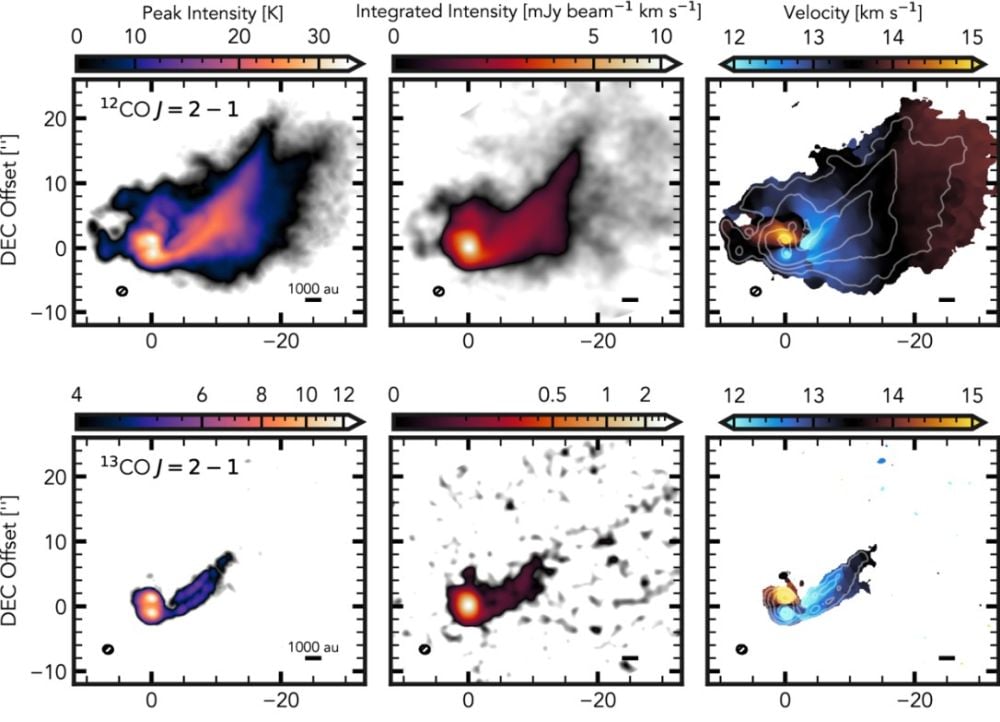 These panels show the gas in the GW Orionis stream. The top row shows 12CO and the bottom row shows 13CO. The left column shows peak intensity maps, the middle column shows integrated intensity maps, and the right column shows line-of-sight velocity maps. The 12CO maps show the length and extent of the gas streamer. The small line in the bottom right of each panel represents 1,000 astronomical units. Image Credit: Galloway-Sprietsma et al. 2026. AnJ. DOI 10.3847/1538-3881/ae8bae
While other telescopes like the ESO’s VLT and its SPHERE instrument could image the misalignment of GW Orionis’ rings, it took the power of ALMA to piece it all together.
These ALMA observations show that the version of star formation normally employed lacks important details. Nothing happens in isolation, and star formation involves turbulent, uneven streams of gas flowing into the star formation site. These streamers can tilt the orbits of planets, and potentially even alter the rotation of stars.
“None of this would have been possible without ALMA. ALMA has the highest resolution offered for these wavelengths. Archival data allowed astronomers to see these high-resolution dust rings to model their relative misalignments, and now our observations use all three ALMA arrays – the 12-meter, 7-meter, and Total Power – to zoom out and see the full extent of the streamer, so really the observations with ALMA have been building, year after year,” Galloway-Sprietsma said.
“Together, these results suggest that GW Ori remains dynamically linked to its parental cloud through ongoing accretion, with the streamer serving as the likely driver of its misaligned disk structure,” the authors write. It appears that the link may be broken soon, as the infall rate seems to be slowing. “The total angular momentum of the streamer is smaller than that of GW Ori’s disk; this, together with the low accretion rate, indicates that we are probably witnessing the end stages of infall,” the authors explain.
If planets form in these rings, then the planets in each ring will be misaligned with each other, all because of the stream of gas. If the streamer feeding into GW Orionis is responsibe for misaligning rings, then it’s natural to question if this is the case in other tilted systems.
“If these streamers are common, then we can naturally explain why planets may not necessarily end up in very orderly systems” said Jaehan Bae, an astronomy professor from the University of Florida who helped lead the new research. “They can have much more random orientations.”
In fact, these streamers could be responsible for more puzzling observations of different star systems. Astronomers have found curious chemical and metallicity anomalies in some systems, and gas streams like this could be responsible. There are also some very pronounced orbital tilts in need of explanations.
The next steps are to use ALMA to detect other, similar streams in other young star systems. Using ALMA to find the shock tracers in GW Orionis will also help clarify the overall picture. “Future work on shock tracers in GW Ori could help pinpoint where the streamer impacts the disk, and population-level studies of streamers will help determine if these structures are commonplace,” the authors write in their paper’s conclusion.
“What we need next is a systematic survey of young stars to see how many have streamers and how many don’t,” Galloway-Sprietsma said. “That will tell us how important they are in shaping planetary systems.”

