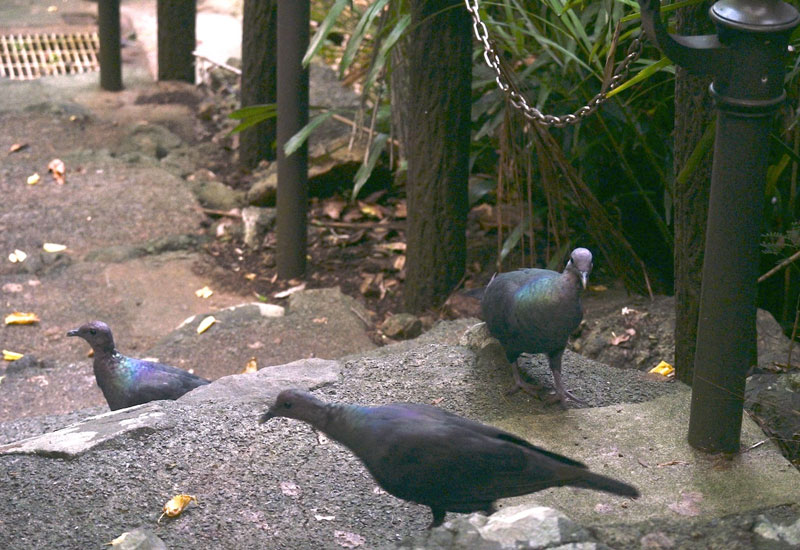
Биологичид Огасавара арлын улаан толгойт тагтааг устах аюулаас аврахын тулд зэрлэг муурыг устгаж, популяцийг нь эрс нэмэгдүүлсэн судалгааг танилцууллаа.
Японы Огасавара арлуудад нутагладаг, нэн ховор улаан толгойт тагтааны (Columba janthina nitens) тоо толгой 2008 онд 80 хүрэхгүй болж буурчээ. Чичижима арал дээрх зэрлэгшсэн муурнууд энэхүү ховор шувууны гол дайсан болж байсан тул 2010 оноос эхлэн тэдгээр муурыг барих эрчимтэй ажиллагааг зохион байгуулсан байна. Гурван жилийн хугацаанд 131 муурыг барьж, популяцийг нь 20-оос доош буулгаснаар насанд хүрсэн тагтааны тоо 111-ээс 966, харин залуу тагтааных 9-өөс 189 болж эрс нэмэгджээ.
Communications Biology сэтгүүлд 2025 оны долдугаар сарын 15-нд нийтлэгдсэн судалгаагаар, эдгээр тагтааны геномын 80 гаруй хувь нь ижил төстэй буюу гомозигот шинжтэй байгаа нь удаан хугацааны туршид ойрын төрлийн цус ойртолт явагдсаныг харуулж байна. Гэсэн хэдий ч судлаачид уг шувуудад хор хөнөөлтэй мутаци харьцангуй бага байгааг тогтоосон нь сонирхол татахуйц үр дүн болжээ. Эрдэмтэд үүнийг “генетикийн цэвэрлэгээ” хэмээн тайлбарлаж байна; өөрөөр хэлбэл, хэдэн зууны турш цөөн тоотой байсан нь хортой мутациуд байгалийн шалгарлаар аажмаар устаж үгүй болох нөхцөлийг бүрдүүлсэн байж болзошгүй юм.
Даичи Цүжимото болон түүний багийнхан 25 шувууны геномыг шинжилж, улаан толгойт тагтааны генетикийн ачаалал нь бусад тагтаатай харьцуулахад доогуур байгааг илрүүлжээ. Олон жилийн турш цөөн тоотой оршин тогтносон нь мутацид өртөмтгий генийг ил болгож, улмаар тэдгээрийг популяциас хасах үйл явцыг хурдасгасан байх талтай. Энэхүү үзэгдэл нь арлын үнэг, хойд зүгийн заан халим зэрэг бусад ховор амьтдад ч ажиглагддаг болохыг судалгаанд дурдсан байна.
Гэсэн хэдий ч генетикийн олон янз байдал бага байгаа нь хүрээлэн буй орчны өөрчлөлтөд дасан зохицох чадварыг хязгаарлаж болзошгүй юм. Судлаачид олзворлосон тагтааны тоог цаашид нэмэгдүүлж, генетикийн тогтмол хяналт тавих нь тус зүйлийг бүрмөсөн устахаас хамгаалахад чухал ач холбогдолтой гэж үзэж байна. Одоогоор олзворлон өсгөж буй шувуудын дундаж наслалт болон цус ойртолтын хооронд шууд хамаарал тогтоогдоогүй байгаа нь цаашдын судалгааны сэдэв хэвээр байна.
Дэлгэрэнгүйг эх сурвалжаас харах
↓Эх сурвалжийг нээх ↓
By 2008, fewer than 80 red-headed wood pigeons remained in Japan’s Ogasawara Islands. On Chichijima Island, introduced feral cats were among the pressures on a bird found nowhere else, and conservation teams began intensive trapping in 2010.
Over the next three years, teams trapped 131 feral cats, cutting the island’s cat population to fewer than 20. At the same time, observations of adult pigeons rose from 111 to 966, while juvenile observations climbed from 9 to 189.
The rebound left researchers with a genetic puzzle. A study published in Communications Biology on July 15, 2025, found that more than 80% of the pigeon’s genome was homozygous, a sign of extreme inbreeding. Yet the endangered birds carried fewer highly deleterious mutations than the more widespread Japanese wood pigeon. The authors propose that centuries at a relatively small population size may have removed part of the species’ harmful genetic load before its recent collapse.
Feral cat control coincides with a sharp pigeon recovery
The red-headed wood pigeon (Columba janthina nitens) is endemic to the Ogasawara Islands, roughly 1,000 kilometers south of Japan’s main archipelago. The islands were inscribed on the UNESCO World Heritage List in 2011. The property includes more than 30 islands covering 7,939 hectares and has unusually high levels of endemism.
The Communications Biology study attributes the pigeon’s decline to human impacts including forest destruction and predation by introduced feral cats. Intensive trapping on Chichijima did not eliminate the cats, but their numbers fell below 20 between 2010 and 2013 as pigeon observations rose.
Humans have inhabited the Ogasawara Islands since 1830, according to the researchers. Their reconstruction of the pigeon’s demographic history indicates that its effective population size was already relatively small before settlement, followed by a much more severe bottleneck during intensified human activity.
Depending on the assumed recombination rate, the genomic analysis estimated that the effective population fell from thousands of individuals to a minimum of either 88 in 1957 or 56 in 1985. Estimates rose to between 117 and 498 by 2007. Researchers cautioned that estimates close to the sampling period are less reliable and may not directly track the number of living birds.
More than 80% of the genome is homozygous
To examine how the population could rebound from such low numbers, Daichi Tsujimoto and colleagues analyzed genomic, pedigree and fitness data. They successfully sequenced and genotyped 25 genomes: eight wild red-headed wood pigeons, eight captive birds from the same subspecies and nine wild Japanese wood pigeons.
Much of the endangered pigeons’ DNA consisted of runs of homozygosity, stretches in which the two inherited copies are effectively identical. The mean inbreeding coefficient calculated from those regions was 0.84 in wild red-headed wood pigeons and 0.88 in captive birds. In Japanese wood pigeons, it was 0.02.
Shorter homozygous regions can preserve signals of much older shared ancestry. The abundance of regions longer than 0.1 megabases pointed to a small effective population extending back roughly 895 years, the researchers estimated. More than 80% of the wild red-headed wood pigeons’ genomes fell within homozygous regions.

The comparison then revealed a different pattern in harmful mutations. Researchers detected 13 nonsense single-nucleotide polymorphisms in the wild and captive red-headed wood pigeons, compared with 96 in Japanese wood pigeons. Nonsense mutations can disrupt protein coding, and the team used their abundance as a proxy for relative genetic load.
Both wild and captive red-headed wood pigeons had a significantly lower ratio of nonsense to silent mutations than Japanese wood pigeons. Researchers interpret that pattern as evidence that deleterious mutations were more effectively removed during the island population’s long history at relatively low numbers.
Slow inbreeding may have exposed harmful mutations to selection
The process proposed by the authors is known as genetic purging. A recessive harmful variant can remain hidden when a bird carries only one copy. As related individuals reproduce and homozygosity increases, those variants are more likely to appear in two copies and become exposed to natural selection. Over generations, selection and genetic drift can reduce or alter the population’s burden of such mutations.
Tsujimoto and colleagues argue that the pigeon’s long period at a relatively small population size may have allowed purging to occur gradually. They distinguish that history from rapid inbreeding after a sudden population crash, when harmful genetic effects can emerge before purging acts effectively.
Not every harmful variant disappeared. Eight of the 13 nonsense variants detected in red-headed wood pigeons were nearly fixed in both wild and captive populations. The authors say fixed deleterious mutations no longer contribute to inbreeding depression in the same way, although they may still lower population fitness.
Other endangered animals have shown evidence of genetic purging, including the island fox, Seychelles paradise flycatcher, northern elephant seal and Iberian lynx. The authors identify long-term isolation and relatively small historical populations as shared features of those cases.

Research on the Seychelles paradise flycatcher, published in 2023, offers a comparison. Its population fell to 28 individuals in the 1960s before recovering to more than 250 by the 1990s. Genomic comparisons found a tenfold loss of genetic diversity, while highly deleterious mutations were partly purged and mildly deleterious mutations accumulated.
Captive pigeons show no significant longevity penalty from inbreeding
Researchers also examined 119 captive-born birds with known pedigrees and lifespans. They found no statistically significant relationship between inbreeding coefficient and longevity. The fitted relationship pointed toward longer lifespans in more inbred birds, but it was not statistically significant, and the authors said improvements in captive-rearing practices over time could explain the pattern.
That analysis did not establish that inbreeding carries no fitness cost. Researchers did not evaluate reproductive inbreeding depression because captive management could bias fertility data, and they did not assess hatching success. They also noted that inbreeding depression may be less pronounced under captive conditions than in the wild.
At Ueno Zoological Gardens in Tokyo, a captive red-headed wood pigeon population began in 2001 with three founders. Breeding among the founders and their descendants increased inbreeding. Managers began introducing wild birds in 2012 and eventually added 13. By 2022, the fifth generation had been born and 198 individuals had been kept in captivity over the program’s history.
Low genetic diversity may still limit the pigeons’ ability to adapt to environmental changes. If the population remains too small, continued genetic drift could further reduce diversity and fix deleterious variants. Researchers call for expansion of the captive population alongside continued genetic monitoring and management.
The UNESCO World Heritage Centre identifies invasive alien species as one of the principal threats to the integrity of the Ogasawara Islands. The pigeon study describes the red-headed wood pigeon as one of the archipelago’s few remaining large seed-dispersing birds after the endemic Bonin wood pigeon disappeared after 1889.
Enjoyed this article? Subscribe to our free newsletter for engaging stories, exclusive content, and the latest news.

