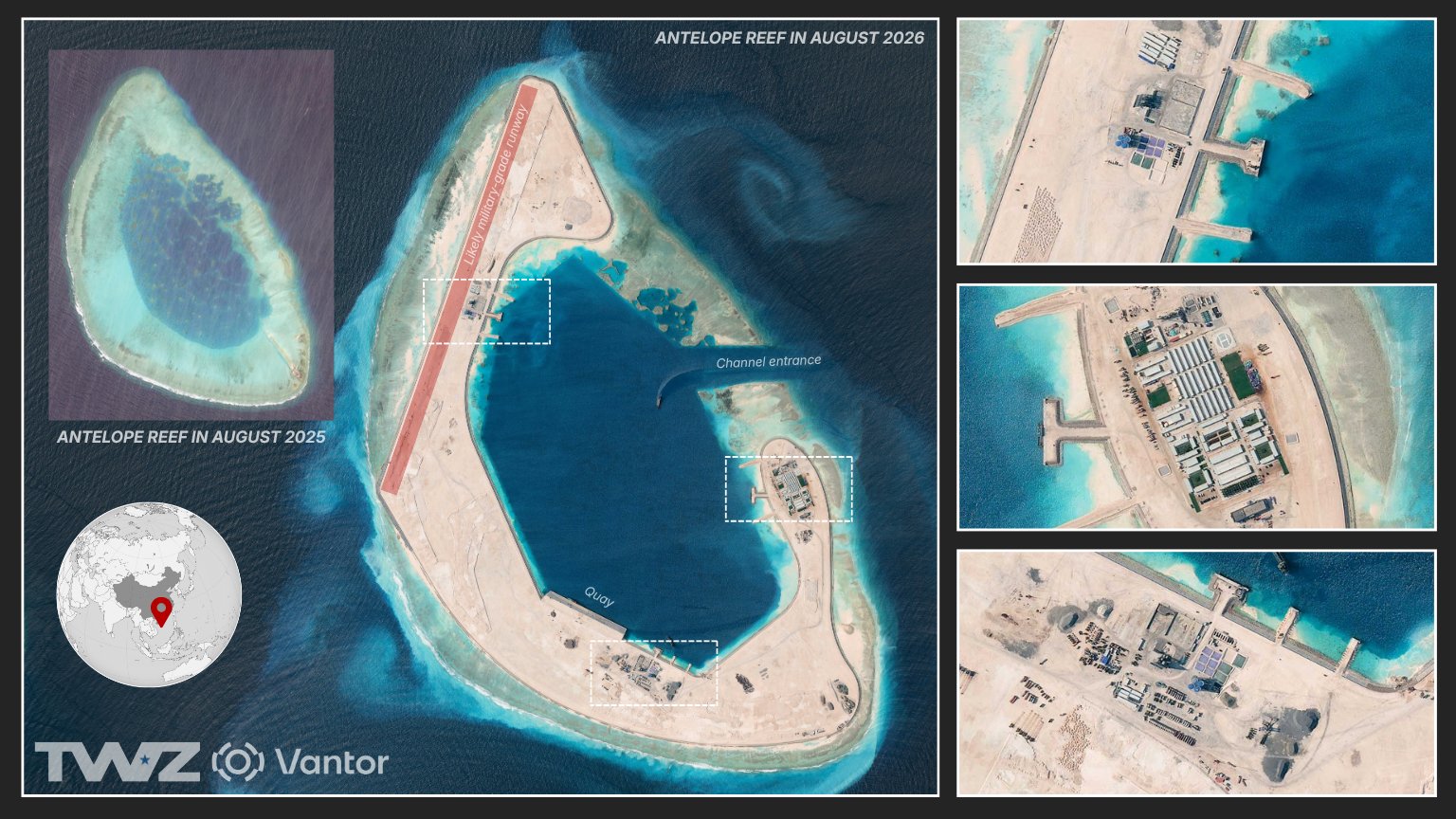
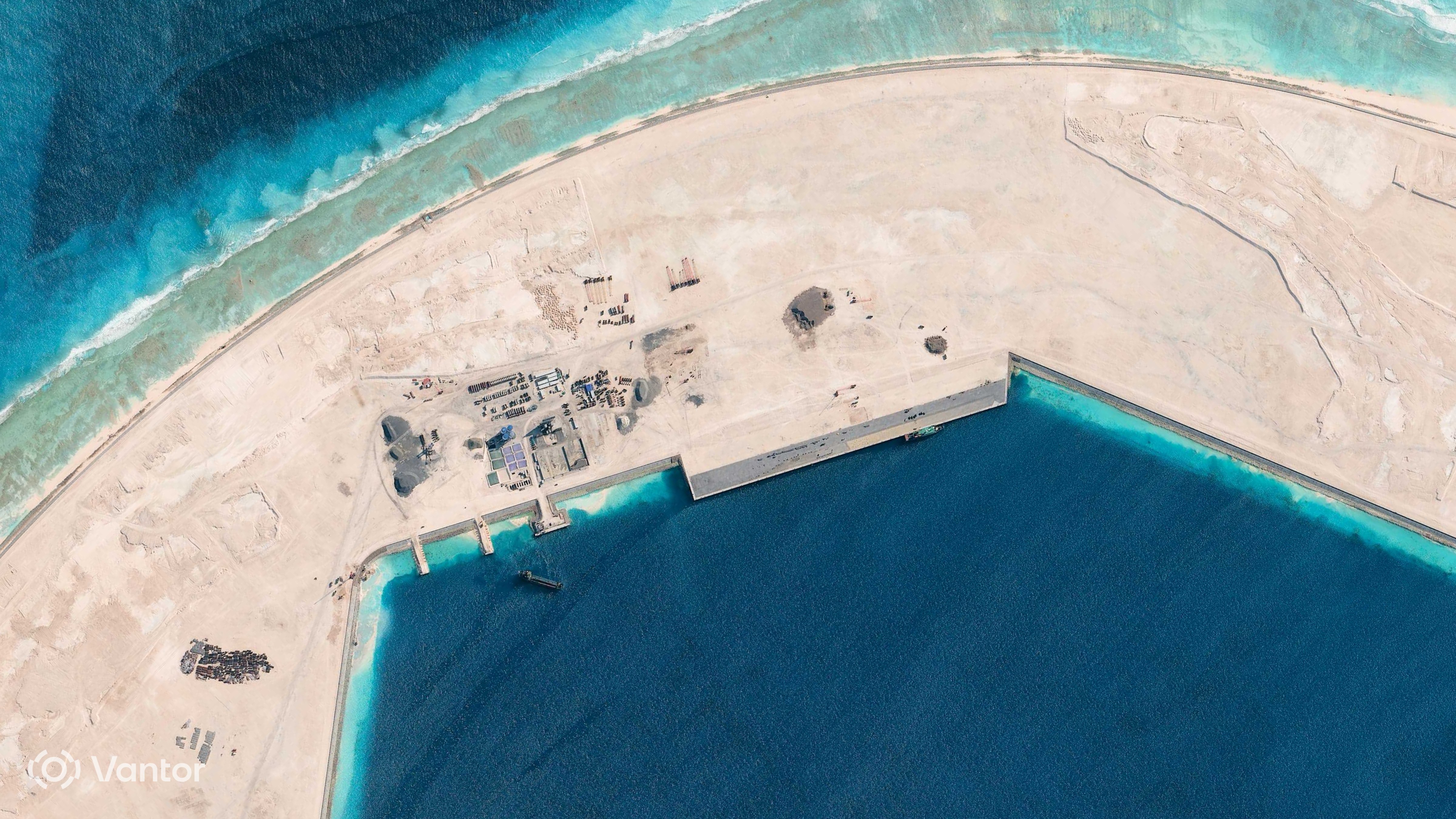
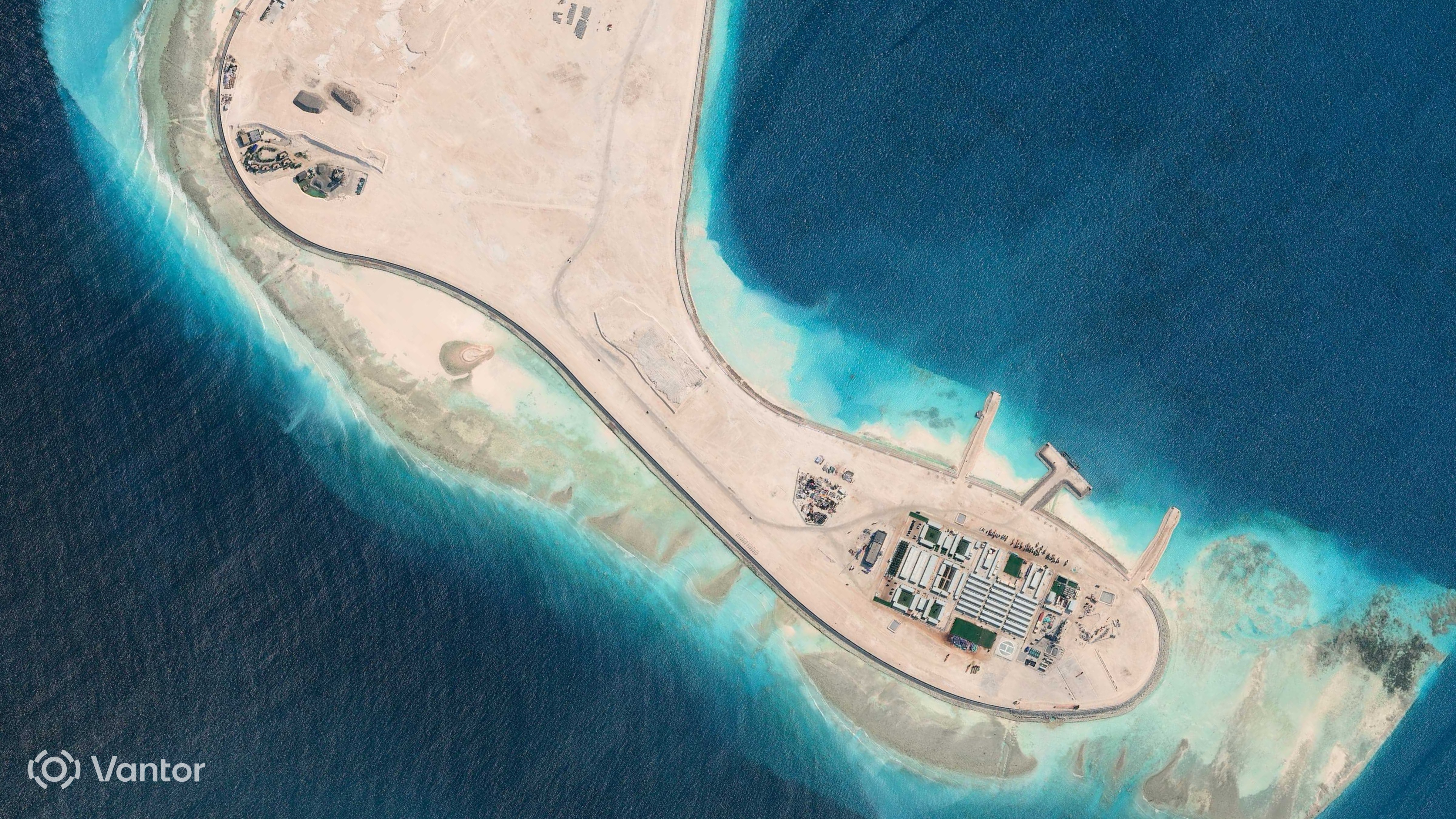
Хятадын тал Өмнөд Хятадын тэнгисийн Антэлоп хадны орчимд 10 сар үргэлжилсэн бүтээн байгуулалтын дүнд 1500 акр талбайтай хиймэл арал байгуулж, цэргийн дэд бүтцийн эхний шатыг дуусгалаа.
Сүүлийн үеийн хиймэл дагуулын зургаар тус арал дээр гүний усны боомт, байлдааны хөлөг онгоц зогсох 2000 гаруй фут урттай зогсоол, 10 мянган фут урттай цэргийн зориулалттай нисэх зурвасын бүтээн байгуулалт эхэлснийг тогтоожээ. Мөн агаарын хөлгийн ангар байж болох 200х200 футын хэмжээтэй байгууламжийн суурийг ухсан байна. Хятадын тал үүнийг арилжааны зориулалттай гэж мэдэгдсэн ч шинжээчид энэ нь бүс нутаг дахь цэргийн хүчийг нэмэгдүүлэх, тагнуул болон хяналтын чадавхыг өргөжүүлэх стратеги гэж үзэж байна.
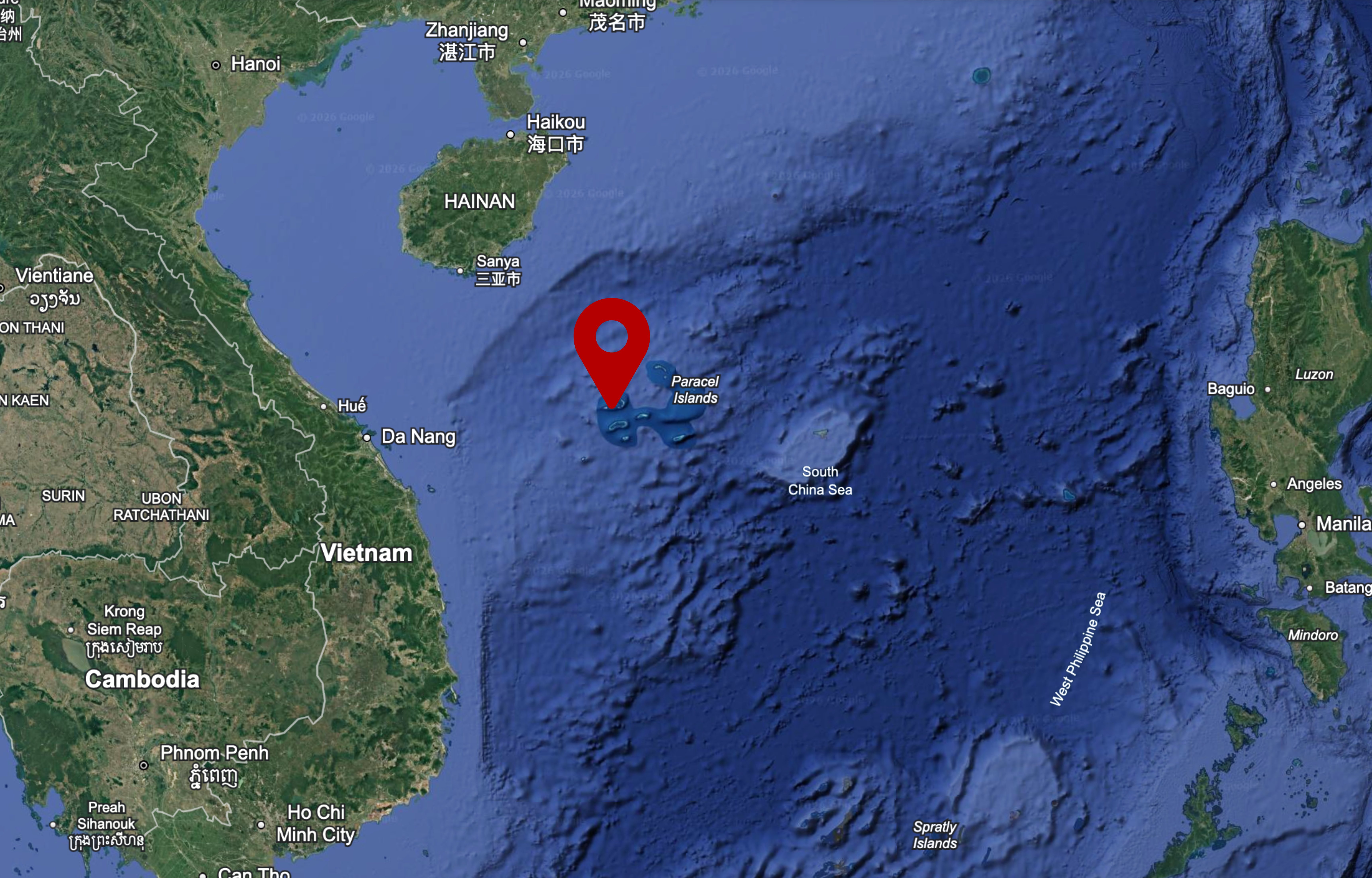
Антэлоп хад нь Хайнань арлаас 160 далайн миль зайд, стратегийн чухал байршилд оршдог. Энэхүү бүтээн байгуулалт нь БНХАУ-ын тэнгисийн цэргийн хүчин болон эргийн хамгаалалтын нисэх хүчний үйл ажиллагааг урагшлуулах, тус бүс нутагт нэвтрэхээс сэргийлэх (A2/AD) сүлжээг бэхжүүлэх боломжийг бүрдүүлж байна. Параселийн арлуудын бүлэгт багтах энэхүү газар нутаг нь олон улсын маргаантай бүсэд тооцогддог бөгөөд Хятад улс 1974 оноос хойш хяналтаа тогтоосон юм.
Дэлгэрэнгүйг эх сурвалжаас харах
Эх сурвалжийг нээх ↓
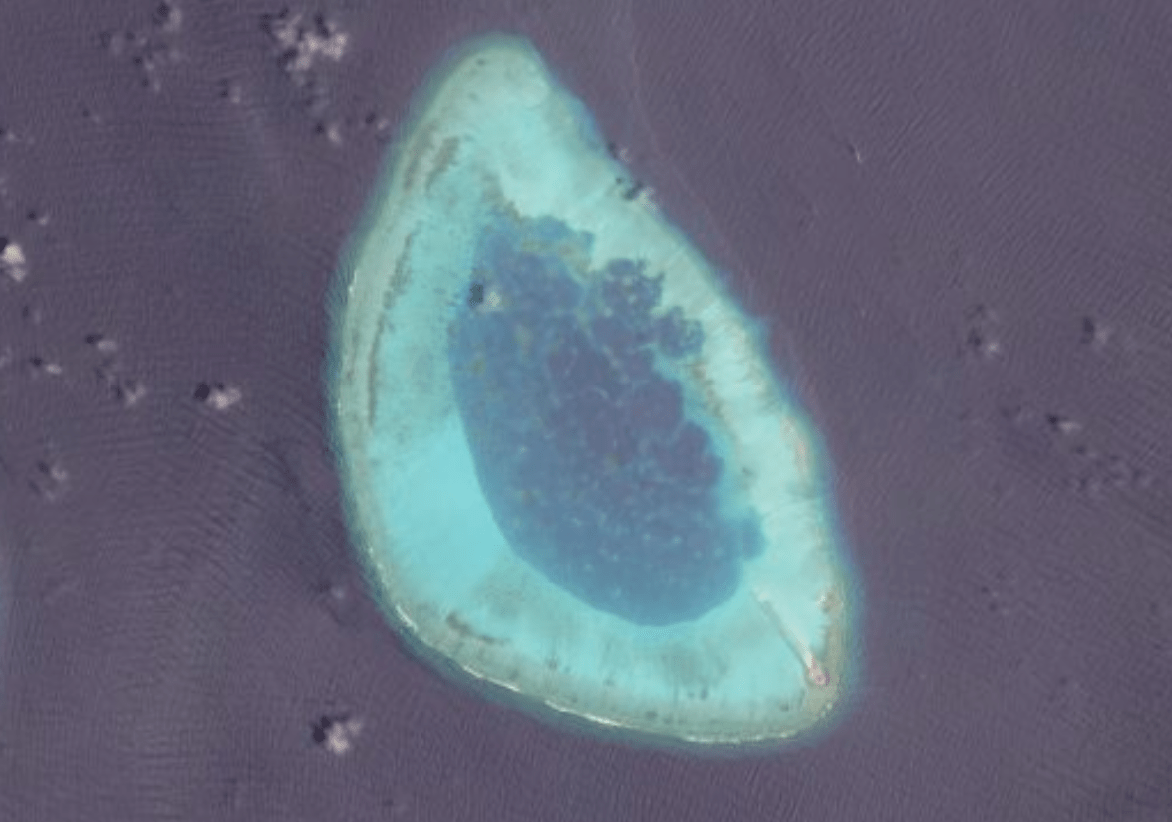
This time last year, Antelope Reef was mostly submerged underwater and barely visible unless you were steaming past at low tide. New satellite imagery, provided to TWZ by Vantor, showcases what the People’s Republic of China (PRC) can construct after 10 months of nonstop dredging: a nearly 1,500-acre artificial island with a deep-water port, 2,000-plus-foot quay capable of berthing warships, and the beginnings of a 10,000-foot-long military-grade runway. Hardly recognizable today, Antelope Reef has become the latest, and one of the largest, man-made outposts in Beijing’s aggressive campaign to militarize and dominate the South China Sea.
The “first phase” of construction is now complete, according to a report from Reuters, following the departure of a fleet of dredgers that have been on station for months. Vantor, a spatial intelligence company, shared the images, dated August 11, with TWZ that show the results of the rapid transformation in detail, which you can view in high resolution below.
Reports surfaced in early 2026 about unusual PRC activity around the reef, which is located in the northwest part of the South China Sea, approximately 160 nautical miles (nm) south of Hainan, China, and 200 nm east of Da Nang, Vietnam. The fleet of PRC cutter-suction dredgers appeared late last year, assembling at the Zhujiang River Estuary and transited with transponders dark on their Automatic Identification System (AIS) to avoid unwanted attention. Once on the scene, they began working around-the-clock to move sand from the seabed to create ground above.
The pace of construction and rate of change has been staggering, and shows how much progress the PRC has made in its reclamation and land-building capabilities. In less than a year, the PRC dredged more than a million tons of sand to reclaim approximately 1,500 acres of land. The teardrop-shaped island is now 3.7 miles long, surrounded by seawalls and internal roads, with ongoing construction underway at three primary locations around the lagoon – which you can see marked on the graphic above. For comparison, construction of the artificial islands in the Spratly Islands, almost a decade ago, took several years.
Antelope Reef, or Lingyang Jiao to the Chinese, Đá Hải Sâm to the Vietnamese, is part of the Crescent archipelago in the Paracel Island chain. China has occupied the Paracels since 1974, but the territory is still disputed by Vietnam and Taiwan.
In the latest satellite imagery from Vantor, several notable features are discernible and were first identified by the Asia Maritime Transparency Initiative. On the northwest side, preparations are being made for what will likely eventually be a 10,000-foot long, 180-foot wide runway, similar to those built at Fiery Cross, Subi Reef, Mischief Reef, and Woody Island. The northwest edge of the island is the only area long enough to accommodate a runway capable of landing large military and commercial aircraft, and grading appears to be about halfway complete – but no concrete has been poured yet. AMTI also identified excavation for a 200-by-200 foot structure nearby, which mirrors the footprint of the large aircraft hangars at China’s other island-airfields.
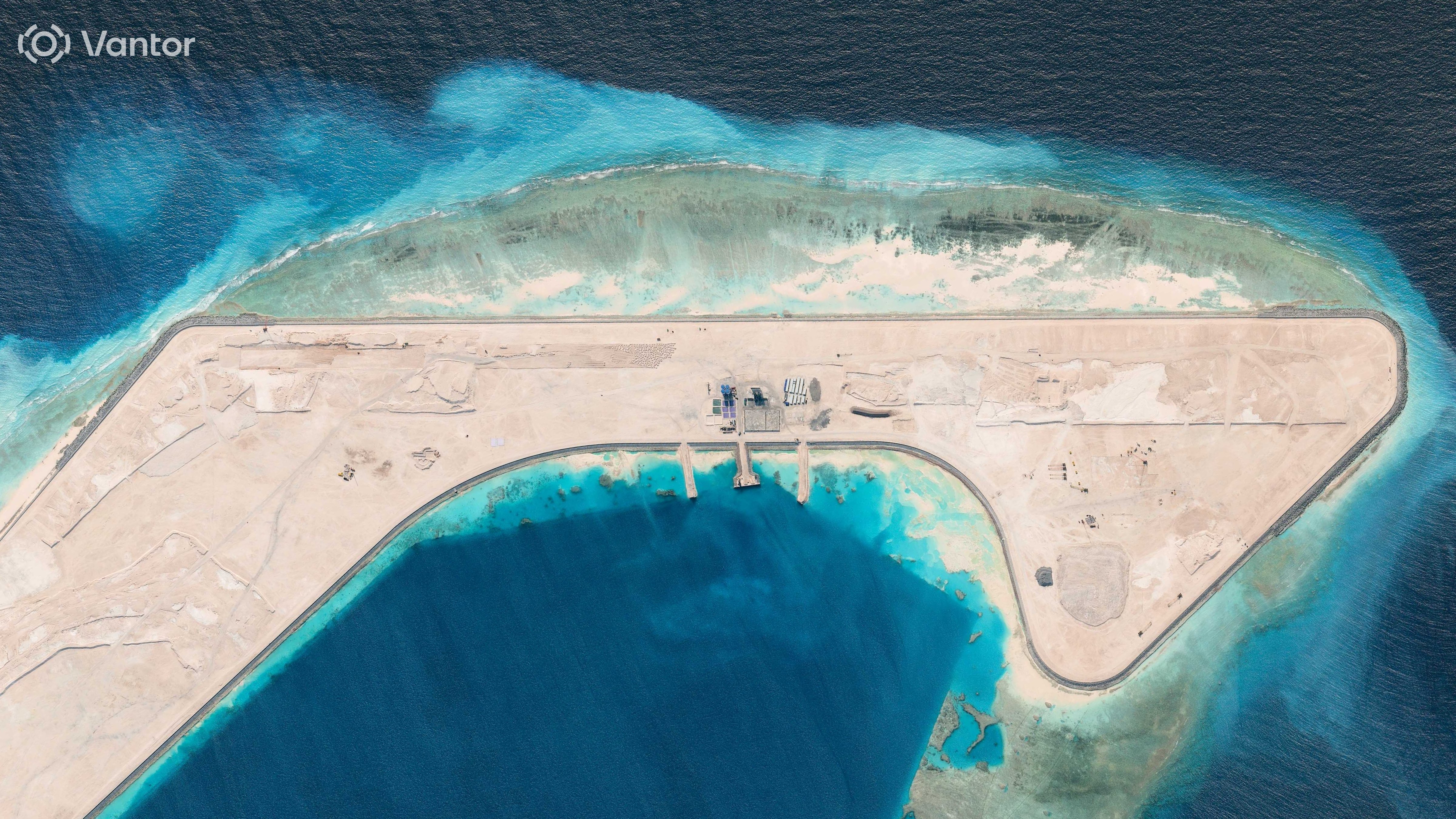
On the southern part of the island, a 680-meter – roughly 2,200 feet – quay where both military and civilian ships can dock inside the lagoon is clearly visible. Reuters noted that a China Coast Guard (CCG) vessel was spotted dockside at the quay recently. The east side of the island, just below the channel entrance, hosts the only part of the base in active use, with green space areas, a helicopter pad, and parking lots, as well as buildings for administrative spaces and housing. Temporary piers are visible at each of the major points. Two concrete plants, located along the northwestern and southern edges of the lagoon, are supporting construction efforts. TWZ has not independently confirmed AMTI’s assessments.
According to PRC state media, Antelope will be used for commercial and civilian purposes – a similar tale told during construction of the other military outposts while they were being developed. It’s worth noting that in 2015, Chinese President Xi Jinping stood in the Rose Garden next to then-President Barack Obama and said, “China does not intend to pursue militarization” in the South China Sea. “Relevant construction activity that China is undertaking in the Nansha Islands does not target or impact any country and there is no intention to militarize,” he claimed, using the Chinese name for the disputed Spratly islands. Since Xi’s head fake, which epitomizes the notorious PRC “say-do” gap, Beijing has built up multiple artificial islands as military outposts, and has used them to press its territorial claims and confront its neighbors across the nine-dash line, in strict defiance of the U.N. Conventions on the Law of the Sea (UNCLOS).
Antelope Reef is located in a key strategic location south of Sanya Port and Yulin Naval Base on Hainan Island, home to two of the three People’s Liberation Army Navy’s (PLAN) aircraft carriers, CNS Shandong and CNS Fujian, as well as a significant submarine force at Longpo Naval Base. A military base there could extend PLA radar and electronic surveillance coverage, adds another dispersed airfield to the PLA’s rolodex to launch sorties from and an additional port to dock ships at, and further extends China’s sweeping air defense umbrella.
The constellation of artificial islands would be instrumental in enforcing total control over the South China Sea, serving as key anti-access/area denial (A2/AD) nodes. They act as logistical and persistent surveillance nodes, among other uses, today and the more that China has dispersed throughout the South China Sea, the greater its options are as well as the credibility of its anti-access capabilities.
“I have no doubt that this marginally benefits China in that it’ll be able to forward deploy more Coast Guard and more militia in the Paracels persistently. It will, I’m sure, facilitate more persistent aerial patrols,” Greg Poling, the senior fellow who oversees AMTI, said on the Why Should We Care About the Indo-Pacific podcast earlier this year. “But the main benefit is probably the ISR [Intelligence, Surveillance, Reconnaissance] component; the ground-based sensing you get just building stuff.”
Beijing’s land grab in the South China Sea shows no signs of slowing down, and Antelope Reef marks the latest in a decades-long string of island seizures that it can leverage during a potential dustup in the future. But whether it will eventually run out of islands to claim remains unclear. “China doesn’t have a lot left to dig,” according to Poling, “so unless China plans to seize another Island, I don’t see it building anything, at least anything substantial.”
Contact the author:ian.ellis-jones@recurrent.io
The post China’s Massive New Artificial Island In The South China Sea Emerges, Primed For Militarization appeared first on TWZ.


