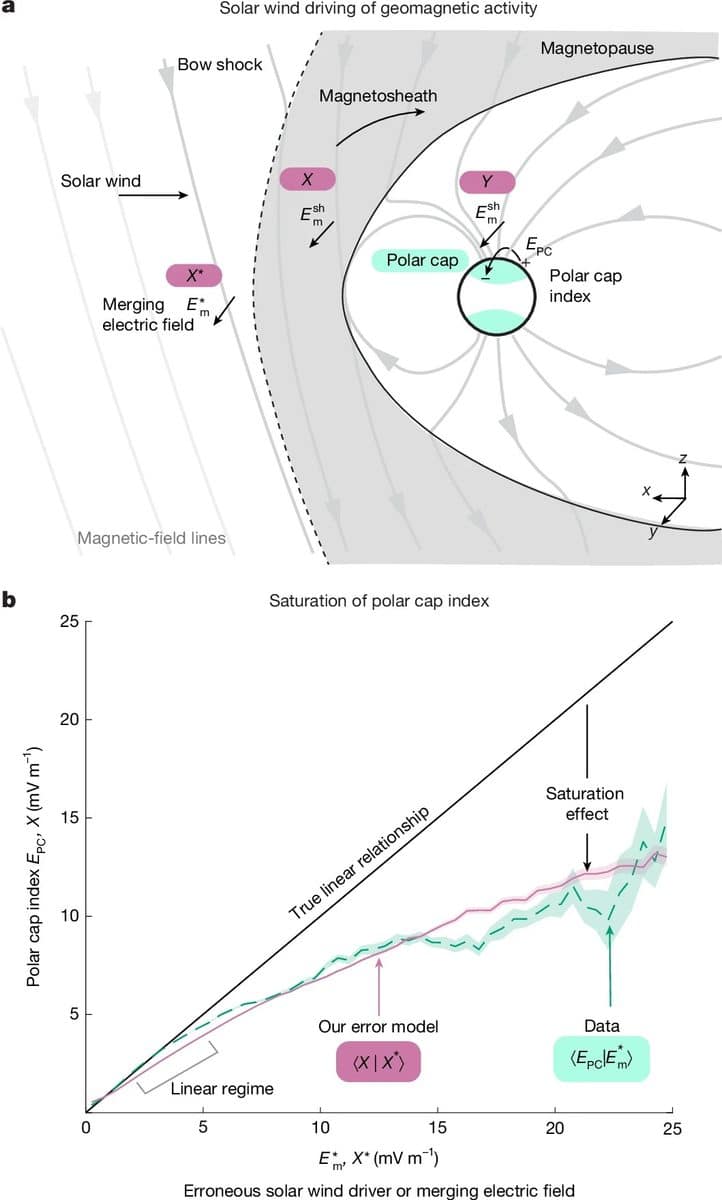
Судлаачид нарны хүчтэй шуурганы үеэр соронзон мандал хананд тулж зогсдог гэх таамаглал нь хэмжилтийн алдаанаас үүдэлтэй статистик үзэгдэл байж магадгүй гэж үзжээ.
NASA-гийн Годдардын сансрын нислэгийн төвийн эрдэмтэн Нитин Сивадас тэргүүтэй баг Дэлхийн соронзон мандал нарны шуурганы нөлөөг хязгаарладаг гэх өмнөх судалгаануудыг дахин нягталсан байна. Нарны салхины мэдээллийг L1 цэг дээр байрлах сансрын аппаратуудаар хэмждэг бөгөөд энэ нь Дэлхийд хүрэхээс өмнөх үеийн өгөгдөл юм. Гэвч нарны шуурганы үеэр хэмжилтийн нарийвчлал буурч, үүнээс үүдэн “дундаж руу тэмүүлэх” хэмээх статистик нөлөө илэрч, соронзон мандал хананд тулсан мэт хуурамч дүр зураг үүсдэг байна.
Судлаачид регрессийн тохируулгын аргыг ашиглан хэмжилтийн алдааг залруулсны дараа соронзон мандал нь нарны цахилгаан соронзон идэвхжилд хананд тулж зогсохгүйгээр үргэлжлүүлэн хариу үйлдэл үзүүлдэг болохыг тогтоожээ. Энэхүү дүгнэлт нь өмнө нь ажиглагдаж байсан “хана” буюу соронзон мандал дээд хүчин чадалдаа хүрсэн гэх ойлголт нь физик үзэгдэл биш, харин өгөгдлийн гажуудлаас үүдэлтэй байж болзошгүйг харуулж байна.
Энэхүү судалгааны үр дүн нь нарны онцгой хүчтэй шуурганы үед сансрын хиймэл дагуул болон цахилгаан дамжуулах сүлжээнд учрах эрсдэл урьд өмнө тооцоолж байснаас өндөр байж магадгүйг анхааруулж байна. Мөн статистик алдааны ийм төрлийн гажуудал нь сейсмологи, анагаах ухаан болон машин сургалтын загваруудад ч нөлөөлөх эрсдэлтэй бөгөөд өгөгдлийн нарийвчлал нь шинжлэх ухааны дүгнэлтэд хэрхэн нөлөөлдгийг онцолжээ.
Дэлгэрэнгүйг эх сурвалжаас харах
↓Эх сурвалжийг нээх ↓
A new study suggests that Earth’s magnetic shield may have been hiding the true power of extreme solar storms. Researchers found that a statistical effect could have made the magnetosphere appear to reach a limit when, in reality, the strongest storms may still push the system much further.
The magnetosphere plays a key role in protecting Earth from the constant stream of charged particles coming from the Sun. When the solar wind hits Earth’s magnetic field, it drives plasma and electric currents into the upper atmosphere, especially near the poles, where the process creates spectacular auroras.
Scientists have studied this interaction for decades using tools such as the Polar Cap Index (PCI). For moderate solar activity, the link between the solar wind and Earth’s magnetic response is fairly straightforward. But during the most powerful storms, scientists noticed something unusual: the response seemed to stop increasing, as if the magnetosphere had reached its maximum capacity.
A new study published in Nature suggests that this apparent “saturation” may not be a real feature of Earth’s magnetic field. Researchers led by Dr. Nithin Sivadas at NASA’s Goddard Space Flight Center argue that the effect could come from the way solar storms are measured.
A Hidden Flaw In Solar Storm Data
Most solar wind data comes from spacecraft such as WIND, ACE and DSCOVR. These satellites sit near the L1 Earth–Sun Lagrange point, around 1.5 million kilometers (930,000 miles) closer to the Sun than Earth. Their position allows scientists to detect solar activity before it reaches our planet. But there is a problem: the solar wind does not stay exactly the same during that journey. Conditions can change, and powerful storm fronts can introduce additional uncertainty into the measurements.
The researchers explain that these errors become larger during extreme events. In other words, the biggest solar storms are also the moments when scientists may have the least precise measurements of the incoming solar wind.
The study points to a statistical effect called regression to the mean. When scientists compare an extreme reading from a spacecraft far from Earth with a less extreme response measured near the planet, the data can create the impression that the magnetosphere is no longer reacting strongly. This could explain why previous studies showed a flattening curve during major storms. The apparent limit may have come from the data itself rather than from a physical barrier around Earth.
A New View Of Extreme Solar Storms
To test their idea, Dr. Nithin Sivadas and his team used a method called regression calibration to correct the measurement bias. The results changed the way the relationship between solar activity and Earth’s response appeared. After the correction, the researchers found no clear sign of saturation. The connection between the solar wind electric field and Earth’s geomagnetic response continued instead of flattening at high levels.
The paper’s authors say this means scientists may have underestimated how strong the effects of rare solar storms could be. Events considered extremely unusual may have the potential to produce much larger disturbances than earlier models suggested.

The study does not mean Earth’s magnetic field stops protecting the planet. It shows that scientists may have misunderstood one part of its behavior during the most intense storms.
A New Threat To Satellites And Electricity
The researchers also warn that this type of statistical problem can appear in other areas of science. The same issue can affect fields such as seismology, medical research and machine learning, where uncertain measurements can sometimes create misleading patterns.
Machine learning systems are particularly sensitive to this problem because models learn from the data they receive. If the data contains a statistical illusion, the model may reproduce it and treat it as a real rule.

For space weather, the findings could change how scientists evaluate risks for satellites and power grids. A major solar storm could create stronger electrical effects than previously expected if the supposed protection from magnetosphere saturation was only a statistical artifact.
Enjoyed this article? Subscribe to our free newsletter for engaging stories, exclusive content, and the latest news.

