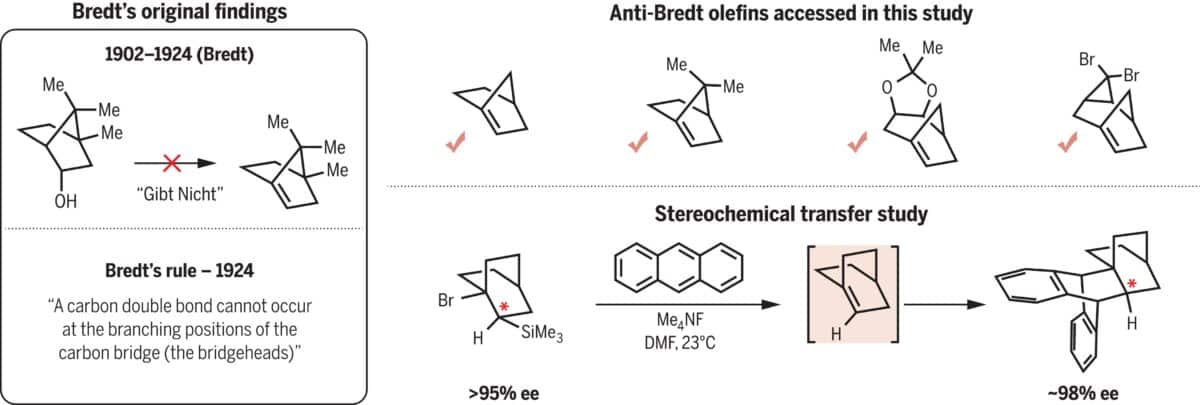
Калифорнийн их сургуулийн (UCLA) судлаачид химийн салбарт зуу гаруй жил мөрдөгдөж ирсэн “Бредтийн дүрэм”-ийг үгүйсгэж, урьд өмнө боломжгүй гэж үздэг байсан молекулуудыг гарган авчээ.
Бредтийн дүрэм нь нүүрстөрөгчийн давхар холбоог жижиг цагирагт бүтэц дотор үүсгэх боломжгүй гэж үздэг байсан юм. Учир нь ийм бүтэц дэх геометрийн хязгаарлалт нь маш өндөр ачаалал үүсгэдэг тул молекулыг тогтвортой байлгах боломжгүй гэж үздэг. UCLA-ийн судлаачид энэхүү тогтворгүй байдлыг даван туулахын тулд молекулуудыг үүсгэмэгц нь өөр бодистой урвалд оруулан барьж авах аргыг боловсруулжээ.
Судлаачид фторын нэгдэл ашиглан “anti-Bredt” нэртэй, өндөр ачаалалтай молекулуудыг гарган авч, тэдгээрийн оршин тогтнолыг химийн урвалаар нотолсон байна. Тооцооллын химийн арга болох нягтын функционалын онолоор (density functional theory) шинжлэхэд, эдгээр молекул нь маш их ачаалалтай хэдий ч давхар холбооны шинж чанараа хадгалж байв.
Энэхүү судалгаа нь химийн шинжлэх ухаанд урьд нь боломжгүй гэж үздэг байсан 3D молекулын бүтцийг гарган авах шинэ боломжийг нээж байна. Нейл Гарг тэргүүтэй багийнхан энэ арга нь эмийн үйлдвэрлэлд шаардлагатай нарийн төвөгтэй молекулын бүтцийг бүтээхэд чухал нөлөөтэй гэж үзэж байгаа юм. Гэсэн хэдий ч Бредтийн дүрэм нь тодорхой нөхцөлд хүчинтэй хэвээр үлдэх бөгөөд эрдэмтэд ийм дүрмүүдийг хувиршгүй үнэн гэхээсээ илүүтэйгээр чиглүүлэгч зарчим гэж үзэх ёстойг онцолжээ.
Дэлгэрэнгүйг эх сурвалжаас харах
↓Эх сурвалжийг нээх ↓
Chemistry’s “rules” are meant to guide us, not constrain us. We’ve recently learned that a rule that has guided generations of chemists—Julius Bredt’s Rule—isn’t always true. Bredt’s Rule tells us that it doesn’t matter what you want to make; if you’re going to create a carbon-carbon double bond (a carbon-carbon double bond is when two carbon atoms share two pairs of electrons), don’t try to create that bond within a small bridged ring. This is because the geometric constraints of the small bridged ring are too great.
A group of researchers at UCLA (University of California, Los Angeles) showed that while most of these supposedly unobtainable molecules won’t last long enough to be seen, some can be made. These molecules will react quickly, and that is enough for chemists.
This study describes a process that allows you to generate these molecules in the course of your reaction mixtures and capture them before they disappear. The study, which was published in Science, provides information about the long held view expressed in their Abstract as follows: “conventional wisdom maintains that ABOs are difficult or impossible to access.”
A Double Bond in the Wrong Position
The problems begin with the geometry of a carbon-carbon double bond. Carbon-carbon double bonds generally prefer an essentially planar (flat) arrangement of atoms. In comparison, small bridged ring systems are stiff and keep their atoms locked in positions that would preclude achieving that geometry. The critical positions in these ring systems are known as bridgehead positions. When a double bond is located at one of these positions in a small ring system, it must twist and/or bend significantly from its usual geometry.
That is exactly the situation described by Bredt’s Rule. Bredt’s Rule was developed through the studies of German chemist Julius Bredt concerning bridged ring systems in the late 19th and early 20th Centuries. Bredt’s work on camphor helped lay the foundation for the structural ideas that became associated with Bredt’s Rule.
Bredt’s Rule ultimately developed into a quick shorthand. Chemists could often use it to eliminate a potential target compound without attempting to synthesize it if it contained a double bond at a bridgehead position that violated the rule.
However, earlier experiments indicated that some violations could be observed temporarily. The challenge was developing a practical method to prepare these compounds and demonstrate that they had indeed formed.
Capturing the Intermediate Before It Disappears
The UCLA team chose to approach the instability as something to manage instead of something to be avoided.
The researchers developed precursor molecules that could be forced into forming anti-Bredt olefins (compounds violating conventional wisdom). A fluoride source triggered the elimination reaction that produced the strained double bond.
Instead of isolating the resulting intermediate in a vial, the researchers sought to add another reactant capable of intercepting it shortly after it formed.
It worked!

The strained intermediate reacted with trapping agents to form more stable compounds that served as chemical evidence that the strained-looking double bond had existed, albeit only briefly.
In addition to demonstrating that various strains of anti-Bredt intermediates existed and could react, several ring systems were tested, namely [3.2.1], [2.2.2] and particularly strained [2.2.1] ring systems. The anti-Bredt intermediates underwent multiple forms of cycloaddition reactions (i.e., where reacting molecules joined together to form new ring structures).
Therefore, the results provide more than just evidence of existence. The intermediate itself can serve as a new synthetic tool enabling chemists to develop compounds whose preparation via traditional methods may prove challenging.
Strain Does Not Equate To Impossibility
The researchers ran additional computational analyses to better understand how severely deformed one of the double bonds was in a highly strained [2.2.1] anti-Bredt olefin.
Utilizing density functional theory, they analyzed the geometry of the aforementioned [2.2.1] anti-Bredt olefin. As expected, the carbon atoms surrounding the double bond in this molecule were substantially displaced from those normally found in an alkene.
As measured by density functional theory, the calculated olefin strain energy was approximately 54.2 kcal/mol.
Although under significant strain, however, the molecule maintained considerable double-bond characteristics. The predicted C-C bond distance was 1.35 Å, consistent with a bond retaining much of its double-bond nature despite deformation.
![Structural Analysis Of [2.2.1] Abo 12 And Synthesis Of A Precursor For Abo Generation](https://dailygalaxy.com/wp-content/uploads/2025/12/Structural-analysis-of-2.2.1-ABO-12-and-synthesis-of-a-precursor-for-ABO-generation-600x1200.jpg)
Thusly, although the molecule was reactive enough to need to be captured promptly upon generation, it was not sufficiently strained so as to render it incapable of forming.
Stereochemical data further supported this assertion. Stereochemical data related to the three-dimensional orientation of atoms in a starting material corresponded with the stereochemical relationship between a product derived from said starting material and the proposed twisted intermediate.
Thusly, both product stereochemistry and theoretical calculations established that the previously believed boundary for violation of Bredt’s Rule was farther outward than many chemists believed.
New Access Points to Chemical Space
These reactions also offer chemists access to molecular architectures that may be difficult to access by means of more conventional methods.
Medicinal Chemistry today frequently employs molecules having complicated 3-D spatial arrangements, rather than merely relying on flat architectural frameworks. Therefore, anti-Bredt chemistry represents yet another route to creating such 3-D spatial frameworks for medicinal applications utilizing abnormally strained intermediates as “stepping stones”.
Neil Garg has argued in his capacity as leader of the UCLA research that this could provide a basis for interest among pharmaceutical researchers seeking reactions that produce complex 3-D molecular frameworks since they increase the number of possible testable compounds. According to an article appearing at Earth.com in which Garg is quoted as stating “there is a big push in the pharmaceutical industry,” he believes there is a “big push…in the pharmaceutical industry” toward producing such 3-D frameworks.
This paper does not indicate whether anti-Bredt compounds are drugs nor does it suggest whether medicines employing this type of chemistry are on the horizon. Rather, its initial contribution is a methodological framework whereby chemists can design and create classes of structures previously viewed as largely inaccessible.
Bredt’s rule continues to describe a legitimate chemical constraint. Many bridgehead double bonds in small ring systems will remain highly strained and thus likely impossible to isolate due to their high instability. However, Garg noted that this distinction between instability and impossibility:
“We shouldn’t have rules like this — or if we have them, they should only exist with the constant reminder that they’re guidelines, not rules.”
Approximately one hundred years ago Bredt’s rule entered into the lexicon of organic chemistry as did others describing chemical constraints. Today chemists know where Bredt’s rule ends regarding an absolute truth.
Enjoyed this article? Subscribe to our free newsletter for engaging stories, exclusive content, and the latest news.


