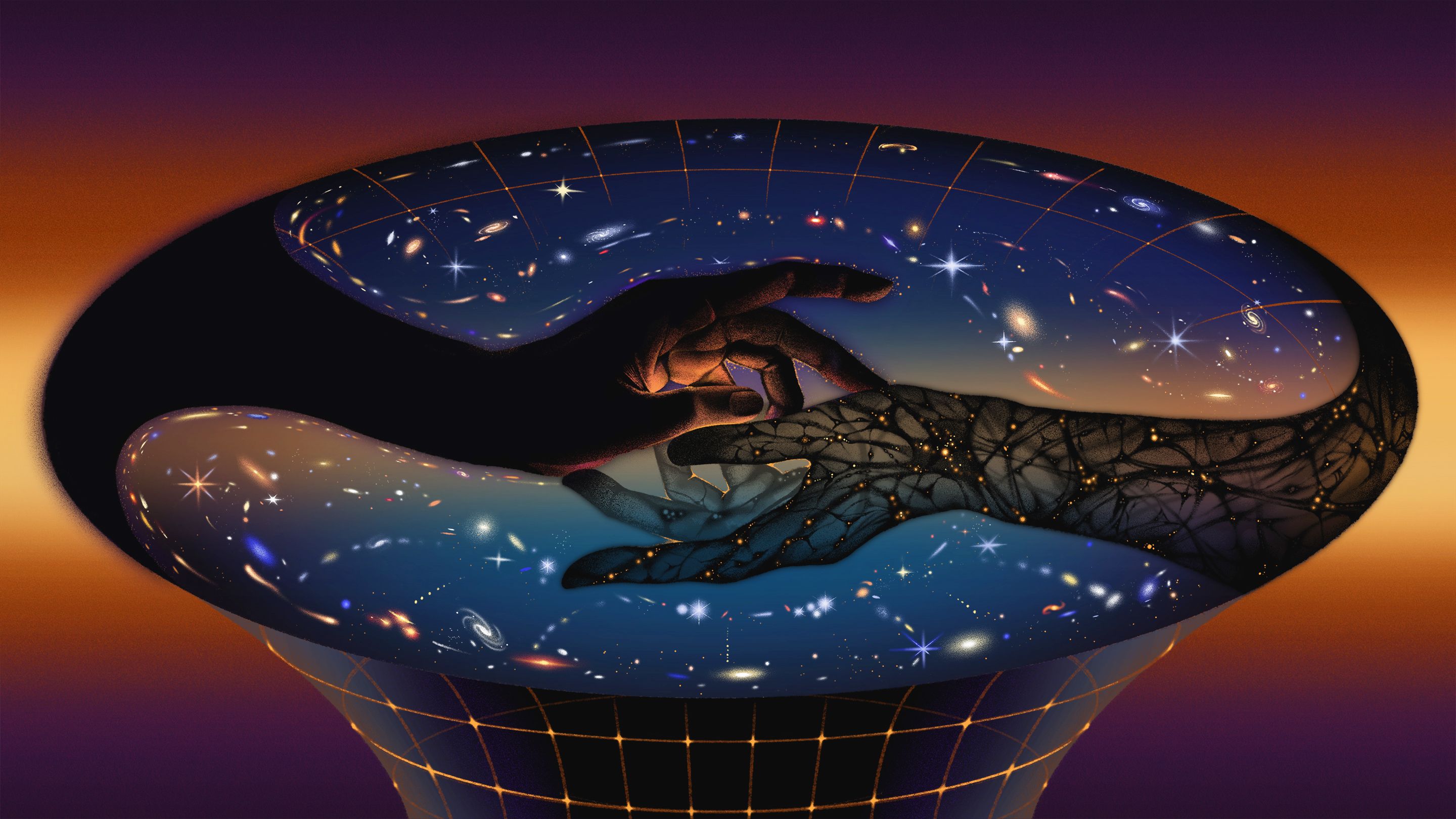
Эрдэмтэд орчлон ертөнцийн тэлэлтийн хурдны зөрүүг тайлбарлах шинэ загварыг дэвшүүлж, харанхуй матер болон харанхуй энерги нэгэн хэмжээст орон зайд харилцан үйлчилдэг байж болзошгүйг таамаглав.
Орчлон ертөнцийн тэлэлтийн хурдыг эрт үе болон орчин үеийн хэмжилтүүдээр харьцуулахад ойролцоогоор 9 хувийн зөрүү ажиглагдсан нь сансар судлаачдын дунд маргаан үүсгээд байгаа юм. Энэхүү зөрүү нь хэмжилтийн алдаа эсвэл физикийн шинэ үзэгдлийн илрэл байж болзошгүй гэж судлаачид үзэж байна. Харвардын их сургуулийн физикч Камрун Вафа болон түүний хамтрагчид харанхуй матер болон харанхуй энерги нь “харанхуй хэмжээс”-ээр дамжуулан хоорондоо холбогддог байж магадгүй гэсэн таамаглалыг дэвшүүлжээ.
Уг загвар нь утасны онол (string theory)-д суурилсан бөгөөд бидний мэдэх дөрвөн хэмжээсээс гадна микроны хэмжээтэй илүү том “харанхуй хэмжээс” оршин байх боломжтойг санал болгодог. Таталцлын хүчийг дамжуулагч онолын бөөм болох гравитонууд энэхүү хэмжээс рүү нэвтэрч, масс хуримтлуулан “харанхуй гравитон” болон хувирдаг байж болзошгүй юм. Эдгээр бөөм нь бусад хэмжээст нөлөөлснөөр харанхуй материйн үүргийг гүйцэтгэж, улмаар харанхуй энергитэй харилцан үйлчлэх боломжтой гэж эрдэмтэд үзэж байна.
2025 оны долдугаар сард хэвлэгдсэн судалгааны өгүүлэлд Жорж Обиед, Камрун Вафа болон тэдний багийнхан энэхүү загвар нь DESI (Dark Energy Spectroscopic Instrument)-ийн өгөгдөлтэй нийцэж байгааг тогтоожээ. Тэдний загвараар харанхуй энергийн хүч болон харанхуй материйн масс нь цаг хугацааны явцад буурч байдаг гэж таамаглаж байна.
Энэхүү өөрчлөлт нь маш бага хурдтай явагддаг тул орчлон ертөнцийн бүхэл бүтэн насыг өнгөрөөж байж л илрүүлэх боломжтой байсан гэж судлаачид тайлбарлав. Хэдийгээр энэ загвар нь онолын хувьд шинэлэг боловч харанхуй хэмжээсийн оршин тогтнол болон түүний харанхуй матер, энергитэй харилцах харилцааг батлахын тулд цаашдын нарийвчилсан судалгаа шаардлагатай хэвээр байна.
Дэлгэрэнгүйг эх сурвалжаас харах
↓Эх сурвалжийг нээх ↓
According to the standard model of cosmology, that expansion rate should be the same no matter how you measure it. But in recent years, scientists have found that the expansion rate of the early universe and that of the more recent universe vary by approximately 9 percent.
That discrepancy, or tension, “has provoked heated debates in the cosmology community about whether this difference could be due to systematic errors or whether it is a signal of new physics,” Teixeira and her co-authors wrote. Their model posits that in a world where dark energy and dark matter interact, what seemed to be a crisis caused by disparate expansion rates instead becomes something to be expected.
A Dark Dimension
If dark energy and dark matter do interact, it could mean that they have a common origin, Khoury said.
Ongoing work in string theory—the idea that our universe, at its smallest, most fundamental level, is made up of vibrating strings—suggests a way these concepts might be connected. In 2019, building on the idea in string theory that dark energy is naturally varying, Vafa and two collaborators concluded that the mass of dark matter particles may also vary over time. This led them to propose in 2022 that dark matter and dark energy could share a link with a so-called dark dimension.
String theory posits the existence of six or seven extra dimensions in addition to our familiar three dimensions of space and one of time. All of these dimensions are thought to be as small as physically possible—close to the Planck scale (10-35 meters)—but the researchers proposed that the dark dimension could be significantly bigger than the others—on the order of a micron (10-6 meters).
Gravitons, theoretical particles that impart the force of gravity, could leak into this enlarged dark dimension. If they did, they would pick up mass and become what are called dark gravitons. These massive gravitons would reside in the dark dimension, but their gravitational effects could be felt in other dimensions, allowing them to fulfill the role that is normally ascribed to dark matter.
In this scenario, “there is a very natural coupling between dark energy and dark matter,” said Georges Obied, a physicist at the University of Chicago. Changes in the size of the dark dimension would affect both dark energy and dark matter.
In a July 2025 paper, Obied and Vafa, along with Alek Bedroya of Princeton and David Wu of Harvard, found that the scenario proposed in 2019 was consistent with the DESI data. Their model predicts that the strength of dark energy and the mass of dark matter will decrease over time and that the rate at which dark energy changes will be proportional to its energy density. Because astrophysical measurements tell us that the energy density of dark energy is extraordinarily small, “it won’t change fast,” Vafa said.
“It’s not surprising that we didn’t see it until now,”he said, because the rate of change is so tiny. “We had to wait the entire age of the universe to detect something that small.”

