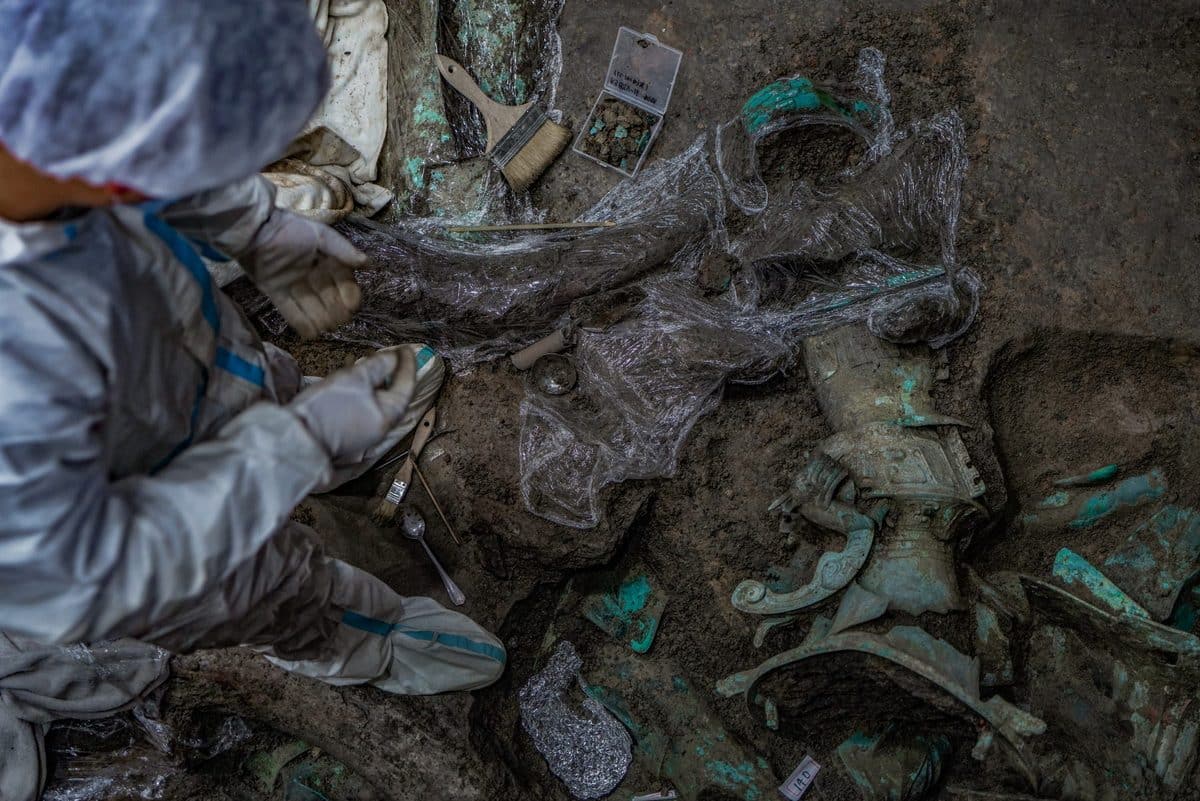
Хятадын Сычуань мужийн эртний олдворын цэгээс хүний гараар бүтээгдээгүй, сансрын гаралтай төмрөөр хийсэн ховор олдвор илрүүлсэн нь металлургийн түүхэнд шинэ нээлт болж байна.
Саншиндуй археологийн дурсгалт газрын 7-р нүхнээс олдсон 20 орчим сантиметр урт, сүх хэлбэрийн энэхүү эд зүйлийг мэргэжилтнүүд нарийвчлан шинжилжээ. “Archaeological Research in Asia” сэтгүүлд нийтлэгдсэн судалгаагаар, тус олдвор нь тухайн үеийн хүмүүсийн боловсруулах боломжгүй, 90 гаруй хувийн төмөр, 7.41-20 хувийн никелийн агууламж бүхий солирын төмрөөр хийгдсэнийг тогтоов. Металлын бүтцийг шинжлэхэд дэлхийн гадаргуу дээр бус, сансарт удаан хугацаанд хөрөх явцад үүсдэг талст бүтэцтэй болох нь батлагджээ.
Хятадын Сычуаний их сургуулийн судлаач Хайчао Ли болон түүний багийнхны дүгнэснээр, энэ нь Хятадын баруун өмнөд бүс нутгаас олдсон хүрэл зэвсгийн үеийн хамгийн анхны солирын төмөр олдвор юм. Тухайн үед Хятадад төмөр хайлуулах технологи бүрэлдээгүй байсан тул Саншиндуйн дархчууд уг материалыг хайлуулах бус, байгаа чигээр нь хэлбэржүүлэн ашигласан болохыг судалгаа харуулж байна. Энэ нь тус бүс нутгийн металлургийн түүхэн дэх цоорхойг нөхөж, эртний хүмүүсийн төмөр ашиглалтын талаарх ойлголтыг өргөжүүлж буй чухал олдвор болжээ.
Одоогоор уг олдворыг ямар зориулалтаар ашиглаж байсан нь тодорхойгүй байна. Судлаачид үүнийг ёслолын зан үйлийн зориулалттай байсан эсвэл бусад хатуу материал боловсруулахад ашигласан багаж байх магадлалтай гэж таамаглаж байна. Хэдийгээр солирын гаралтай нь батлагдсан ч яг ямар төрлийн солир болохыг нарийвчлан тогтоох ажил үргэлжилж байгаа бөгөөд олдвор нь гурван мянган жилийн турш хөрсөнд байснаас болж ихээхэн зэвэрсэн тул цаашид нарийн нягт нямбай хадгалалт, судалгаа шаардлагатай байгааг эрдэмтэд онцолжээ.
Дэлгэрэнгүйг эх сурвалжаас харах
↓Эх сурвалжийг нээх ↓
Pit No. 7 at the Sanxingdui site in Sichuan Province has yielded thousands of ritual objects over decades of excavation: bronze masks with protruding eyes, ivory, jade tools, and figurines whose purpose remains disputed. One object, though, stood apart from everything else.
Embedded upright in the southern wall of the pit, a roughly 20-centimeter axe-like artifact remained there for three millennia before archaeologists carefully removed it, surrounding soil and all, and carried it to a laboratory.
The analysis, published in Archaeological Research in Asia, showed that the object was not made from any metal the Sanxingdui people could have produced themselves. It came from space.
Meteorite Iron Identified at Bronze Age Site in Southwest China
X-ray fluorescence found that the artifact is at least 90 percent iron by weight, with 7.41 percent nickel and trace elements beyond that. The nickel runs uniformly through the object.
A follow-up laboratory analysis using electron microscopy confirmed nickel levels of roughly 20 percent, far above the median of around 11 percent seen in other Chinese meteoritic iron finds. Reproducing that consistency would have been extremely difficult with the metal-processing methods available during the late Shang period, and the grain structure of the metal records the sort of very slow cooling that happens in space rather than on Earth’s surface.
Bronze dominated the era. An alloy of copper and tin, it had been refined by Chinese smiths to extraordinary levels by the time Sanxingdui was at its height, roughly 1600 to 1050 BC. Iron smelting did not become widespread in China until around 800 BC. Only then did the technology needed to reach the required temperatures emerge.
The Sanxingdui smiths were working iron centuries earlier, but they were not smelting it. They shaped a fragment already processed by forces no furnace could reproduce.
A team led by Haichao Li of Sichuan University described the find as “the earliest Bronze Age meteoritic iron artefact found in Southwest China,” one that “fills a critical gap in the region’s metallurgical records and provides new insights into early iron use both regionally and globally.”
Largest Meteoritic Iron Artifact Ever Found in China
So far, thirteen meteoritic iron artifacts have been identified in China. The earliest confirmed example, a knife from Narensu cemetery in Xinjiang, has been radiocarbon-dated to approximately 3000 BC.
Most of the reported artifacts date to the Shang Dynasty and come from the country’s north. The Sanxingdui piece is the largest meteoritic iron artifact found in China to date.
Size is only part of what makes it unusual. In the Central Plains, smiths generally used meteoritic iron as a supplementary material, setting it into bronze blades or decorative inlays, and the resulting objects were typically buried alongside high-status individuals. At Sanxingdui, the artifact is entirely meteoritic iron. It carries no decoration.

The Li team writes that its presence “further highlights the distinctive metallurgical practice in Southwest China, in contrast to contemporaneous practices in the Central Plains.”
What the object actually did remains unresolved. Its position, described by the researchers as “vertically embedded at the bottom of the eastern wall’s southern section,” in a pit holding some 17,000 extraordinary ritual objects including bronze masks, figurines, and ivory, points toward ceremonial significance, though there is another possibility.
The artifact is hard. Bronze objects found elsewhere at Sanxingdui bear cut marks from extremely hard tools, and the iron axe may have been one of them.
Meteorite Type Remains Unclassified, Researchers Say
The meteoritic origin is well-supported. Its specific meteorite type is not.
“While the SEM-EDS results provide preliminary insights, they are insufficient to definitively classify the specific type of meteorite… the precise classification, therefore, remains unresolved,” said Zishu Yang of Sichuan University. The team plans to compare the artifact’s composition against known meteorite falls in the region.

Further sampling comes with a cost. The artifact is heavily corroded after three thousand years underground and is being kept under controlled conditions to prevent additional deterioration.
Future work, the researchers note, should focus on high-resolution characterization to pin down both the artifact’s classification and whether it served as a tool, a weapon, or an offering treated as precious specifically because of where the raw material came from.
Enjoyed this article? Subscribe to our free newsletter for engaging stories, exclusive content, and the latest news.

