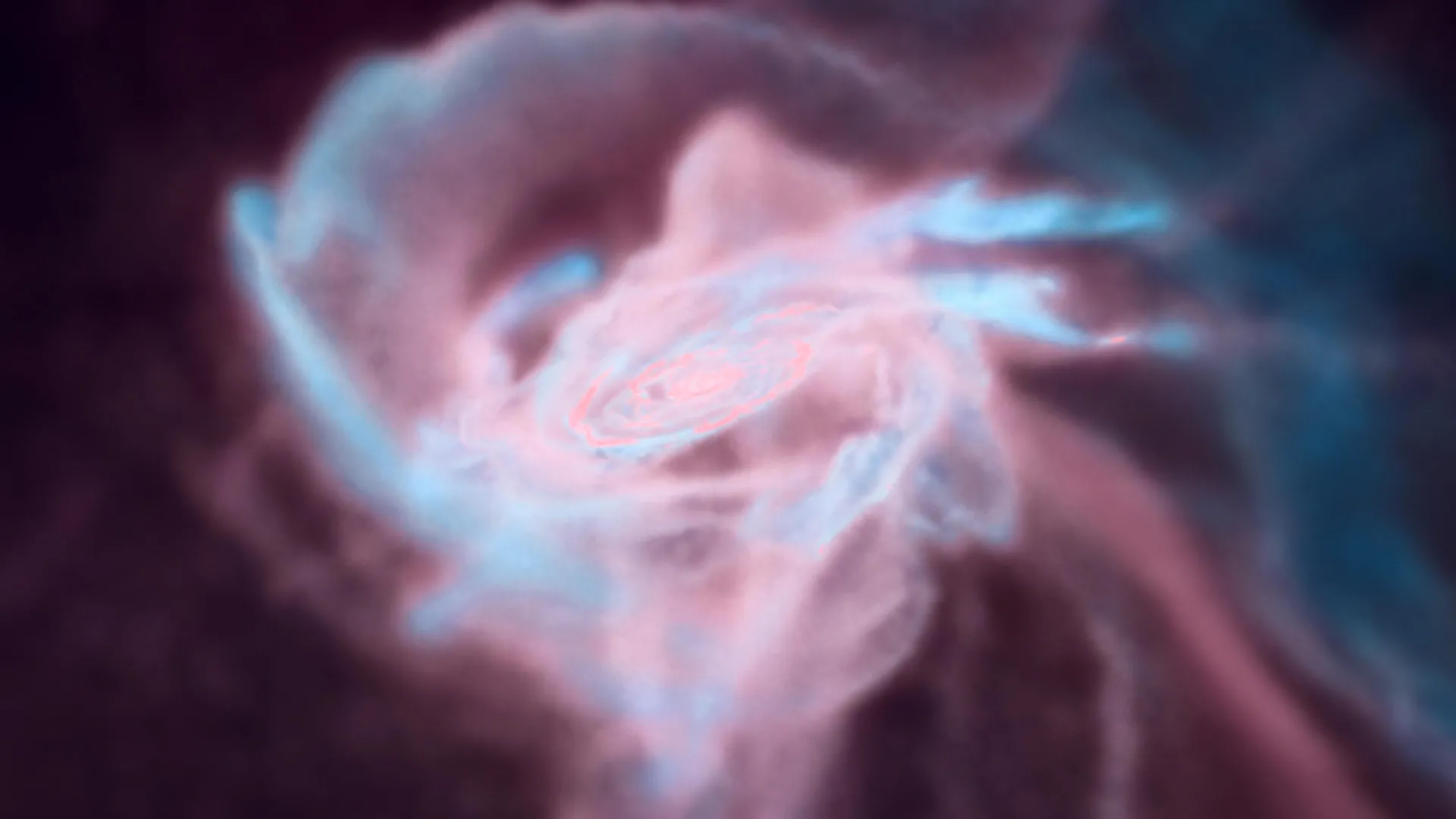
Шинэ загварчлалын үр дүнд эдгээр нууцлаг биетүүд нь эртний орчлонд асар хурдацтай өсөж байсан хар нүхнүүд болохыг тогтоов.
Жэймс Вэбб сансрын телескопоор (JWST) илрүүлсэн “бяцхан улаан цэгүүд” (Little Red Dots) хэмээх олон тооны биетүүдийн мөн чанарыг судлаачид тодруулахаар ажиллаж байна. Макс Планкийн Астрофизикийн хүрээлэнгийн эрдэмтэн Сүнмён Чон тэргүүтэй баг Японы Үндэсний одон орон судлалын төвийн ATERUI III суперкомпьютерийг ашиглан эртний орчлон ертөнцийн нарийвчилсан загварчлалыг гүйцэтгэлээ.
Энэхүү загварчлалаар эртний галактикуудаас ялгарах хэт ягаан туяа нь хийн үүлэн доторх оддын үүсэлтийг саатуулж, улмаар тухайн хий нь нэгэн аврага том од болон хувирах нөхцөлийг бүрдүүлдэг болохыг харуулжээ. Энэхүү аврага од нь мөхөж, хар нүхний үрийг бий болгодог байна. Ингэж үүссэн хар нүхнүүд нь өтгөн хийн дискийн хүрээлэлд орсноор орчин үеийн хар нүхнүүдээс хэдэн арав дахин хурдан өсөх боломжтой болдог ажээ.
Судалгааны үр дүн нь эдгээр “бяцхан улаан цэгүүд” нь хар нүхний асар хурдацтай өсөлтийн эхний үе шатыг илэрхийлж байж болзошгүйг харуулж байна. Энэхүү таамаглал нь их тэсрэлтээс хойш 600 хүрэхгүй жилийн дараа аварга том хар нүхнүүд хэрхэн үүссэн тухай олон жилийн турш үргэлжилсэн тааврыг тайлах боломж олгож болзошгүй юм.
Тус загварчлал нь ямар нэгэн ер бусын физикийн хууль шаардахгүйгээр, эртний орчлон ертөнцийн байгалийн жамаар ийм нөхцөл бүрэлдэн бий болсныг нотолж байна. Жэймс Вэбб телескоп илүү олон ийм биетүүдийг илрүүлэхийн хэрээр эдгээр өгөгдөл нь орчлон ертөнцийн анхны хар нүхнүүд хэрхэн бүрэлдэж, сансрын хувьсалд хэрхэн нөлөөлснийг ойлгоход үнэтэй суурь болох юм.
Дэлгэрэнгүйг эх сурвалжаас харах
↓Эх сурвалжийг нээх ↓
Among the many surprises uncovered by the James Webb Space Telescope, one of the strangest has been a large population of tiny, intensely red objects known as Little Red Dots. Their true nature has remained unclear. Now, new simulations performed with Japan’s ATERUI III supercomputer suggest these objects may be rapidly growing black holes that took advantage of conditions in the early Universe that no longer exist today.
The findings do not require unusual physics or highly unlikely events. Instead, the simulations indicate that Little Red Dots could arise naturally from the environment of the young cosmos, where black holes were able to grow at extraordinary rates.
Simulating the Early Universe
The research was led by Sunmyon Chon of the Max Planck Institute for Astrophysics. The team used the ATERUI III supercomputer at the National Astronomical Observatory of Japan to carry out some of the most detailed cosmological simulations yet of the early Universe.
The simulations began on the scale of a young galaxy and then progressively focused on smaller regions, eventually reaching individual clouds of gas. This demanding approach required the high-resolution computing power of ATERUI III.
The results suggest that intense far-ultraviolet (FUV) radiation from nearby galaxies can prevent ordinary stars from forming inside some gas clouds. Instead of breaking apart into many smaller stars, the gas can collapse into a single supermassive star.
That enormous star can then collapse and create a black hole seed.
Black Holes Growing at Extreme Speeds
Once these black hole seeds form, the simulations show that they can become surrounded by thick disks of dense gas. These gas-rich environments trap radiation and allow the black holes to consume material much more efficiently than black holes can in the modern Universe.
Under these conditions, the black holes can grow dozens of times faster than would be possible today.
The properties of these simulated black holes closely resemble the Little Red Dots (LRDs) observed by the James Webb Space Telescope (JWST). That similarity suggests the mysterious red objects could represent an early stage of extremely rapid black hole growth.
A Longstanding Black Hole Mystery
Astronomers have struggled for years to explain how supermassive black holes appeared so early in cosmic history. Some of these black holes contain millions or even billions of times the mass of the Sun, yet they already existed less than 600 million years after the Big Bang.
JWST was expected to help solve this puzzle by detecting fainter and more distant galaxies than previous telescopes could see.
Because light moves at a finite speed, observing very distant objects also means looking into the past. If a galaxy is 11 billion light-years away, its light has traveled for 11 billion years before reaching Earth. What we see is therefore the galaxy as it appeared 11 billion years ago. The same principle applies to a galaxy 12 billion light-years away, whose light is 12 billion years old.
JWST can peer farther back in time than earlier observatories, giving astronomers an unprecedented view of the young Universe.
Little Red Dots May Hold the Answer
Instead of immediately resolving the mystery of early black hole growth, JWST revealed something unexpected: a large population of tiny, extremely red objects that researchers began calling Little Red Dots (LRDs).
The new simulations suggest those objects may actually be the missing piece of the puzzle.
According to the model, the conditions needed to create and rapidly grow these black holes developed naturally in the early Universe. No exotic assumptions or rare coincidences were necessary. That could also help explain why Little Red Dots appear to be so common in JWST observations.
As JWST continues finding more LRDs and future telescopes look even deeper into cosmic history, this model could give astronomers a valuable framework for understanding how some of the Universe’s earliest black holes formed, grew, and helped shape the evolution of the cosmos.

