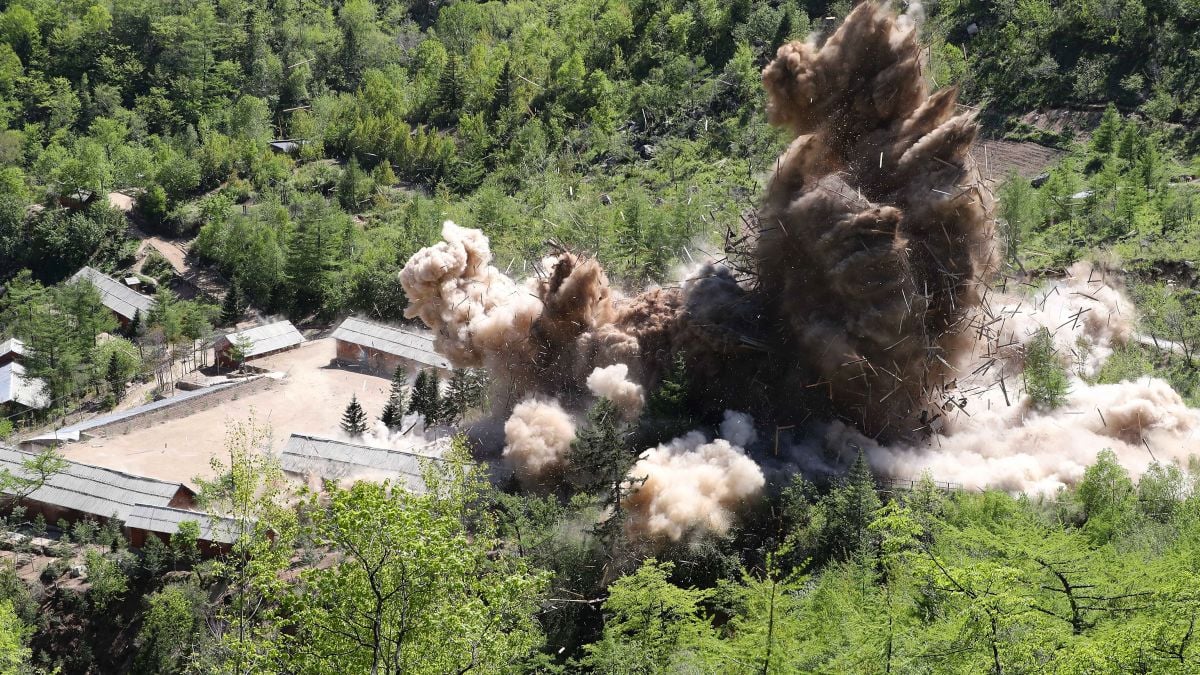
Хойд Солонгосын цөмийн туршилтын талбайд хийсэн дэлбэрэлтүүд нь тухайн бүс нутгийн газар хөдлөлтийн идэвхжилийг олон жилийн турш нэмэгдүүлж байгааг эрдэмтэд тогтоожээ.
Хойд Солонгосын Пунге-ри цөмийн туршилтын талбайд 2006-2017 оны хооронд зургаан удаагийн томоохон цөмийн туршилт явуулсан нь Мантап уулын доорх газрын хэвлийд хүчтэй нөлөөлсөн байна. Өмнөд Солонгосын Пусаны үндэсний их сургуулийн судлаач Кван-Хи Ким болон түүний баг 2008-2025 оны хоорондох газар хөдлөлтийн бичлэгүүдэд дүн шинжилгээ хийж, 1399 удаагийн сул чичирхийллийг илрүүлжээ. Эдгээр газар хөдлөлт нь туршилтууд дууссаны дараа ч намжихгүй, харин ч жил ирэх тусам эрчимжсэн байна.
Судлаачдын үзэж буйгаар, цөмийн дэлбэрэлтүүд нь байгалийн жамаар аль хэдийн эвдрэлд ойртсон байсан газрын гүний чулуулгийн механик тэнцвэрийг алдагдуулжээ. Дэлбэрэлтийн улмаас үүссэн хөндий нурах болон чулуулгийн давхаргын шилжилт нь хэдэн арван километрийн зайд орших хагарал бүхий бүсүүдэд нөлөөлж, газар хөдлөлтийн идэвхжилийг өдөөсөн байна. Мантап уулын тэгш бус гадаргуу болон геологийн тогтоц нь энэхүү стресс хуримтлагдах нөхцөлийг бүрдүүлж, газар хөдлөлт үргэлжлэхэд нөлөөлжээ.
Энэхүү судалгааны үр дүн нь газар доорх цөмийн туршилтын байгаль орчинд үзүүлэх нөлөөллийг зөвхөн дэлбэрэлтийн үеэр бус, олон жилийн турш нарийн хянах шаардлагатайг харуулж байна. Шинжлэх ухааны “Science” сэтгүүлд нийтлэгдсэн энэхүү дүгнэлт нь цөмийн туршилтын талбайнууд болон тэдгээрийн орчмын геологийн тогтвортой байдлыг үнэлэхэд шинэ чиг хандлагыг нээж өглөө.
Дэлгэрэнгүйг эх сурвалжаас харах
↓Эх сурвалжийг нээх ↓
When you gaze into the abyss, so Nietzsche proclaimed, sometimes the abyss gazes back into you.
And if you pummel Earth’s crust with the most powerful class of explosives humanity has ever devised, the planet may not necessarily remain silent in return.
In tunnels gouged under Mount Mantap in North Korea, six nuclear devices were detonated between 2006 and 2017.
Now, geologists have discovered evidence that those tests reactivated previously quiet faults – setting off a succession of hundreds of earthquakes that continued to intensify years after the final test took place.
“The most remarkable result is not simply that earthquakes followed underground nuclear tests, but how the seismicity evolved,” seismologist Kwang-Hee Kim of Pusan National University in South Korea told ScienceAlert.
“Instead of being strongest immediately after the explosion and then fading, the activity increased over several years.”
North Korea’s Punggye-ri nuclear test site sits beneath Mount Mantap, a 2,205-meter (7,234-foot) peak in the country’s northeast.
The remote location was well suited to testing the nation’s expanding nuclear capabilities: tunnels could be driven horizontally into the mountain beneath hundreds of meters of solid rock, helping contain the explosions.
The site’s first underground test was conducted in October 2006. Five more were conducted in the ensuing 11 years, each unleashing a tremendous explosion of energy into the rock below.
The final test took place on 3 September 2017 – and it was the largest by a wide margin.
The Hiroshima bomb exploded with an energy of about 15 kilotons. The final Punggye-ri test unleashed an estimated 100 to 250 kilotons – powerful enough to produce the same signal as a magnitude 6.3 earthquake.
An underground nuclear explosion doesn’t need a pre-existing cavern. The blast vaporizes and melts surrounding rock, excavating an underground cavity while sending intense stresses through the rock beyond it. As that cavity cools, its roof can collapse under the weight above.
That appears to be exactly what happened beneath Mount Mantap. Just 8.5 minutes after the 2017 explosion, instruments detected a magnitude 4.1 seismic event interpreted as the collapse of the newly formed cavity. Meanwhile, satellite radar captured the mountain itself crumpling under the force of the blast.
That was not unexpected.
“Earthquakes caused directly by explosion damage, cavity collapse, or a conventional aftershock-type response would normally begin promptly and decrease as the transient disturbance dissipates,” Kim said.
And, as it was the final test, the cavity collapse should have marked the beginning of the end of the seismic disruption from Punggye-ri.
But three weeks later, Earth started grumbling.
“At Mt. Mantap, however, only a few events were reported immediately after the sixth test,” Kim continued, “whereas the sustained tectonic seismicity began about 20 days later and then intensified over the following years.”
The earthquakes raised an intriguing question. Most previous research at Punggye-ri had focused on the nuclear tests themselves – where and when the explosions occurred, and how powerful they were.
What happened to the crust in the years afterward was much less well understood.
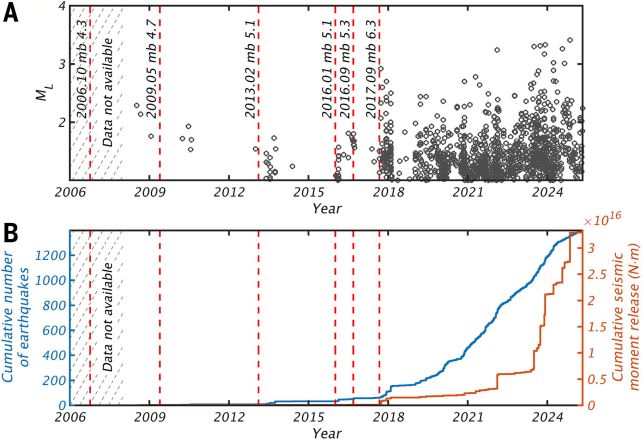
So the researchers went back and combed through 17 years of seismic recordings from stations in China and South Korea, spanning 2008 to 2025.
The team used a technique called matched-filter detection, which allowed them to pick out tiny earthquakes that routine monitoring had missed.
They found 1,399 of them.
Mount Mantap is not known as a seismically active place, though. In fact, it’s almost exactly the opposite. When the researchers looked at historical records, what they found was a whole lot of practically nothing, going back hundreds of years.
Between 23 BCE and 1903 CE, they found just one event – a large crustal earthquake within 200 kilometers – a magnitude 6.7 event in 1810, around 100 kilometers away from Mount Mantap.
“Major regional and global earthquake catalogs likewise documented no crustal earthquakes within 50 km of the site between 1 January 1904 and 3 September 2017,” Kim said.
That doesn’t mean the ground had been completely silent. Historical records are incomplete, particularly for tiny earthquakes in remote places, and the team’s much more sensitive search picked up sparse local activity beginning in 2013, after the third nuclear test.
Even so, the region remained relatively quiet. Until 2017.
On 23 September 2017, the mountains shuddered… and then never really stopped.
Earthquakes continued to rattle the region over the following months and years. Stranger still, rather than gradually dying away, the activity intensified.
“Both the earthquake rate and seismic moment release continued to increase through May 2025, the end of our study period,” Kim said.
That would be intriguing enough – but the locations of the earthquakes started to reveal another pattern.
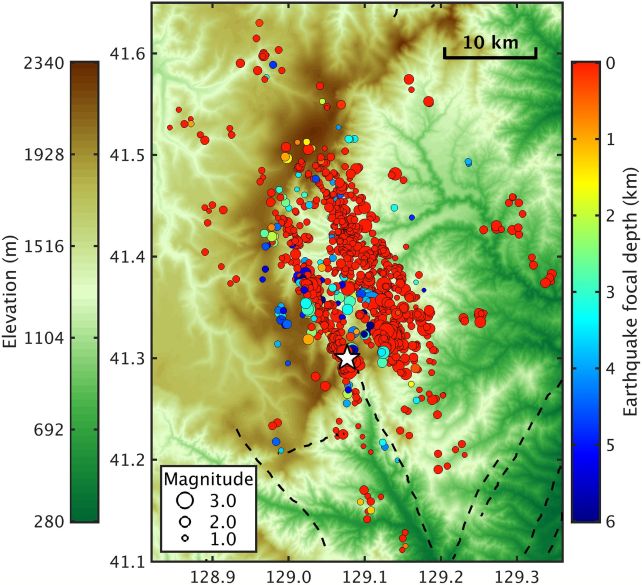
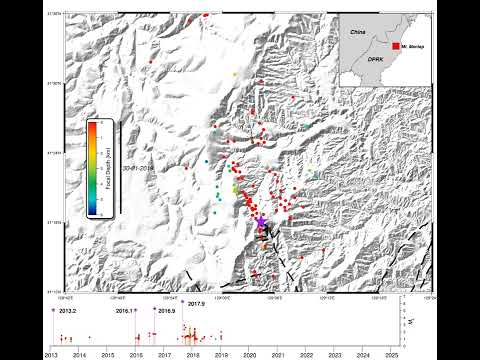
The team was able to precisely trace 955 of the earthquakes. When they plotted those locations, they weren’t scattered higgledy-piggledy around Mount Mantap. Instead, they mapped out two roughly parallel structures running north-northwest from the test site.
One followed the projected continuation of a fault already mapped south of Punggye-ri. The other didn’t correspond to any known surface fault – but still traced a distinctly fault-like pattern.
That pattern suggested that the nuclear tests had disturbed pre-existing weaknesses in the crust. But that left a puzzle: How could explosions that ended in 2017 still be influencing earthquakes years later?
It wasn’t because the energy from the blasts was still reverberating through the mountain.
“The seismic waves themselves did not continue acting for years,” Kim said. “Rather, we infer that the repeated tests altered the mechanical balance of a heterogeneous crust that was already close to failure.”
The immediate effects of an underground nuclear explosion are relatively short-lived. The blast can fracture surrounding rock, alter stresses nearby, and – as happened after the final Punggye-ri test – cause the newly formed cavity to collapse.
But those effects alone couldn’t explain earthquakes appearing tens of kilometers away and continuing to intensify years later. Instead, the researchers believe that the cumulative effects of repeated explosions were responsible.
“An everyday analogy would be a stack of rough blocks that is already being squeezed and is close to sliding,” Kim explained.
“Repeated jolts can alter how the load is shared between the blocks. Even after the jolting stops, the movement of one contact can transfer stress to neighboring contacts, some of which may slip only later.”
Mount Mantap itself may have helped shape where that transferred stress ultimately found an outlet. Its steep, uneven topography creates variations in the stresses already acting on the shallow crust, making some locations more favorable for slipping than others.
The mountain itself wasn’t the trigger, Kim stressed. Rather, its topography provided a “long-lived mechanical framework” that helped determine where the effects of the nuclear tests played out.
Whether that process could eventually produce a much larger earthquake is unclear. The longer of the two fault-like structures extends for around 24 kilometers; if it represents a single connected fault that ruptured along its entire length, the researchers estimate it could theoretically produce an earthquake around magnitude 6.4.
But that’s a hypothetical scenario, not a prediction. There’s no evidence such an earthquake is imminent, and the structure may instead consist of multiple smaller fault segments.

The findings nevertheless suggest the geological consequences of underground nuclear testing may need to be monitored for much longer than previously appreciated – both at Punggye-ri and potentially at other test sites where pre-existing faults are already close to failure.
Related: All Those Nuclear Tests Decades Ago Have Revealed Something New About Our Planet’s Core
They also complicate the job of distinguishing seismic activity caused by nuclear testing from ordinary tectonic earthquakes. As Kim put it, the results “broaden the time window that should be considered; they do not lower the standard of evidence required to establish causality.”
And causality here can’t be proven as it could in a controlled experiment. The faults were already there, loaded by natural stresses, and earthquakes might eventually have occurred without the nuclear tests.
But the timing, location, and unusual evolution of the seismicity all point in the same direction.
“Our interpretation is that the tests disturbed a crustal volume already close to failure and advanced or facilitated slip on pre-existing faults,” Kim said.
The findings have been published in Science.

