Мөсөн бүрхүүлийн эвдрэлийн улмаас цэнгэг ус болон далайн усны экосистемийг холбож байсан ховор тогтоц үгүй болсныг эрдэмтэд баталлаа.
Канадын нутаг дэвсгэр, Эллесмир арлын хойд хэсэгт орших Милн фиордын нуур нь мөсөн бүрхүүлийг хаалт болгон ашиглаж, цэнгэг усыг далайн давстай уснаас тусгаарлан хадгалж байсан Арктикийн өвөрмөц байгалийн тогтоц байв. Гэвч 2020 оны долдугаар сард Милн мөсөн бүрхүүл хагарч эхэлснээр уг нуур богино хугацаанд далай руу урсжээ. Scientific Reports сэтгүүлд нийтлэгдсэн судалгаагаар, 2020 оны намар гэхэд нуурын ихэнх хэсэг болон түүнд амьдарч байсан экосистем бүрэн алга болсныг тогтоосон байна.
Бритиш Колумби, Альберта, Лавал болон Карлтоны их сургуулийн судлаачид хиймэл дагуулын ажиглалт болон талбайн судалгааны мэдээлэлд үндэслэн энэхүү өөрчлөлтийг баримтжуулжээ. Судалгааны багийн ахлагч Жереми Бонногийн тэмдэглэснээр, мөсөн бүрхүүл болон нуур олон арван жилийн турш нимгэрч байсан бөгөөд 2020 оны хагарал нь экосистемийг устгах эцсийн цэг болсон байна. Нууранд байрлуулсан мэдрэгч төхөөрөмжүүдийн 2022 оны долдугаар сарын мэдээллээр, тус бүс дэх цэнгэг ус бүрэн давстай усаар солигдсон нь тогтоогджээ.
Энэхүү үзэгдэл нь Арктикийн байгаль орчин хэр хурдацтай өөрчлөгдөж болохыг харуулж байна. Мөсөн бүрхүүл хагарч, түүнийг бүрдүүлж байсан байгалийн хаалт алга болсноор цэнгэг ус далай руу шууд урсч, улмаар нуурын оршин тогтнох нөхцөл үгүй болжээ. Судлаачдын үзэж байгаагаар, олон мянган жилийн турш бүрэлдэн тогтсон энэхүү экосистем нь хүний амьдралын хугацаанд дахин сэргэх боломжгүй юм.
Дэлгэрэнгүйг эх сурвалжаас харах
↓Эх сурвалжийг нээх ↓
A lake that had survived for thousands of years in the Canadian Arctic is now gone. Researchers have confirmed that the collapse of the Milne Ice Shelf in 2020 drained Canada’s last epishelf lake, taking with it a rare ecosystem that existed between freshwater and ocean environments.
Hidden in the remote landscape of northern Ellesmere Island, in Nunavut, the Milne Fiord epishelf lake was one of the Arctic’s most unusual natural systems. It existed thanks to a massive ice shelf that acted like a wall, keeping freshwater trapped above seawater.
The disappearance of this lake is more than the loss of a body of water. It marks the end of a fragile environment that had developed over thousands of years and shows how quickly Arctic landscapes can change. The region, known in Inuktitut as Tuvaijuittuq, meaning “the place where ice never melts”, is now facing a reality where even long-lasting ice formations are becoming vulnerable.
Northern Ellesmere Island remains one of the most important Arctic areas for summer sea ice and ice-dependent wildlife, including polar bears, ringed seals and Atlantic walruses. But the collapse of the Milne Ice Shelf has shown that even these remote frozen environments are not untouched by recent changes.
Ice Shelf Collapse Drained A Hidden Lake
The Milne Fiord epishelf lake disappeared after a major crack caused the Milne Ice Shelf to break apart in July 2020. According to a study published in Scientific Reports by researchers from the University of British Columbia, the University of Alberta, Université Laval and Carleton University, the lake started draining almost immediately after the breakup.
By autumn 2020, most of the lake and the ecosystem living inside it had disappeared. Scientists reached this conclusion by combining years of satellite observations, ocean measurements and field research collected before and after the collapse.
“The ice shelf and lake had been thinning for decades, but the 2020 breakup was the last straw. The lake drained within months,” said Jérémie Bonneau, the study’s lead author.
An epishelf lake forms in a very specific way. An ice shelf creates a barrier that traps a layer of freshwater above seawater connected to the ocean. This unusual structure creates different layers of habitat, allowing freshwater and marine organisms to live side by side. Once the ice shelf broke apart, that natural barrier disappeared. Without it, the freshwater could no longer remain trapped inside the fjord.
Scientists Watched A Unique Ecosystem Fade Away
After the breakup, researchers continued monitoring what happened beneath the surface. As reported by the study, measurements collected after 2020 showed that by July 2022, salty water had completely replaced the freshwater layer that once defined the lake.
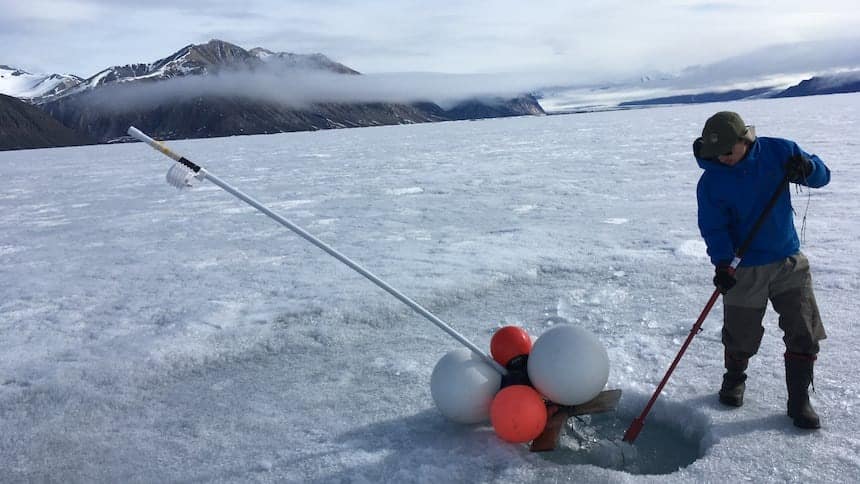
The scientists relied on instruments placed inside the ice shelf area to track changes in temperature, water depth and salt levels. These sensors remained in place longer than expected because the pandemic prevented researchers from returning during the 2020 field season.
Two years later, the team recovered the instruments and found that they had recorded the transformation of the ecosystem during a period when direct observation was impossible.
“We saw the [Milne Ice Shelf] breakup on satellite images, and two years later we got the data,” said Bernard Laval, one of the study’s co-authors. “The instruments were there, observing. We just couldn’t reach them.”

The researchers also found that freshwater from Milne Fiord is now flowing directly into the ocean because the remaining ice shelf can no longer hold it back. The conditions needed for the lake to exist have disappeared.
A Millennia-Old Lake Is Gone Forever
Scientists had to travel through several Arctic locations before reaching the remote site, where a small Twin Otter aircraft transported them with their equipment. The instruments they installed provided rare information about the collapse of an Arctic ecosystem as it happened. They captured the moment when a landscape that had remained stable for generations suddenly began to change.
Researchers say the loss of the epishelf lake cannot simply be reversed. For the lake to return, the ice shelf would need to rebuild itself and recreate the barrier that once separated freshwater from seawater.
“These systems took thousands of years to form and were lost in months,” Bonneau said. “On any human timescale, they are not coming back.”
Enjoyed this article? Subscribe to our free newsletter for engaging stories, exclusive content, and the latest news.

