Судлаачид Сарны хөрсний бүтэц нь бусад одны системийн өндөр хөгжилтэй иргэншлийн үлдээсэн биет ул мөрийг хадгалан үлдэх боломжтой эсэхийг судалж байна.
SETI Institute-ийн судлаач Льюис Ж. Пино болон түүний баг Сарны хөрсөн дэх реголит давхаргад агуулагдах технологийн гаралтай бичил хэсгүүдийг илрүүлэх судалгаа хийжээ. Энэхүү судалгааны ажил нь радио дохиог хүлээхээс илүүтэйгээр, галактикийн урт хугацааны туршид Сарны гадаргуу дээр хуримтлагдсан физик олдворуудыг эрж хайх шинэ арга барилыг санал болгож байна.
Судлаачид уг судалгаанд хоёр төрлийн хиймэл хэсгүүдийг авч үзжээ. Үүнд: иргэншлийн томоохон байгууламжийн эвдрэлээс үүдэлтэй “Архиповын хэсгүүд” болон зориудаар илгээсэн бие даасан төхөөрөмж буюу “Брасуэллийн хэсгүүд” багтаж байна. Сар нь агаар мандалгүй, тектоник идэвхжилгүй тул сансраас ирсэн ийм төрлийн бичил хэсгүүдийг олон сая жилийн турш хадгалан үлдэх хамгийн тохиромжтой орчин гэж үзэж байна.
Гэсэн хэдий ч сансрын биетүүд Сарны гадаргуу дээр маш өндөр хурдтайгаар ирж мөргөлдөх нь тэдгээр нарийн бүтцийг устгах эрсдэлтэй. Судлаачид хиймэл оюун ухаан болон өндөр нарийвчлалтай электрон микроскопыг ашиглан нэг шоо метр Сарны хөрсөн дэх их хэмжээний бичил шороон дундаас ийм төрлийн технологийн ул мөрийг ялгах боломжтой гэж таамаглаж байна.
Энэхүү судалгаа нь ямар нэгэн олдвор илрүүлээгүй тохиолдолд ч галактик дахь хиймэл материалын тархалтын талаарх шинжлэх ухааны үнэ цэнтэй хязгаарлалтуудыг тогтоох ач холбогдолтой юм. Уг ажлыг arXiv цахим хуудсанд урьдчилсан байдлаар нийтэлж, International Journal of Astrobiology сэтгүүлд хянуулахаар илгээжээ.
Дэлгэрэнгүйг эх сурвалжаас харах
↓Эх сурвалжийг нээх ↓
Tiny fragments of alien technology could be hiding inside the moon’s dusty surface, according to a new study exploring a different way to search for extraterrestrial civilizations. Instead of waiting for distant radio signals, researchers are examining whether lunar regolith could preserve physical traces left behind by advanced societies from other star systems.
The search for extraterrestrial intelligence has mostly focused on detecting radio transmissions from space. But this method depends on timing: a civilization may have existed millions or billions of years ago and disappeared long before humans began listening.
A research paper led by Lewis J. Pinault, an associate researcher at the SETI Institute, examines the possibility of finding microscopic technological remains inside lunar soil. The study, published as a preprint on arXiv and submitted to the International Journal of Astrobiology, explores how the moon could have collected material traveling through the galaxy over long periods.
Ancient Alien Debris May Hide On The Moon
The research focuses on two possible types of artificial particles: Arkhipov particles and Bracewell particles. Named after Ukrainian astronomer Alexei Arkhipov, Arkhipov particles would be accidental pieces of industrial debris. A civilization building enormous structures, such as a Dyson swarm, could eventually produce fragments through collisions or destruction. Some of these pieces might escape their original star system and travel through interstellar space.
The second category, Bracewell particles, comes from physicist Ronald Bracewell. These objects would be deliberately created and sent to other solar systems, acting like small autonomous probes or “smart dust.”
The researchers point out that the age of the galaxy leaves plenty of time for such material to move between star systems. The Milky Way is around 13 billion years old, while the sun takes approximately 230 million years to complete one trip around the galaxy. The study explores whether some of these particles could have eventually reached our solar system and landed on the moon.
A Cosmic Archive Buried in the Moon’s Soil
Unlike Earth, the moon has no atmosphere to destroy incoming objects before they reach the ground. The moon also lacks plate tectonics and a water cycle, meaning that material deposited on its surface is not constantly recycled or carried away. This makes lunar soil a more stable environment for preserving ancient particles.
The researchers describe impact gardening as another important factor. Tiny meteorites repeatedly strike the surface, mixing the upper layers of soil and potentially burying microscopic objects beneath the regolith.
The paper notes that some durable materials could survive long journeys through space. Advanced substances such as ceramics, graphene, and titanium-tungsten superalloys could resist cosmic radiation for periods between 100 million and 1 billion years.
The arrival process would still be a major challenge. The study explains that particles entering the solar system could accelerate to around 42 km/s at the distance of Earth’s orbit. At those speeds, impacts with the lunar surface could destroy delicate structures. The authors examine how solar radiation pressure could slow certain particles depending on their size and density.
AI Could Search Through Billions Of Lunar Grains
Finding a possible technological fragment in lunar soil would require analyzing an enormous amount of material. The researchers calculate that examining just one cubic meter of lunar regolith, weighing about 1.5 metric tons, would involve searching through more than a trillion micrometer-sized grains.
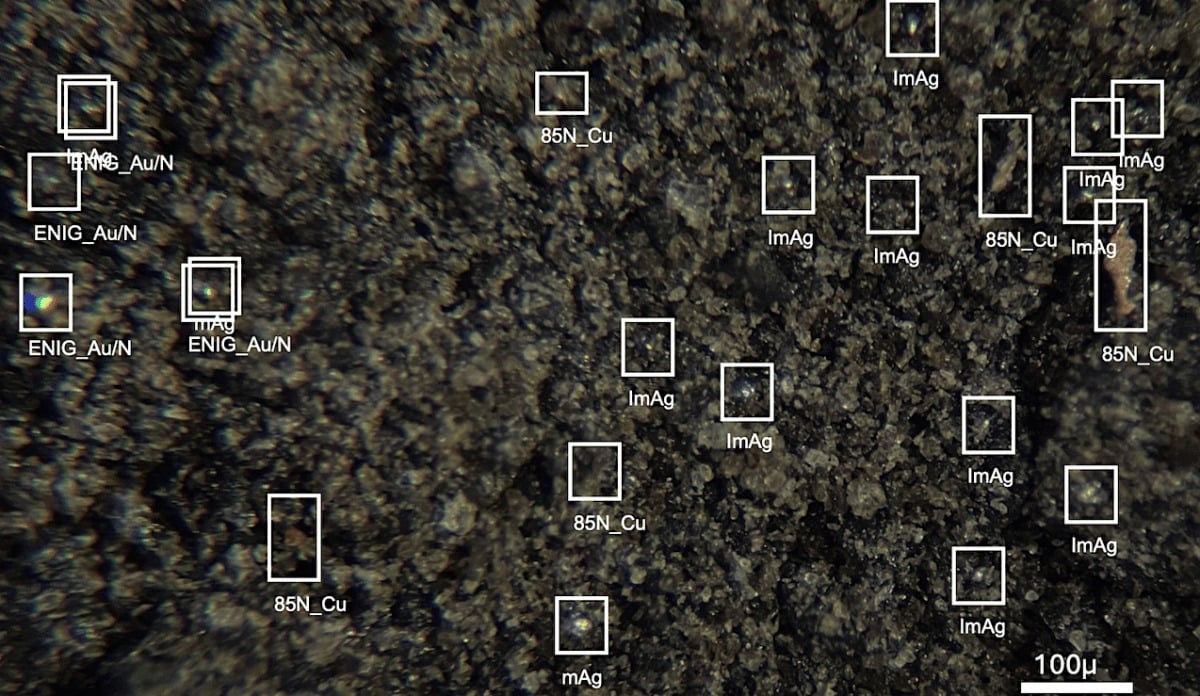
The study proposes using artificial intelligence to make this process possible. High-resolution scanning electron microscopes could create detailed images of lunar particles, while computer vision systems could identify unusual samples.
The research team has previously worked with a model called YOLO-ET, designed to help detect possible technosignatures. Particles marked as unusual could then be studied using advanced tools such as focused ion beam facilities and nano-CT scanners.
The authors also explain that a search without any discovery would still provide valuable scientific limits. Examining a cubic meter of lunar soil could help reduce uncertainty about how much artificial material advanced civilizations may have released into the galaxy.
Enjoyed this article? Subscribe to our free newsletter for engaging stories, exclusive content, and the latest news.

