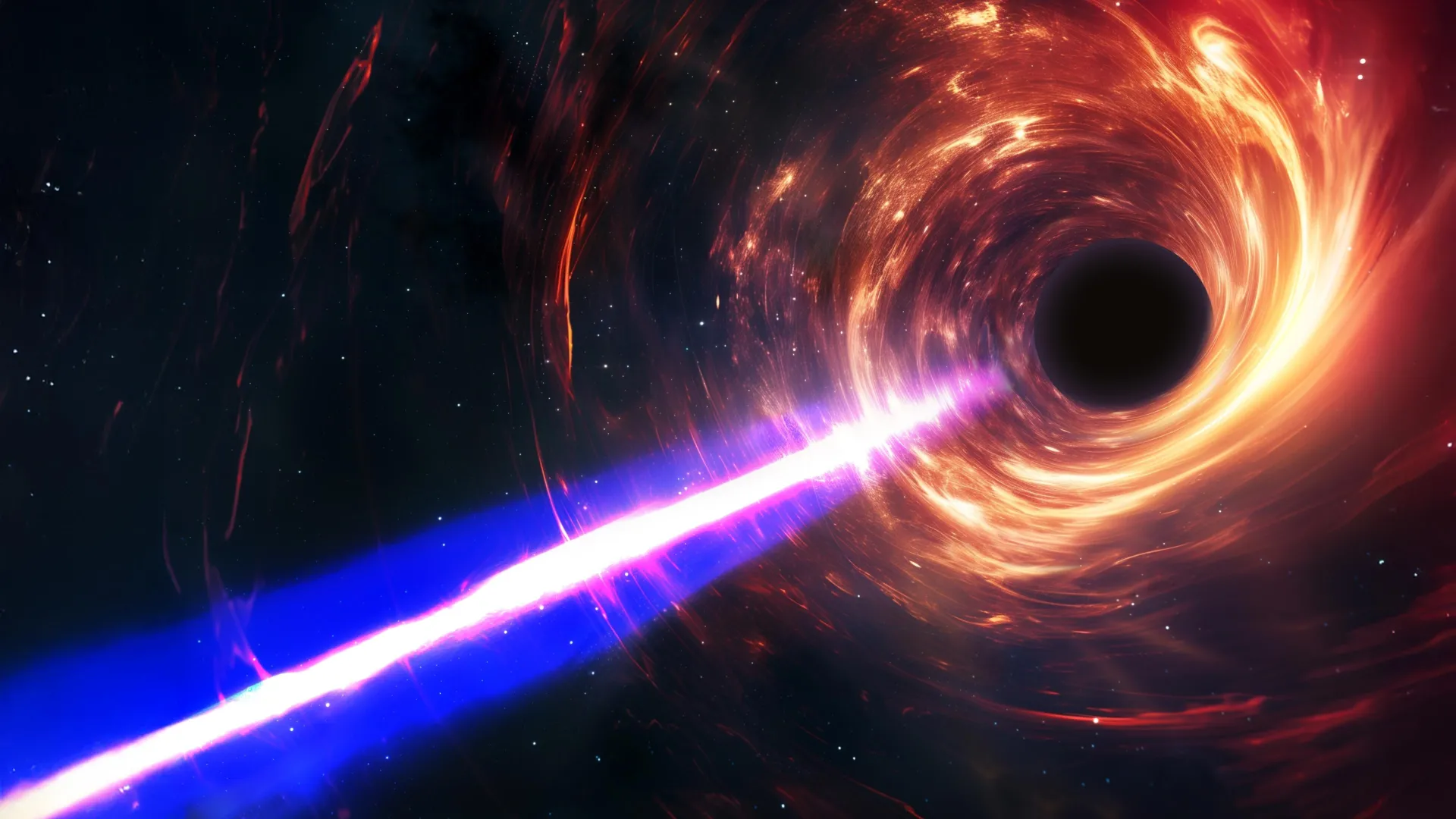
Олон улсын судлаачдын баг хар нүхнүүд хэмжээнээсээ үл хамааран ижил хэмжээний тэжээл шингээх үедээ хүчтэй тийрэлтэт урсгал ялгаруулдаг болохыг тогтоов.
Ахисан түвшний судалгааны хүрээлэнгийн (IAS) эрдэмтэн Эндрю Мүммэри болон Көртин их сургуулийн судлаач Адель Гүүдвин нарын тэргүүлсэн олон улсын баг хар нүхний тийрэлтэт урсгалын үүсэлтэй холбоотой шинэ нээлт хийлээ. Nature Astronomy сэтгүүлд нийтлэгдсэн энэхүү судалгаанд Америк, Австрали, Энэтхэг, Өмнөд Африк болон сансрын дуран авайнуудын олон жилийн ажиглалтын мэдээллийг нэгтгэсэн байна.
Судлаачид хар нүх оддыг залгих үед үүсдэг “түр зуурын тасалдал” (tidal disruption events)-ийг ашиглан тэдгээрийн хооллолтын үйл явцыг ажиглажээ. Хар нүх оддыг бутлах үед бүх материалыг бүрэн залгидаггүй бөгөөд ихээхэн хэсгийг нь сансарт хүчтэй тийрэлтэт урсгал хэлбэрээр цацдаг байна. Энэхүү үйл явц нь хэдэн сар эсвэл хэдэн жилийн турш үргэлжилдэг тул эрдэмтэд хар нүхний төлөв байдлын өөрчлөлтийг бодит цаг хугацаанд хянах боломжтой болжээ.
Шинжилгээний үр дүнд хар нүхнүүд хоёр тодорхой үе шатанд тийрэлтэт урсгал үүсгэдэг болохыг илрүүлсэн байна. Эхнийх нь одны материалыг маш хурдацтай идэж байх эхэн үед, харин хоёр дахь нь тэжээлийн хэмжээ нь Эддингтоны хязгаарын хоёр хувь хүртэл буурах үед тохиолддог ажээ. Энэхүү хоёр хувийн босго нь манай галактикийн жижиг хар нүхнүүдэд ч ажиглагддаг тул хар нүхний физик нь хэмжээнээсээ үл хамааран ижил зарчмаар явагддаг гэсэн дүгнэлтэд хүрчээ.
Энэхүү нээлт нь ирээдүйд хар нүхний идэвхжилийг урьдчилан таамаглах, сансрын дуран авайнуудын ажиглалтын хуваарийг илүү үр ашигтай төлөвлөхөд чухал ач холбогдолтой юм. Судлаачид 2028 онд ашиглалтад орох Square Kilometre Array радио телескопын төслийн хүрээнд энэ аргыг өргөнөөр ашиглах боломжтой гэж үзэж байна.
Дэлгэрэнгүйг эх сурвалжаас харах
↓Эх сурвалжийг нээх ↓
An international team of astronomers co-led by an IAS scholar has identified what appears to be a universal rule governing one of the most dramatic behaviors of black holes: the production of powerful jets.
The researchers found that black holes can launch jets at the same critical stage of their feeding cycle, regardless of their size. That includes “stellar-mass” black holes about ten times the mass of our sun as well as supermassive black holes that are millions of times heavier.
The work was carried out by Andrew Mummery, Martin A. and Helen Chooljian Member (2025-30) in the School of Natural Sciences at the Institute for Advanced Study, and Adelle Goodwin, a Forrest Research Foundation Fellow at Curtin University’s International Centre of Radio Astronomy Research in Western Australia.
Watching Black Holes Tear Stars Apart
Published in Nature Astronomy under the title “A universal critical accretion rate for black hole jet formation,” the study brings together years of observations across multiple wavelengths. The researchers combined data from telescopes in America, Australia, India, South Africa, and space.
Their focus was on tidal disruption events, which occur when a star passes so close to a supermassive black hole that intense gravitational forces rip it apart. These events gave the team a rare opportunity to watch how a black hole behaves after suddenly receiving a large supply of stellar material.
“We really wanted to figure out this massive puzzle,” said Mummery. “Why do some supermassive black holes blast out radio jets right after shredding a star, while others just sit there looking completely dormant, only to suddenly fire up their jets months or even years later?”
Black holes are often compared with cosmic vacuum cleaners, but their feeding behavior is much messier. “When a black hole tears apart a star, it does not swallow everything neatly,” Goodwin stated.
Some of the stellar material falls toward the black hole, while much of it can be violently expelled into space through powerful outflows. These enormous cosmic “burps” can carry material across vast distances and can significantly affect the evolution of the galaxies that contain them.
A Faster Way to Study Supermassive Black Holes
Astronomers have long suspected that black holes obey the same basic physical rules even when their masses differ enormously. Confirming that idea has been difficult because changes around supermassive black holes can normally unfold over thousands or even millions of years.
Tidal disruption events offer a way around that problem. When a star is destroyed, the resulting feeding episode around a supermassive black hole can evolve over just a few years. That gives scientists a much faster view of processes that would otherwise be extremely difficult to track in real time.
The key insight behind the new study emerged in an unexpected setting. During an astrophysics conference in Madrid, Mummery and Goodwin were talking in a bar when they realized that the same rule known to govern jet production in smaller black holes might also apply to supermassive ones.
Two Distinct Phases of Black Hole Jets
To test the idea, the researchers examined twenty tidal disruption events using observations in optical light, ultraviolet light, X-rays, and radio waves.
They eventually narrowed the sample to ten high-quality events for which they could reliably determine both the black hole’s feeding rate and the timing of its radio outflows.
The analysis revealed two separate periods when jets can form.
The first occurs early, while the black hole is consuming material at an extremely high rate. The second appears much later, hundreds to thousands of days after the star was initially torn apart.
At that later stage, the black hole’s feeding rate falls to about two percent of its Eddington limit, the point at which the outward pressure of radiation balances the inward pull of gravity.
That two percent threshold is especially important because it is already known to trigger jet formation in much smaller black holes within our galaxy. Finding the same threshold in supermassive black holes suggests that this part of black hole physics works in essentially the same way across an enormous range of masses.
Predicting When Black Holes Will Erupt
The discovery could also have practical value for astronomers.
If researchers can predict when a black hole is likely to produce a delayed jet, they can schedule observations more efficiently and increase their chances of catching these short-lived events as they happen.
That could make better use of heavily requested telescopes and reduce the number of observations made when little activity is expected.
The ability to anticipate these eruptions may become particularly useful for major future observatories, including the Square Kilometre Array radio telescope project, which is expected to begin collecting scientific data in 2028.
“We hope that our work will pave the way for even more profound discoveries about our universe,” said Mummery.

