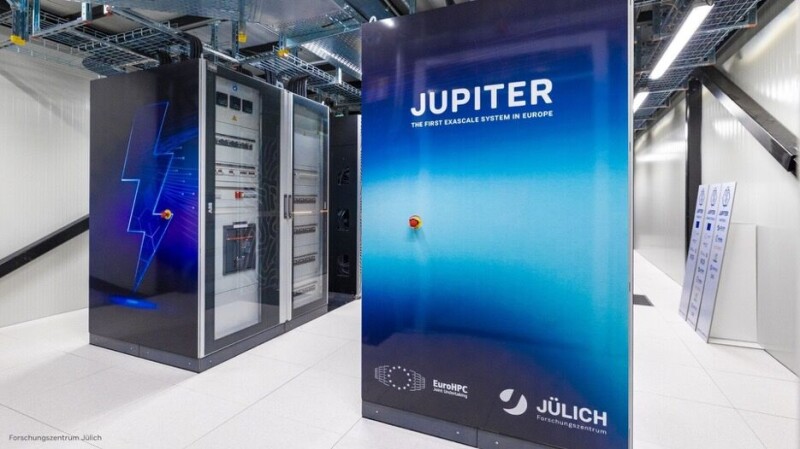
Францын SiPearl компани Европын холбооны анхны эксаскале хүчин чадалтай Jupiter суперкомпьютерт зориулсан Rhea1 процессоруудыг нийлүүлж эхэлснээр Европын технологийн бие даасан байдлыг бэхжүүлэх чухал алхам хийв.
Мягмар гарагт SiPearl компани өөрийн бүтээсэн Rhea1 CPU-г Bull системд нэгтгэхээр нийлүүлэлтээ эхлүүлсэн байна. Одоогоор дэлхийн хамгийн хүчирхэг 500 суперкомпьютерийн жагсаалтын тавдугаарт бичигдэж буй Jupiter нь өмнө нь Nvidia-гийн Америкт үйлдвэрлэсэн GH200 суперчипүүдийг ашиглан амжилт тогтоож байсан юм.
Rhea1 процессор нь Arm-ын Neoverse V1 архитектурт суурилсан 80 цөмтэй, 61 тэрбум транзистор бүхий чип бөгөөд GPU-д тохиромжгүй шинжлэх ухааны тооцоолол болон HPC ажлын ачааллыг гүйцэтгэхэд зориулагджээ. Уг процессор нь 64 ГБ багтаамжтай HBM2e санах ой болон DDR5 санах ойн сувгуудаар тоноглогдсон нь их хэмжээний өгөгдөлтэй ажиллахад өндөр үр ашигтай юм.
Юлих суперкомпьютерийн төвийн захирал Томас Липперт энэхүү технологи нь шинжлэх ухааны салбарт өгөгдлийн боловсруулалтыг илүү хүртээмжтэй болгоно гэж онцоллоо. EuroHPC JU-ийн гүйцэтгэх захирал Андерс Дам Женсений хэлснээр, энэ нь Европын судалгаа, аж үйлдвэр болон дэд бүтцийг нэгтгэж, HPC экосистемийг хүчирхэгжүүлэхэд чиглэсэн томоохон эргэлт болж байна.
Jupiter систем бүрэн ашиглалтад ороход 1,300 зангилаа бүхий 2,600 процессортой болох бөгөөд CPU-ийн хэсэг нь 5 петаFLOPS хүчин чадалтай байх төлөвтэй байна. Түүнчлэн SiPearl компани өөрийн Rhea2 процессоруудыг Alice Recoque суперкомпьютерт ашиглахаар төлөвлөж байгаа нь тус компанийн зах зээл дэх байр суурийг улам бэхжүүлж байна.
Дэлгэрэнгүйг эх сурвалжаас харах
↓Эх сурвалжийг нээх ↓
Talk about digital sovereignty! Europe’s most powerful supercomputer, Jupiter, is finally getting the domestic silicon infusion it’s been waiting for. On Tuesday, French chip designer SiPearl began delivery of its long-anticipated Rhea1 CPUs to Bull for integration into the system. Jupiter, which came online last year, became the European Union’s first exascale supercomputer. It currently holds the designation of being the fifth most powerful system on the Top500 ranking of publicly known supercomputers. But that feat wasn’t achieved using European silicon. The Jupiter Booster, which set the EU record, was powered by 24,000 American-made GH200 superchips from GPU giant Nvidia. These high-end accelerators were the precursor to the Grace Blackwell superchips used in its AI rack systems and featured a single Grace CPU and H200 GPU. However, the Booster section is only part of the larger Jupiter system. SiPearl’s chips will power a second CPU-only partition. Rhea1 has been under development for several years and marks a turning point for sovereign supercomputing. Based on Arm’s Neoverse V1 core designs, the chip is already showing its age. Even the Grace CPUs powering the booster section use Arm’s newer V2 cores. Yet, the Rhea1 is still notable. With 61 billion transistors, the 80-core chip was designed specifically for running HPC and scientific workloads not well suited to GPUs. In many respects, the chip is reminiscent of the Fujitsu A64FX CPUs that propelled Japan’s Fugaku supercomputer to the number one spot on the Top500 back in early 2020. Each Rhea1 processor is equipped with four stacks of HBM2e totaling 64 GB and achieving 1.8 TB/s of bandwidth. Along with the HBM, each Rhea1 CPU has four DDR5 memory channels. Many HPC workloads benefit from a higher ratio of memory bandwidth to FLOPS. This is why systems like Fugaku have historically done so well on the Top500’s HPCG benchmark relative to their positioning on the more commonly cited HPL bench. “Its high memory bandwidth is particularly well suited to applications that benefit from efficient access to large amounts of data. Bringing this European processor technology into JUPITER is an important step in making these capabilities available to the scientific community,” Thomas Lippert, director of the Jülich Supercomputing Centre, said in a statement. For Anders Dam Jensen, executive director of EuroHPC JU, the delivery represents a major turning point for the EU. “This achievement demonstrates what Europe can accomplish by bringing together research, industry and world-class infrastructure to build a stronger European HPC ecosystem,” he said. When complete, Jupiter’s CPU partition will fill 1,300 nodes totaling 2,600 processors with estimates putting its total output at 5 petaFLOPS. While tiny compared to the booster, it remains relevant as not all workloads can take advantage of GPU-based compute. Jupiter isn’t SiPearl’s only win. The Alice Recoque supercomputer is slated to use the chip dev’s Rhea2 chips in its CPU partition and AMD’s MI430X accelerators in its GPU partition. ®

