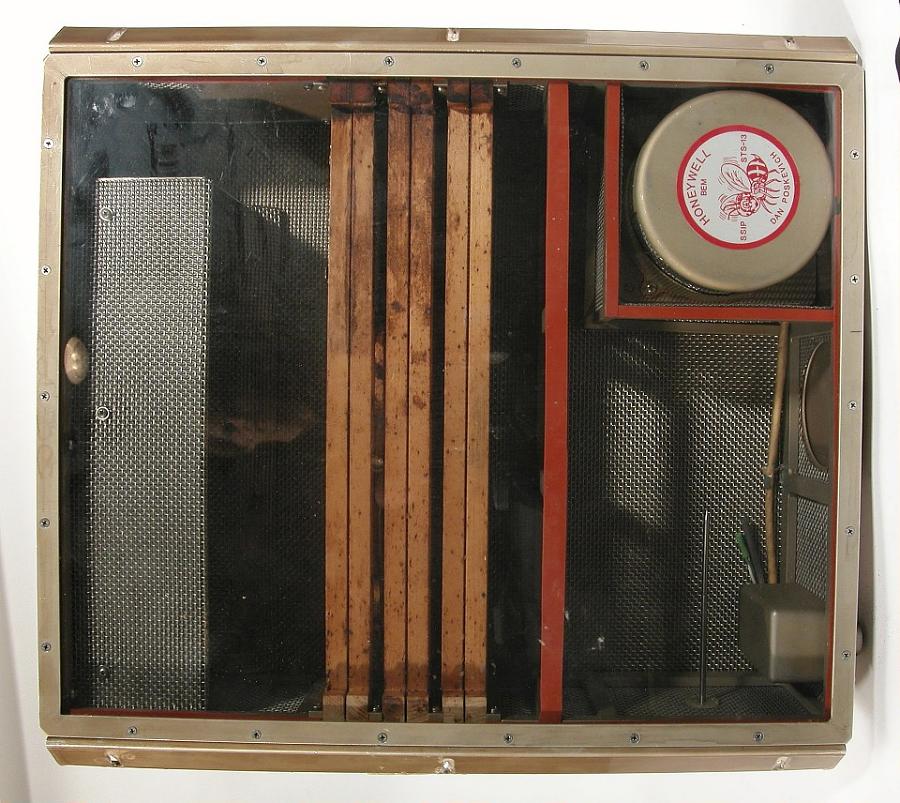
Бичил таталцлын нөхцөлд зөгий хэвийн хэмжээтэй зөгийн балны үүр барьж чадах эсэхийг тогтоох судалгааг 1984 оны дөрөвдүгээр сард Challenger сансрын хөлөг дээр явуулжээ.
NASA-гийн STS 41-C нислэгийн үеэр 3,400 орчим ажилчин зөгий болон нэг хатан зөгийг тусгай төхөөрөмжид байршуулан сансарт илгээсэн байна. Туршилтын зорилго нь таталцалгүй орчинд зөгий үүрний бүтцээ хэвийн барьж чадах эсэхийг ажиглахад чиглэжээ. Дөрөвдүгээр сарын 9-ний өдөр сансрын нисгэгчид зөгийг нислэг үйлдэх явцдаа төхөөрөмжийн хана мөргөж байгааг бичиж авсан боловч долоо хоногийн дараа буюу дөрөвдүгээр сарын 13-нд хөлөг газардах үед зөгий шинэ орчиндоо дасан зохицсон байжээ.
Судалгааны үр дүнд зөгий сансарт 200 см² талбай бүхий үүр барьж, сахар болон усны найрлагатай тэжээлээ хадгалж, 35 орчим өндөг гаргасан байна. Сансарт баригдсан үүрний эсийн нягтрал, гүн, диаметр нь Дэлхий дээрх үүртэй ерөнхийдөө ижил байсан ч эсийн чиглэлд тодорхой өөрчлөлт ажиглагджээ. Эрдэмтэд үүнийг таталцлын дохио дутагдсанаас үүдэлтэй зөгийний чиг баримжаа алдагдсантай холбоотой байж болзошгүй хэмээн тайлбарласан байна.
Туршилтын явцад гарсан өндөгнүүд эх дэлхийд эргэн ирсний дараа хагараагүй бөгөөд үүний тодорхой шалтгааныг судлаачид тогтоож чадаагүй юм. Мөн тус туршилт нь зөгийнүүдийн өмнөх насны туршлага болон сансрын орчны температурын нөлөөллийг бүрэн ялгаж салгахад хүндрэлтэй байсан нь судалгааны хязгаарлагдмал тал болжээ. Энэхүү түүхэн төхөөрөмж нь өдгөө АНУ-ын Виржиниа муж дахь Smithsonian National Air and Space Museum-д хадгалагдаж байна.
Дэлгэрэнгүйг эх сурвалжаас харах
↓Эх сурвалжийг нээх ↓
The bees were loaded into their aluminum enclosure on April 5, 1984, one day before space shuttle Challenger launched on the STS 41-C mission. By April 9, three days after launch and on the mission’s fourth calendar day, astronauts were seeing the honeybees repeatedly crash into the walls of their flight chamber. The crew recorded the collisions on video, giving researchers an early look at how the insects were coping with weightlessness.
That same day, the shuttle’s second rendezvous with the Solar Maximum Mission satellite had been delayed by Mission Control. NASA’s history of the flight says the astronauts used the extra time for the bee experiment, Earth photography and work with a large-format camera. By April 13, when Challenger landed after a seven-day mission, the bees appeared to have adapted, with those making directed flights now avoiding the chamber walls.
The colony contained roughly 3,400 worker bees and one queen according to the scientific study, although NASA gave a figure closer to 3,300. The experiment was designed to answer a simple question: could honeybees build normal honeycomb without gravity? The week-long flight gave researchers a rare chance to see how both bee behavior and comb construction changed in microgravity.
There was reason to doubt that normal construction would be possible. The researchers cited earlier work showing that bees use sensory bristles between the head and thorax to help detect gravity. When those bristles were sealed in previous experiments, the insects had difficulty building comb normally.
Dan Poskevich, a student at Waverly Central High School in Tennessee, proposed the experiment through NASA’s Shuttle Student Involvement Program. Poskevich and four coauthors from the U.S. Department of Agriculture and Honeywell later reported the results in a 1985 paper in Apidologie. The bees survived the week with low mortality and produced about 200 square centimeters of comb, stored sugar syrup in it and laid roughly 35 eggs.
Two Identical Boxes, One in Orbit
The experiment used two nearly identical bee enclosure modules, one aboard the shuttle and one kept on Earth for comparison. Each measured about 11.75 by 38.10 by 45.72 centimeters and contained three wooden frames, a feeder trough, a small flight chamber, a fan and two temperature probes. The feeder held about 1.67 liters of water, sucrose and agar, with the agar thickening the syrup so it would remain manageable in weightlessness.
The second module stayed at Johnson Space Center in Houston as a ground control. On April 6, it was briefly placed in a centrifuge to simulate the forces of launch and ascent. Astronauts inspected the flight colony four times and recorded video on April 9 and April 11 before the shuttle returned to Edwards Air Force Base on April 13.
The crew described an active colony. Bees crawled over the syrup and fed directly from it, while another group gathered near the air inlet and fanned their wings. Workers formed clusters stretching between the food source and the growing comb, and some carried dead bees toward the fan area.

NASA’s compendium of shuttle biology experiments also records that the bees linked themselves into a chain about 10 inches long. The ground colony, meanwhile, built very little comb. The researchers believed temperature was probably a major reason for the difference.
The cluster in Houston remained between about 21 and 29 degrees Celsius, while the colony in orbit reached roughly 31 degrees by April 9. The authors cited earlier work placing optimal wax secretion at around 33 to 36 degrees. A warmer Earth-based trial conducted at Johnson Space Center in September 1983 produced more than 200 square centimeters of comb, suggesting temperature may have strongly affected the ground result.
Cell Sizes Held, Cell Angles Did Not
After the mission, researchers compared six pieces of honeycomb: three produced in orbit, two from the warmer 1983 ground trial and one from a conventional hive in Beltsville, Maryland. In most respects, the space-built comb looked surprisingly normal. Cell density, depth, diameter and wall thickness were broadly similar to comb produced under Earth gravity.
Cell density averaged about 800 cells per square decimeter, while internal diameters ranged from 4.76 to 5.12 millimeters. These measurements showed that the bees could still construct cells of roughly normal size in microgravity. The most noticeable difference was not the shape of the cells but their orientation.
On Earth-built comb, cells on opposite faces ran parallel to each other. On the larger of two pieces constructed in orbit without foundation wax, however, cells on one side tilted upward toward the plastic lid by an average of 9.4 degrees. Cells on the opposite face tilted downward toward the floor by an average of 7.2 degrees.

The authors interpreted this as evidence of disorientation. Two pieces attached to the lid were roughly parallel, but their faces angled toward one another instead of remaining vertical relative to the lid. A third piece, apparently started from the module floor, showed an even wider range of cell angles and wall thicknesses of up to 3.6 millimeters.
The researchers suggested that disorientation might explain those irregularities as well, although they could not determine the exact cause. The results showed that bees could still produce recognizable honeycomb without normal gravity cues. What changed most clearly was the direction in which the cells were built.
Eggs That Never Hatched
The queen laid about 35 eggs during the mission, but none survived. After the shuttle returned, the eggs were moved to standard hive equipment near Johnson Space Center, where they failed to hatch. The researchers did not identify a specific cause and noted that the eggs had been exposed to conditions that were not fully known.
The study also had important limitations. The bees were about 15 days old at launch and may already have had experience building comb, which could have influenced how they worked in microgravity. The experiment was also never replicated, making it difficult to separate the effects of weightlessness from temperature and other environmental factors.
The enclosure itself continued to be used after the mission. It later housed houseflies on another shuttle flight in 1985. Today, the Bee Enclosure Module is displayed in the Space Science gallery at the Smithsonian National Air and Space Museum’s Steven F. Udvar-Hazy Center in Chantilly, Virginia.
Enjoyed this article? Subscribe to our free newsletter for engaging stories, exclusive content, and the latest news.

