
Английн Шорхам эрэг дээрээс олдсон чулууг археологчид дундад палеолитын үед хамаарах эртний хүн төрөлхтний багаж хэрэгсэл гэж баталлаа.
Бен Виттен гэх хүү гурван жилийн өмнө Шорхам эрэг дээр тоглож байхдаа бусад чулуунаас өөр харагдах нэгэн хайрган чулууг олж гэртээ авчирчээ. Тэрээр уг чулууг тоглоом болгон ашиглаж, заримдаа гээгдүүлдэг байсан ч гурван жилийн дараа Уортингийн музейд болсон чулуун зэвсгийн үеийн үзэсгэлэнг үзэхдээ өөрийн олсон чулуутай төстэй зүйлс байгааг анзаарсан байна. Түүний ээж олдворын гэрэл зургийг Уортингийн музейн археологийн куратор Жэймс Сэйнсберид илгээснээр уг олдворыг шинжлэх ухааны үүднээс судлах боломж бүрджээ.
Жэймс Сэйнсбери гэрэл зургийг үзээд уг олдвор нь 40,000-аас 60,000 жилийн тэртээх дундад палеолитын үед неандерталчуудын урласан гар сүх болохыг тогтоосон байна. Хоёр талыг нь нямбай засаж ирлэсэн уг зэвсэг нь тухайн бүс нутагт маш ховорт тооцогдох олдвор бөгөөд сүүлийн арван жилд музейд ирсэн хамгийн эртний олдвор болжээ. Неандерталчууд ийм төрлийн гар сүхийг мах хэрчих, мод цавчих, газар ухах зэрэг олон төрлийн ажилд ашигладаг байсан нь тогтоогдсон юм.
Уг олдвор Шорхам эрэг дээр хэрхэн ирсэн нь тодорхойгүй байгаа бөгөөд судлаачид үүнийг эрэг орчмын барилгын ажил эсвэл мөстлөгийн үеийн газарзүйн өөрчлөлттэй холбоотой байж болзошгүй хэмээн таамаглаж байна. Одоогоор уг гар сүхийг Британийн музейн “Portable Antiquities Scheme” хөтөлбөрт бүртгэж, олон нийтэд үзүүлж байна. Энэхүү тохиолдол нь мэргэжлийн бус хүн ч гэсэн байгаль орчноо ажиглах замаар түүхэн ач холбогдолтой чухал нээлт хийж болохыг харууллаа.
Дэлгэрэнгүйг эх сурвалжаас харах
↓Эх сурвалжийг нээх ↓
For three years, a shiny piece of flint that Ben Witten picked up on Shoreham Beach sat in his bedroom. He was only six when he found it, and at the time there was no reason to think it was anything more than an unusual stone. By his own account, he would occasionally lose it among his belongings and then find it again later.
Shoreham Beach, on the West Sussex coast, is covered with millions of flint pebbles in shades of grey, brown and white. But this particular stone stood out to Ben. “I just thought it looked different [from] all the other different pebbles and stones,” he told the BBC, explaining why he decided to take it home.
A Curator Expecting Another Pebble
Three years later, when Ben was nine, he visited a Stone Age exhibition at Worthing Museum, a few miles farther along the coast. Some of the small, pointed prehistoric tools in the display cases looked surprisingly similar to the stone he had kept in his room. His mother, Emma, decided to send photographs of it to James Sainsbury, the museum’s curator of archaeology.
Sainsbury was not expecting anything remarkable. “When I saw the email saying ‘beach find,’ I thought, ‘Here’s another pebble,’” he later recalled. But after looking at the photographs, it became clear that Ben’s stone was something much more significant.
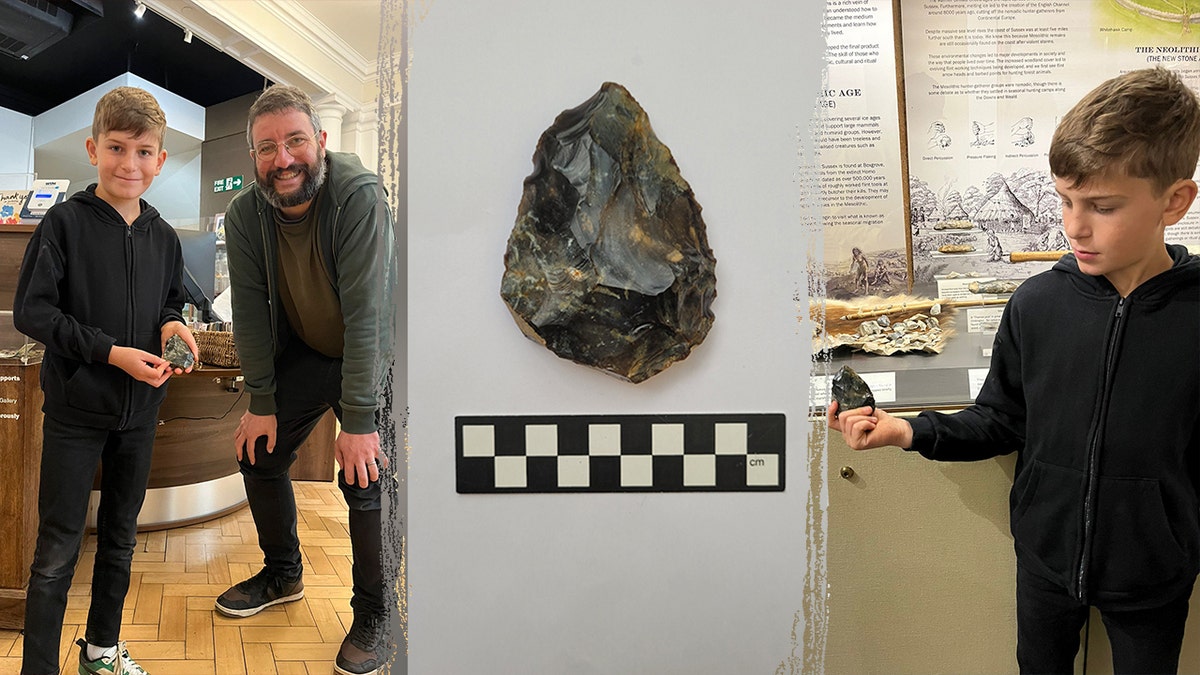
The object was identified as a prehistoric hand axe. In a November post, Worthing Museum said it was almost certainly made by a Neanderthal and dated it to roughly 40,000 to 60,000 years ago, during the late Middle Paleolithic. The stone that had spent years sitting in a child’s bedroom was therefore tens of thousands of years old.
Rarer Than the Pebbles Around It
Worthing Museum regularly receives archaeological objects brought in by local residents. According to Sainsbury, many are other types of flint tools or Roman artifacts, but Ben’s discovery was far older. He told Fox News Digital that it was the oldest object anyone had shown him in more than a decade at the museum.
Neanderthal hand axes are also relatively rare in Sussex. Sainsbury said this was the first one found locally in years, while the museum noted that such discoveries are uncommon even for professional archaeologists. The fact that a young boy had found one simply by walking along a beach made the discovery especially unusual.

The axe is bifacial, meaning that both sides of the flint were deliberately shaped. It is small enough to fit in the palm of a hand and shows relatively little sign of wear. Its carefully worked edges also make it clearly different from an ordinary stone that had simply been shaped by the sea.
Neanderthals made tools like this by chipping flint into carefully worked shapes with sharp, functional edges. Hand axes were probably useful for several different tasks, including cutting, digging, butchering animals and chopping wood. Their construction required planning and considerable skill.
How It Reached the Beach
Exactly how the hand axe ended up on Shoreham Beach is still unclear. One possibility is that it was brought there much more recently during construction or coastal-defense work involving stone and sediment. If that happened, the place where Ben found it may not have been anywhere near its original archaeological location.
Another possibility is that the axe came from the prehistoric landscape surrounding the area. The coastline would have looked very different 40,000 to 60,000 years ago because sea levels and geography changed dramatically during the Ice Age. “The sea would have been further away than it is now,” Sainsbury said.

“We don’t know exactly what the Sussex coast looked like back then,” he added. That uncertainty makes it difficult to reconstruct exactly where the tool was made, used or lost. Archaeologists can study the object itself, but much of the story of how it reached a modern beach remains unknown.
From Bedroom to Display Case
Ben later agreed to lend the hand axe to Worthing Museum, where it was placed on public display until February. After that, it was due to be returned to him and his family. Although Ben had originally wanted to keep it, he said he felt the museum was a better place for it than his bedroom.
The discovery also appears to have sparked a deeper interest in archaeology. Ben said he would like to become an archaeologist when he grows up. His find has already given him the kind of experience that many people working in the field may never have.
For Sainsbury, the story also shows that important archaeological discoveries are not limited to trained specialists. “I hope people realize that they don’t need specialist training to find interesting archaeology,” he said. Members of the public can make meaningful discoveries simply by noticing when something looks unusual.
Worthing Museum said the hand axe would also be recorded through the British Museum’s Portable Antiquities Scheme. What began as a shiny stone picked up by a six-year-old had turned out to be an object made by Neanderthals tens of thousands of years ago. For three years, one of the rarest archaeological finds in the area had simply been sitting in a child’s bedroom.
Enjoyed this article? Subscribe to our free newsletter for engaging stories, exclusive content, and the latest news.

