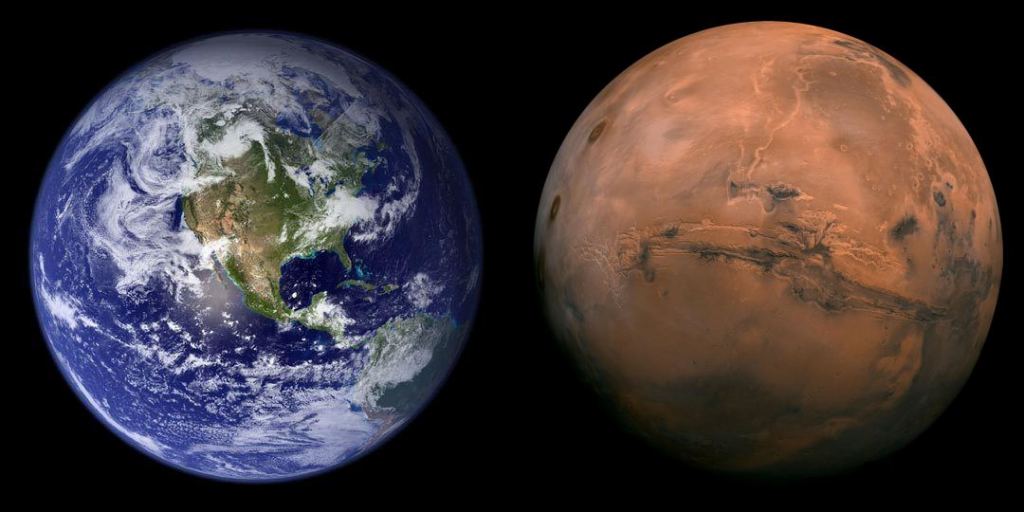
Шинэ судалгаагаар Дэлхий болон Ангараг гараг нь нарны аймгийн бүрэлдэхүүнд зэрэгцэн оршдог ч үүсэл хөгжлийн үндсэн үйл явц нь эрс ялгаатай байсныг тогтоожээ.
Копенгагены их сургуулийн Globe Institute-ийн судлаачид Дэлхий болон Ангараг гарагийн царцдас, мандал дахь натри, цайр, кали зэрэг дэгдэмхий элементийн харьцааг шинжлэн, тэдгээрийн үүсэл хөгжлийн түүхийг сэргээн босгожээ. Nature Astronomy сэтгүүлд нийтлэгдсэн уг судалгаагаар, Дэлхий гарагийн нийт массын 75 гаруй хувь нь жижиг чулуулаг буюу “хайрга” хуримтлагдах замаар үүссэн хоёр протопланетаас бүрддэг бол Ангараг гарагийн массын дийлэнх нь гариг үүсгэгч том биетүүдийн мөргөлдөөнөөс үүссэн болохыг тогтоосон байна.
Судлаачид статистик загварчлал ашиглан, дэгдэмхий элементүүд гараг үүсэх үйл явцад хэрхэн алдагдсаныг тооцоолжээ. Энэхүү арга нь уламжлалт изотоп шинжилгээний аргуудаас илүү нарийвчлалтай бөгөөд нарны аймгийн эхэн үеийн хий, тоосны дискнээс гарагууд хэрхэн бүрэлдсэнийг шууд ойлгох боломжийг олгож байна.
Эрдэмтэд судалгааны үр дүнд тодорхой хэмжээний тодорхой бус байдал байгааг хүлээн зөвшөөрч байна. Тухайлбал, нарны аймгийн эхэн үеийн үүсгэгч материалын химийн найрлага болон Ангараг гарагийн үүсэлд оролцсон биетүүдийг Веста астероидтой төстэй байсан гэж таамагласан нь тооцоололд нөлөөлж болзошгүй юм.
Гэсэн хэдий ч судалгааны үндсэн дүгнэлт нь өөрчлөгдөөгүй бөгөөд энэ нь цаашид экзопланетуудын амьдрах орчныг судлахад чухал ач холбогдолтой юм. Ирээдүйд ашиглалтад орох Habitable Worlds Observatory зэрэг дурангууд нь өөр оддын систем дэх гарагуудын химийн найрлагыг тодорхойлж, тэдгээр нь ус болон амьдралыг тэтгэгч бодисуудыг хадгалах боломжтой эсэхийг урьдчилан таамаглахад тусална.
Дэлгэрэнгүйг эх сурвалжаас харах
Эх сурвалжийг нээх ↓
According to Nebula Theory, the Solar System formed about four and a half billion years ago from a massive accretion disk of gas and dust that orbited our Sun. Alas, there are still questions about how they formed, with scientists favoring one of two possible pathways. Either they emerged from collisions between larger rocks (planetesimals), or from the gradual accumulation of pebbles by planetesimals.
New research from the University of Copenhagen has offered new evidence that could settle the debate. Using a novel approach, they have reconstructed the earliest stages of the planets’ formation by analyzing their chemical composition. Their results suggest that a hybrid model that merges the two pathways could explain how rocky planets like Earth and Mars formed, which could have implications in the study of exoplanets.
The research was led by Assistant Professor Haiyang S. Wang and Professor Anders Johansen, researchers from the Center for Star and Planet Formation, part of the Globe Institute at the University of Copenhagen. They were joined by researchers from the Institute for Particle Physics and Astrophysics at ETH Zürich, the Nevada Center for Astrophysics (NCfA), the Lunar and Planetary Laboratory, and multiple universities. A paper detailing their findings was published in the scientific journal Nature Astronomy.
An artist’s depiction of a protoplanetary disk in which planets are forming. Credit: ESO/L. Calçada
The team’s approach focuses on specific elements located in the crust and mantle of Earth and Mars. Specifically, they focused on volatile elements like sodium, zinc, and potassium, elements that have relatively low melting points and evaporate at high temperatures. By analyzing the abundance of these elements, scientists are able to determine what processes the planet underwent during formation.
“It is a major detective job to figure out what happened back then when most of the evidence disappeared long ago,” said Johansen in a Globe Institute press release. “But even after 4.5 billion years, the compositions of Earth’s and Mars’ mantles remain the same. You can think of them as an imprint of the formation process.”
Combined with advanced statistical modeling, they then calculated the most likely formation scenarios for the two planets. Their results demonstrated that volatile elements are lost from pebbles as they travel toward a planet’s surface. Based on their relative abundance on Earth and Mars, this suggests that the two planets formed in different ways: Mars formed primarily through planetesimals colliding while Earth began largely as two protoplanets that grew through pebble accretion. As Wang summarized:
The most surprising result was that Earth and Mars appear to have formed in different ways. You might have expected that two planets formed side by side in the same solar system would share a more similar formation history.
At least 75 percent of Earth’s mass appears to originate from two young planets, known as protoplanets, that grew large by accreting pebbles, while planetesimals contributed up to 25 percent. In contrast, roughly three-quarters of Mars’ mass appears to come from planetesimals, with the remaining quarter originating from pebble accretion.
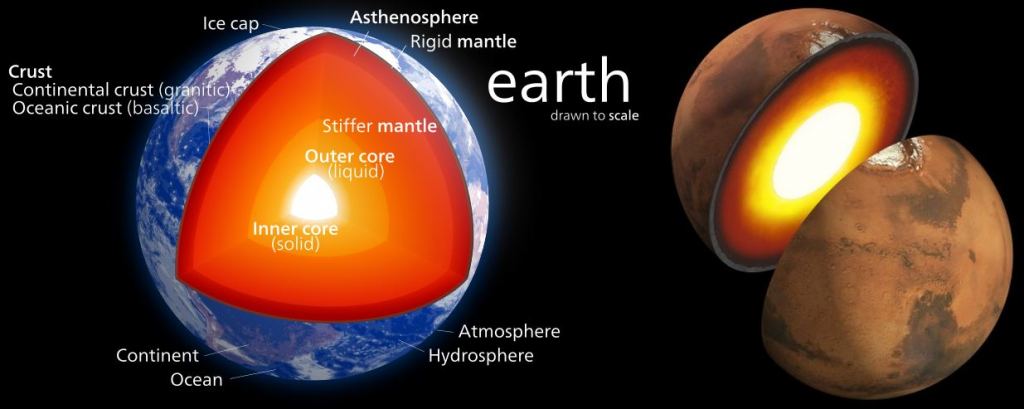 Earth and Mars are both differentiated bodies, meaning they’re made up of different layers of material with different densities. Credit: (Earth) Kelvinsong, (Mars) NASA
The researchers stress that their results are based on statistical modeling that contains uncertainties. These include the assumption of the chemical composition of the young Solar System’s accretion disk that would eventually form the planets. In addition, based on Mars’ similarities to Earth, it was also assumed that the planetesimal building blocks were chemically similar to the asteroid Vesta.
Lastly, it is traditionally assumed that volatile elements are lost more efficiently during pebble accretion than during giant impacts. But as Wang noted, even after the results are adjusted for these assumptions, the main conclusion remains the same:
The exact percentages may vary somewhat, but our analyses consistently indicate that Earth and Mars formed in two different ways. Our method provides a more precise and direct way of understanding planet formation than the more widely used isotope-based approach, which can often be interpreted in multiple ways.
What’s more, a better understanding of the formation pathways of rocky planets could help inform the ongoing search for habitable exoplanets. The Nancy Grace Roman Space Telescope, which launched on August 30th, is equipped with a Wide Field Instrument and a field of view that is at least 100 times larger than that of the Hubble Space Telescope.
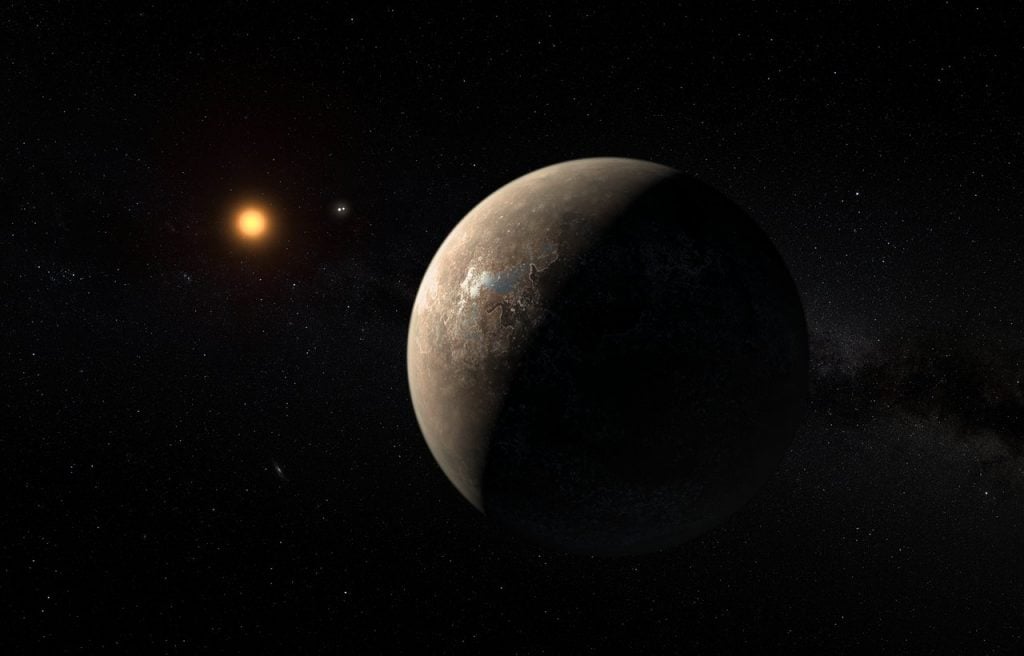 This artist’s impression shows the planet Proxima b orbiting the red dwarf star Proxima Centauri, the closest star to our Solar System. Credit: ESO/M. Kornmesser.
The Habitable Worlds Observatory (HWO), when it deploys in the 2040s, will have even more powerful resolution and sensitivity. Along with ground-based observatories that combine large primary mirrors with adaptive optics (AOs), these observatories will be able to characterize exoplanets by determining their chemical compositions. This is vital to determining whether or not they are capable of supporting life, aka. “habitable.”
“If we understand how planets lose volatile elements during their formation, we can also become better at predicting how much water and other life-supporting substances they ultimately retain,” said Johansen.
Further Reading: The Globe

