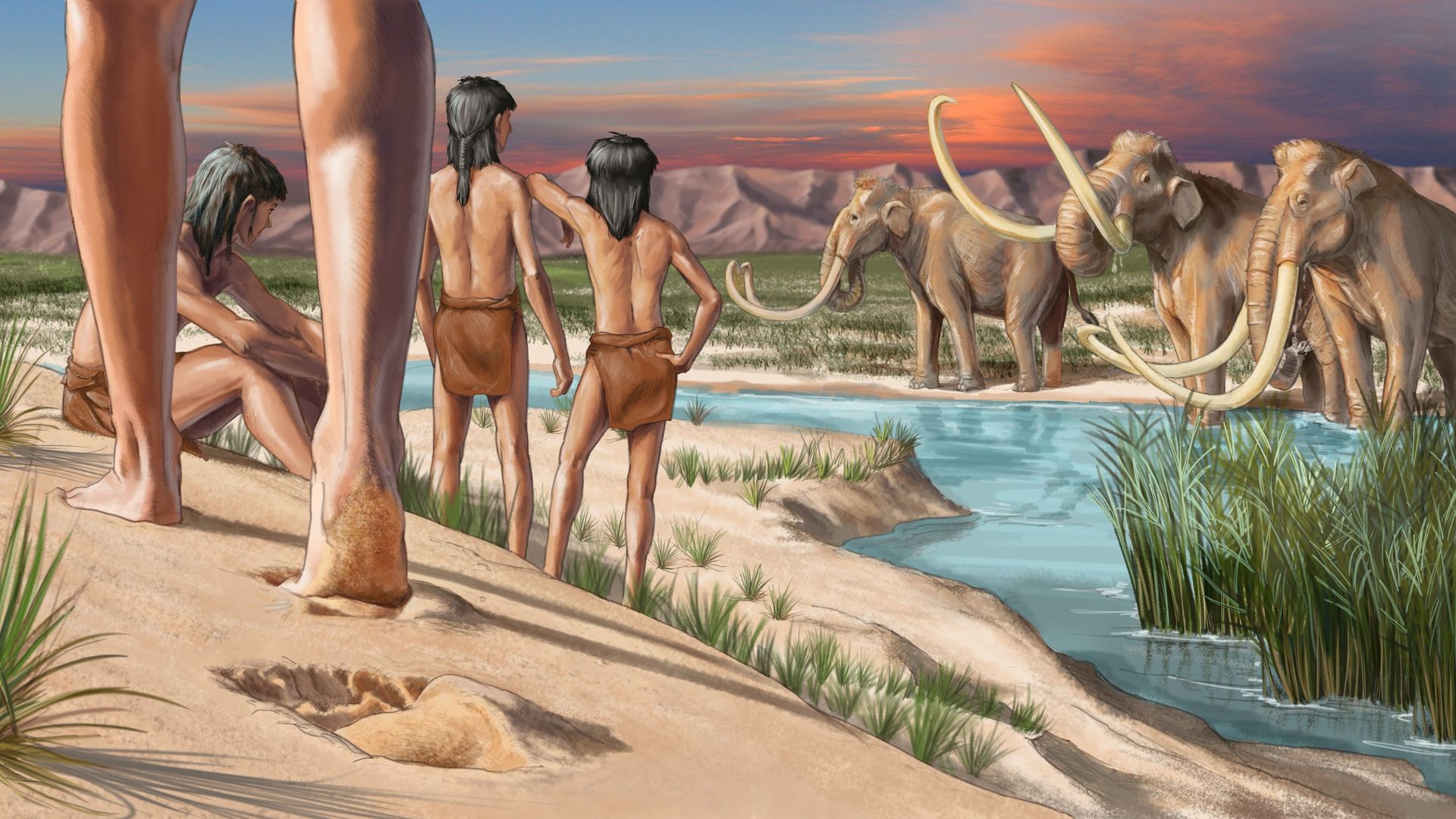
Нью-Мексико дахь Уайт Сэндс үндэсний цэцэрлэгт хүрээлэнгээс олдсон эртний ул мөр нь хүн төрөлхтөн Америк тивд төсөөлж байснаас эрт буюу 23,000 жилийн өмнө ирснийг баталж байна.
АНУ-ын Геологийн албаны судлаач Кэтлин Спрингер болон түүний багийнхан Уайт Сэндс дэх эртний хүн болон амьтдын мөр бүхий чулуулгийн давхаргад судалгаа хийжээ. “Science Advances” сэтгүүлд нийтлэгдсэн уг судалгаагаар эртний хүмүүс мөстлөгийн хамгийн хүйтэн үе (26,500–19,000 жилийн өмнө) болон түүнээс хойших уур амьсгалын огцом өөрчлөлтийн үед тус бүс нутагт амьдарч байсан нь тогтоогдсон байна. Эртний цэцгийн тоос, навчны лав, бактерийн мембран зэрэг органик молекулуудад хийсэн шинжилгээгээр 24,200 жилийн өмнө тус газарт том нуур, шилмүүст ой мод байсныг нотолжээ.
Археологич Салли Рейнольдсын тэмдэглэснээр, уур амьсгал дулаарч, нуур ширгэх явцад орчин нөхцөл эрс өөрчлөгдсөн ч хүмүүс тухайн бүс нутагт үргэлжлүүлэн амьдарсаар байв. Энэхүү олдвор нь Америк тивд хүмүүс 13,000 жилийн өмнө ирсэн гэх уламжлалт таамгийг үгүйсгэж, Азиас ирсэн нүүдэлчид илүү эрт ирсэн болохыг харуулж байна.
Уг талбайгаас мамонт, аварга том залхуу баавгай зэрэг мөстлөгийн үеийн амьтдын мөр, мөн бараа зөөхөд ашиглаж байсан байж болох чарганы ул мөр зэрэг олон төрлийн олдвор илэрчээ. Судлаачид эдгээр олдворыг тухайн үеийн хүмүүсийн амьдралын агшин зуурын гэрч хэмээн үзэж байгаа бөгөөд хүмүүс өөрчлөгдөж буй байгаль орчны нөөц боломжийг ашиглан нутаг сэлгэж байсан байх магадлалтай гэж таамаглаж байна.
Дэлгэрэнгүйг эх сурвалжаас харах
↓Эх сурвалжийг нээх ↓
Some of the first people in North America lived through extreme climate change at the peak of the last ice age, a new study suggests.
Researchers studied ancient pollen locked in rocks at White Sands National Park in New Mexico, which houses an archaeological site thought to contain the oldest human footprints in the Americas. The researchers previously dated those footprints to around 21,000 to 23,000 years ago, though their age is the subject of some scientific debate because they are significantly older than other Indigenous sites in the Americas.
The new findings, published Wednesday (Oct. 14) in the journal Science Advances, suggest that humans kept using White Sands after temperatures warmed and thus saw the landscape undergo rapid changes during the coldest era of the last ice age, known as the Last Glacial Maximum (26,500 to 19,000 years ago).
“It’s remarkable that early humans in the region were real-time witnesses to a rapidly changing environment discernible within a human lifetime — that is really food for thought,” study co-author Kathleen Springer, a research geologist at the U.S. Geological Survey, said in a statement.
The White Sands footprints suggest that people from Asia reached the Americas via the region around the Bering Strait much earlier than scientists initially thought, challenging a long-held assumption that humans arrived on the continent around 13,000 years ago. While some scientists have disputed the methods used to date the footprints, evidence is building that they are around 23,000 years old.
White Sands contains footprints from various time periods, including footprints of a caregiver and a toddler who were there 10,000 years ago. Over thousands of years, people trudged across the New Mexico landscape alongside iconic ice age animals, including mammoths and giant ground sloths. The researchers have also discovered sled-like drag marks alongside ancient footprints at White Sands, providing evidence for a kind of travois — a wooden frame made from two poles bound together — that people likely would have used for transporting goods.
By looking at ancient pollen for the new study, researchers could deduce which plants grew across the millennia when humans lived in the area. The site’s rock samples also contained waxes from plant leaves, membrane lipids from bacteria, and other organic molecules that helped the researchers better understand the environmental conditions of the time.
The analysis revealed that around 24,200 years ago, White Sands had a large lake and its surrounding mountains were coated in conifer trees (Pinus, Abies, and Picea). Then, over the next two millennia, temperatures rose, the lake began to shrink, and the conifer trees were replaced by oak trees (Quercus) and sagebrush, according to the statement.
- Inuit figurine: A 700-year-old Indigenous carving of a European made a century before Columbus
- ‘It gives us a glimpse of a different kind of Viking life’: Archaeologist Neil Price on the sea-kings, sorcerers and Sámi who lived during the Viking Age
- Ancient Egyptians sacrificed pharaohs’ servants so they could continue to serve their king in the afterlife, new study finds
“Throughout these periods of change, the people continued to visit and live in this area,” study co-author Sally Reynolds, a paleoanthropologist at Bournemouth University in the U.K., said in the statement. “The sediments containing their footprints show us their environment changed significantly within individual human lifetimes.”
The researchers speculated that people might have returned to White Sands at different times to benefit from the changing climate, with a shrinking lake potentially providing higher concentrations of animals and plants. However, while the footprints document that humans were present, they reveal little about their behavior.
“The footprints give us a snapshot of the people who lived there over 20,000 years ago,” Reynolds said. “But they are not a continuous movie of their lives. They are individual frames — showing moments when humans, mud, water and chance came together.”

