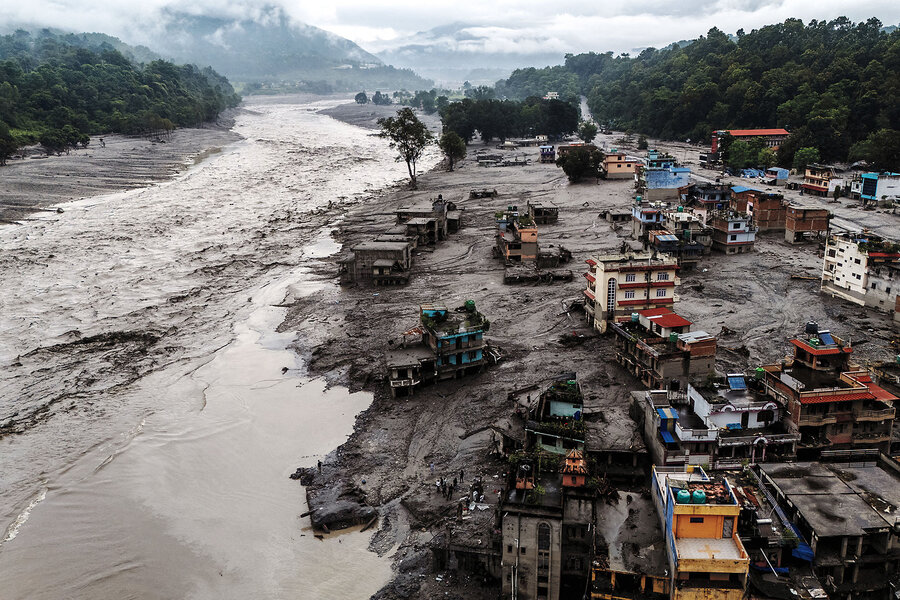
Мөстлөг, хад чулууны нуралт үер үүсгэсний улмаас Дүнгэ хот сүйдэж, оршин суугчид гэртээ буцах эсэхээ хүлээж байна.
Наймдугаар сарын 26-нд Балба, Хятадын хилийн ойролцоо хад чулуу, мөс нурснаар урьд нь хаагдсан цутгал голын ус Бхоте-Коши, Тришули голын сав газарт хүрч үерлэжээ. Дараагийн хэдэн долоо хоногт 1,500 гаруй хүн амиа алдсан гэж мэдээлж, 5,600 гаруй хүн сураггүй болжээ. Засгийн газрын урьдчилсан тооцоогоор сэргээн босголт, нөхөн сэргээлтэд 4.8 тэрбум ам.доллар шаардлагатай байна.
Jacob Turcotte/Staff
НҮБ-ын Төслийн үйлчилгээний албаны тооцоогоор Балбын төв хэсэгт 2.2 сая тонн орчим нуранги, хурдас суурьшлын бүс, зам болон голын голдирлыг даржээ. Дүнгэ хотод үер байшин, бизнесүүдийг сүйтгэж, хөрш Тришули базартай холбодог хоёр бетон гүүрийг нураасан тул оршин суугчид түр гүүр нээгдэх хүртэл гол гатлах өөр арга хайж байв.
Эрх баригчид аюулгүй газрыг тогтоох хүртэл Дүнгэ болон ойр орчмын суурин руу буцахгүй байхыг иргэдэд зөвлөжээ. Нүүлгэн шилжсэн өрхүүдэд зургаан сар хүртэл хугацаанд сар бүр 15 мянган рупи буюу ойролцоогоор 100 ам.долларын түрээсийн тусламж олгохоор амласан ч олон хүн дэмжлэгээ хүлээсээр байна.
Зоогийн газраа үерээс хэдхэн хоногийн өмнө нээсэн Шанти Ламичане гэр бүлтэйгээ өөр газар шинээр амьдралаа эхлүүлэх үү, эсвэл Дүнгэдээ үлдэх үү гэдгээ шийдэж чадахгүй байна. Зарим оршин суугч нүүх хүсэлтэй байгаа ч олонх нь өөр явах газаргүй, амьдралаа өнгөрүүлсэн нутгаа орхихоос татгалзаж байна. Уур амьсгал дулаарч, мөсөн голууд хайлахын хэрээр үүнтэй төстэй үер улам ойр ойрхон, илүү хүчтэй болж болзошгүйг эрдэмтэд анхааруулжээ.
Дэлгэрэнгүйг эх сурвалжаас харах
↓Эх сурвалжийг нээх ↓
Dhunge, Nepal
|
Nov. 11, 2026, 5:00 a.m. ET
|
5 min read
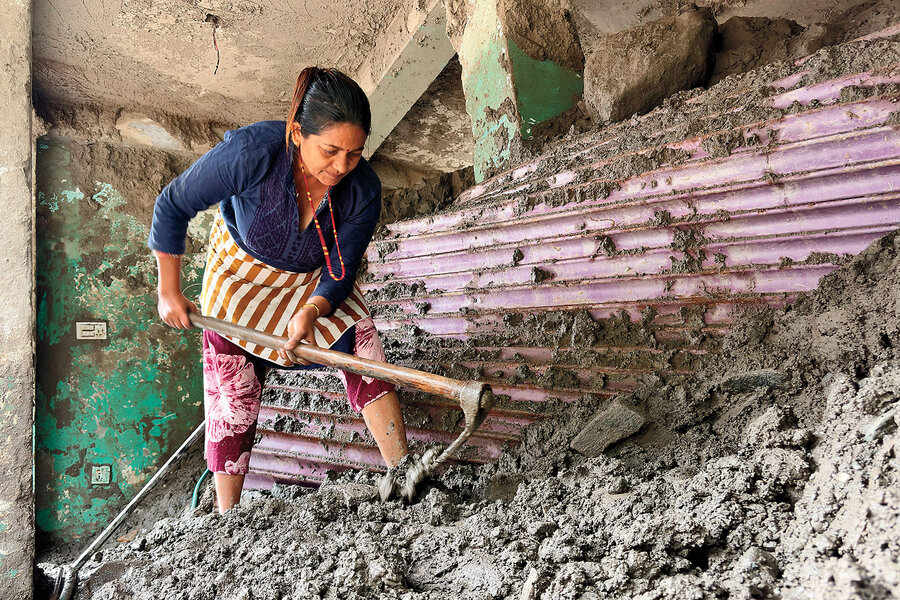
Shanti Lamichane pulls a long-handled hoe toward her, scraping wet earth and stones from a mound of debris. Beneath her muddy feet is the spot where she used to perch by her restaurant’s wooden reception desk – a proud and newly minted business owner, watching buses of tourists pull into the riverside market town of Dhunge.
Then came the flood.
On Aug. 26, an avalanche of rock and ice came crashing down near the Nepal-China border, and unleashed a once-blocked tributary onto the Bhote Koshi and Trishuli river systems. In the weeks after, more than 1,500 people were reported dead and over 5,600 missing. A preliminary government assessment places total recovery and reconstruction costs at $4.8 billion – money the Nepalese government still has to gather and allocate. It must also decide whether it’s willing to invest in reconstruction along the region’s riverbanks, especially as scientists warn that a warming climate and melting glaciers could make floods like these more frequent, and more destructive.
Some residents are eager to leave Dhunge and rebuild elsewhere, but others cannot imagine abandoning the place where they have spent their lives.
Jacob Turcotte/Staff
“It felt like the end of the world,” says Ms. Lamichane, lifting larger stones from the mud with her bare hands. “The flood destroyed everything – our homes, our life savings, our businesses, and so many lives. But this is still our home. … I don’t know what to do.”
Left in limbo
Customers were eating vegetable-stuffed parathas and drinking tea when a police pickup passed the morning of Aug. 26, its loudspeaker warning that the Trishuli River was flooding and everyone should get to higher ground.
Patrons abandoned their meals and ran. Ms. Lamichane followed. As she climbed a nearby hillside, she remembers a brief silence, then a rising roar. Water, mud, and rocks tore through Dhunge, burying buildings and sweeping away vehicles.
Across central Nepal, an estimated 2.2 million metric tons of debris and sediment covered areas that had once held homes, roads, and river channels, according to the United Nations Office for Project Services. In Dhunge, the ground is now level with Ms. Lamichane’s third-story restaurant. On the fourth floor, where she lived with her 9-year-old son and 7-year-old daughter, green walls are smeared with silty sludge, and stacks of rubble reach the ceiling.
Aakash Hassan
Shanti Lamichane clears mud from the remains of her restaurant, which she opened days before the flood, in Dhunge, Nepal, Oct. 7, 2026.
After the flood, Ms. Lamichane took her children to her parents’ home in a nearby village. Her husband returned from Saudi Arabia, where he had been working at a restaurant. Two months later, the family is in a sort of limbo.
Authorities have told residents of Dhunge and surrounding areas not to return while officials assess which sites are safe. Technically, they’re not even supposed to be digging out properties or making repairs, but no one is enforcing this on the ground.
The government has promised up to six months of rental assistance for displaced families, but Ms. Lamichane and many other residents say they are still waiting for help.
“The government is committed to providing relief to families who lost their homes and need other assistance,” says Shanti Mahat, a spokesperson for the National Disaster Risk Reduction and Management Authority. The payments – 15,000 rupees (about $100) a month – are a temporary measure until authorities make a final decision on where people can rebuild. But even this process will take time, she says, as officials work to identify those in need and connect them with suitable housing.
In the meantime, Ms. Lamichane and her husband are struggling with the idea of starting from scratch elsewhere.
The restaurant, which she’d opened just days before the flood, was the culmination of years of saving. The family had renovated the space and filled it with new furniture. She hoped to carry on the legacy of her father-in-law, who ran a small eatery in the market for 45 years.
The couple know there could be more floods in the future. But without the promise of alternative housing or a reliable income, it’s difficult to explore other options.
As of now, “we are hoping to rebuild and praying the river is kinder to us,” says Ms. Lamichane. “This is the only property I own. So let me keep digging.”
A village full of life
Before this summer’s flood, Dhunge’s growing market had attracted workers from elsewhere in Nepal, hoping to make a living off the steady stream of people who passed through the hill town en route to the northern mountains or Hindu holy sites. The bustling village, located three hours north of Kathmandu, was the perfect spot to have a meal or refuel.
Mohammad Irfan moved here from the country’s West three years ago to open a motorcycle repair shop, which is now a flat expanse of sand and gravel. Mr. Irfan is among the roughly 100 locals still missing.
His brother, Mohammad Younis, came to search for him after the flood. An experienced excavator operator, he joined the local municipality’s clearance efforts. For two months, he has helped remove debris and widen the river channel, hoping to find his brother’s remains.
“This place was green, beautiful, and full of life,” says Mr. Younis. “Now, it is barren, almost haunted.”
The flood pummeled schools, government buildings, and businesses, and tore down the two concrete bridges that linked Dhunge to the neighboring Trishuli Bazar, cutting the community off from other hill towns and main access roads. Residents resorted to zip lines and makeshift crossings until a temporary suspension bridge opened in October.
Narayan Devi Dangal worries she might never feel safe living beside the river again. The flood damaged the four-story house her family had built after Nepal’s 2015 earthquake, which destroyed their old home in Dhunge.
Deepen your worldview
with Monitor Highlights.
Politics with respect
Get political stories with respectful analysis.
There‘s a world of new ideas in every
Books newsletter.
There‘s more to life, enrich yours with
Culture & Learning weekly.
Follow humanity‘s discoveries with
Science & Nature stories in your inbox.
Gain a spiritual perspective
from the stories in your inbox.
Want to understand the deeper impact of critical events? Learn the Monitor‘s insight.
Already a subscriber?Log in to hide ads.
Yet they, too, have returned to clear the debris, uncertain how long they can afford to rent elsewhere.
“Paddy fields used to separate our house from the river. Now the river has practically reached into our house,” says her son, Navin Kumar, an accountant at a hydropower project upstream that was also badly damaged. “I have lived here all my life, got married and have a young son. I know this place may not be safe, but we have nowhere else to go.”

