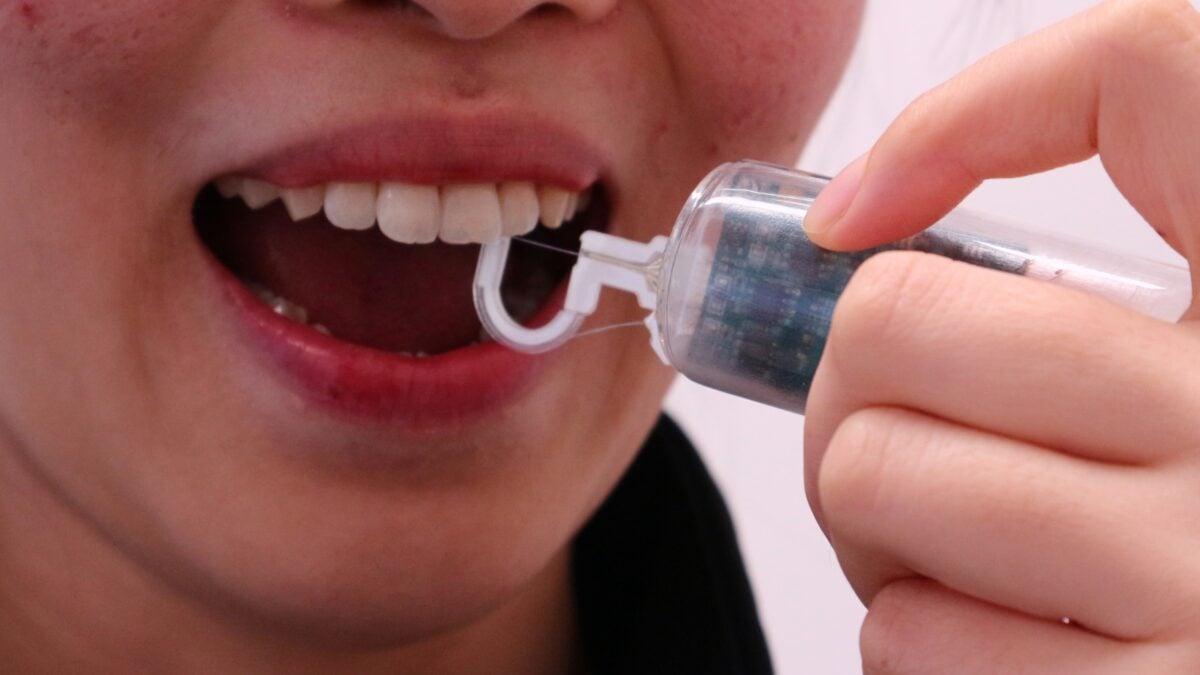
Төхөөрөмж шүдний завсрын буйлны шингэнээс глюкоз, шээсний хүчил болон буйлны үрэвслийн шинжийг хэмжих боломжтойг урьдчилсан туршилтаар харуулжээ.
Шүд, буйлны эрүүл мэнд биеийн болон тархины эрүүл мэндтэй холбоотой бөгөөд амны хөндийн эрүүл мэнд муу байх нь чихрийн шижин, зүрхний өвчин, цус харвалт зэрэг эмгэгтэй хамааралтай байж болохыг сүүлийн жилүүдийн судалгаанууд харуулж байна. Хонконгийн Шинжлэх ухаан, технологийн их сургуулийн биотехнологич Хнин Ин Ин Ньейнээр ахлуулсан баг шүдний завсрын утсаар буйлны шингэн цуглуулж, эрүүл мэндийн үзүүлэлт хэмжих төхөөрөмж бүтээжээ.
Ердийн шүдний завсрын утас шиг хэлбэртэй уг төхөөрөмж шингэнийг микрошингэний камерт дамжуулж, мэдрэгчээр шээсний хүчил, глюкоз, устөрөгчийн хэт исэл болон хүчиллэгийн түвшнийг хэмждэг бөгөөд үр дүнг утасгүйгээр ухаалаг утсанд илгээдэг. Шүд, буйлны завсарт байдаг энэ шингэн нь цусны урсгалтай бодисын солилцооны бүтээгдэхүүн, уураг, үрэвслийн маркер солилцдог ч бага хэмжээгээр ялгардаг тул цуглуулахад хүндрэлтэй байжээ.
Science Advances сэтгүүлд нийтэлсэн урьдчилсан туршилтад эрүүл хүмүүсээс гадна чихрийн шижин, цусан дахь шээсний хүчил ихсэх болон амны хөндийн эрүүл мэнд муутай хүмүүс оролцсон байна. Төхөөрөмжийн глюкозын хэмжилт цусны шинжилгээний үзүүлэлттэй ойролцоо, харин шээсний хүчлийн хэмжээ цусан дахь түвшинтэй хүчтэй хамааралтай байв; хүчиллэгийн түвшин болон устөрөгчийн хэт ислийн хэмжилтийг буйлны ховилын гүнийг тооцоолоход ашиглаж болохоор байжээ.
Гэвч цуглуулсан шингэний бараг тал нь шүлс байсан бөгөөд цус ч холилдох боломжтой нь үр дүнд нөлөөлж болзошгүй. Дан шүлсний шинжилгээгээр глюкозын талаар хангалттай мэдээлэл илрээгүй ч цус холилдсон сорьцын үр дүн өөр байж болохыг судлаачид тэмдэглэжээ. Иймээс уг төхөөрөмж цусны шинжилгээг орлох нь батлагдаагүй бөгөөд чихрийн шижин, буйлны өвчтэй хүмүүст энэ аргаар хяналт хийх нь эмчилгээний үр дүнд нөлөөлөх эсэхийг цаашдын эмнэлзүйн туршилтаар шалгах шаардлагатай.
Дэлгэрэнгүйг эх сурвалжаас харах
↓Эх сурвалжийг нээх ↓
The health of our teeth and gums is closely connected to the health of our bodies and brains.
In recent years, growing evidence has begun to show that poor oral health is associated with a slew of other concerning conditions, including dementia, diabetes, stroke, heart disease, cancer, and even death.
A new flossing device that captures the gunk between our teeth could be a high-tech way to monitor oral health and the body’s metabolism at the same time – all from the comfort of your home.
In a recent ‘test run’ among small groups of people, published in Science Advances, the tool’s glucose and uric acid readings closely tracked those from a blood test.
It could also use acidity and hydrogen peroxide measurements to reliably estimate the size of a person’s gum pockets, an indicator dentists often use when diagnosing periodontal (gum) disease.
The device was invented by a team led by biotechnologist Hnin Yin Yin Nyein at the Hong Kong University of Science and Technology (HKUST), and they argue it has capabilities that have eluded the field for decades.
The unique contraption is shaped like a typical dental flosser with a complex pulley system that harvests fluid and directs it into a dedicated microfluidic chamber with biosensors.
Within minutes of flossing, these sensors can measure uric acid, glucose, hydrogen peroxide, and pH in the fluid.
The results are then sent wirelessly to a smartphone.
The fluid that the device is capturing is distinct from saliva. It’s called gingival crevicular fluid (GCF), and it exists in the grooves around and between teeth.
Because the GCF sits close to the surface of the gums, it exchanges metabolites, proteins, and inflammatory markers with the bloodstream.
For decades now, scientists have tried to use this fluid to analyze gum disease, and other health conditions, but it is produced in very small amounts that are hard to capture.
When a person flosses, however, it uproots some of the GCF.
That’s why scientists in China decided to use a flossing system to harvest this precious liquid.
Their device was tested in preliminary trials, not only on healthy participants, but also on those with diabetes, high uric acid levels (known as hyperuricemia), and poor oral health.
The readouts were distinct for each ailment.
Glucose levels in flossing fluid, for instance, closely matched measurements in the bloodstream.
What’s more, uric acid levels were strongly correlated with blood levels.
The findings suggest that invasive blood tests that track glucose and uric acid levels could potentially be rivaled by a non-invasive flossing system
“No home monitoring tool simultaneously addresses systemic metabolism and oral inflammation – a critical gap for patients with diabetes, hyperuricemia, and periodontitis, where metabolic dysregulation worsens gum disease and oral inflammation impairs metabolic control,” write the authors of the study.
An invention like this could help fill that gap, but it still requires some tweaking and testing.
For instance, saliva made up nearly half of the fluid collected along with GCF, and blood can also get mixed in.
When researchers tested saliva on its own, it did not seem to harbor much information on glucose levels at all. But it’s possible that blood-contaminated samples do.
“Despite these limitations, the system is designed with clinical translation in mind,” argues the team.
They have called for a future clinical trial to see whether GCF-guided monitoring improves clinical outcomes in patients with both diabetes and gum disease.
“By converting a daily habit practiced by billions into a diagnostic act, this work establishes native GCF as an accessible biofluid for noninvasive, personalized health care,” the authors conclude.
The research has been published in Science Advances.
This article was fact-checked by Rebecca Dyer and edited by Rebecca Dyer. While we pride ourselves on our process, we are only human. If you spot a mistake, please let us know.

