
Ягаан шуугианы богино давтамжтай дууг тархины удаан долгионтой тааруулахад унтаж буй хүмүүсийн тархи-нугасны шингэний урсгалын долгион нэмэгджээ.
Тархи-нугасны шингэн нойрны үед тархийг дайран урсаж, хаягдал болон хортой бодисыг гадагшлуулахад оролцдог. Түүний урсгалын алдагдал Альцгеймер, Паркинсоны өвчин зэрэгтэй холбоотой гэж өмнөх судалгаанууд харуулсан бөгөөд тархинд амилоид, тау зэрэг молекул хуримтлагдах нь дементийн зарим хэлбэрт нөлөөлдөг.
Science Translational Medicine сэтгүүлд нийтлэгдсэн судалгаанд 18–52 насны 14 эрүүл насанд хүрэгчийг хамруулжээ. Оролцогчдыг MRI шинжилгээнд унтаж байх үед тархи-нугасны шингэний урсгалыг хэмжиж, толгойд нь зүүсэн EEG төхөөрөмжөөр тархины цахилгаан идэвхжлийг хянасан байна.
Судлаачид нойрны үеийн мэдрэлийн удаан долгионы оргил үетэй яг тааруулан ягаан шуугианы маш богино дуу гаргахад мэдрэлийн идэвхжил нэмэгдэж, тархи-нугасны шингэний урсгалын долгион томорчээ. Ингэснээр мэдрэлийн удаан долгион болон шингэний урсгалын хооронд шалтгаант холбоо байгааг харуулж, урсгалын хүчийг өөрчлөх боломжтойг тогтоосон байна.
Гэхдээ энэ нь цөөн оролцогчтой туршилт бөгөөд урсгал нэмэгдэх нь тархины эрүүл мэндэд бодит ашиг тустай эсэхийг судлаагүй. Судлаачид уг аргыг цаашид эмнэлзүйн бүлгүүд, насжилт, мэдрэлийн доройтол болон нойрны эмгэгийн хүрээнд шинжлэхээр төлөвлөж байна.
Дэлгэрэнгүйг эх сурвалжаас харах
↓Эх сурвалжийг нээх ↓
Each night, as sleep takes hold, you drift off to a place known to nobody else.
While you’re away there, the brain’s nightly wash cycle begins.
Waves of cerebrospinal fluid (CSF) flow over and through your brain, clearing out waste and harmful substances, and helping to refresh you to face another day.
These fluid flows – which can also happen while we’re awake – are vital for brain health, with research showing disruptions to CSF flow are linked to diseases such as Alzheimer’s and Parkinson’s.
“Brain waste clearance is really important for Alzheimer’s and other forms of dementia, which are caused, in part, by the buildup of molecules like amyloid and tau in the brain,” says neuroengineer Joshua Levitt, formerly of Boston University and MIT, and now the co-founder and CTO of neuro-tech startup CereBloom.
“If we can improve brain waste clearance, we may be able to help prevent the buildups of these plaques that lead to disease.”
In a recent study published in Science Translational Medicine, Levitt and fellow researchers discovered a way to boost CSF flow while people slept, using carefully timed bursts of generated noise.
When CSF flows through the brain during non-rapid eye movement (NREM) sleep, the flows match up with slow waves of neural activity that can be seen using electroencephalography (EEG).
In their experiment, the researchers studied 14 healthy adults, aged 18 to 52, who successfully fell asleep while undergoing an MRI scan.
The MRI scan was able to detect CSF flow while they slept, and EEG caps worn on their heads monitored the accompanying neural waves.
By playing very brief bursts of pink noise – similar to the fuzzy static of white noise, but softer and deeper, due to a different balance of frequencies – which were precisely timed to coincide with the peaks of the brain’s slow electrical waves, the researchers were able to strengthen the neural activity.
But that’s not all they saw.
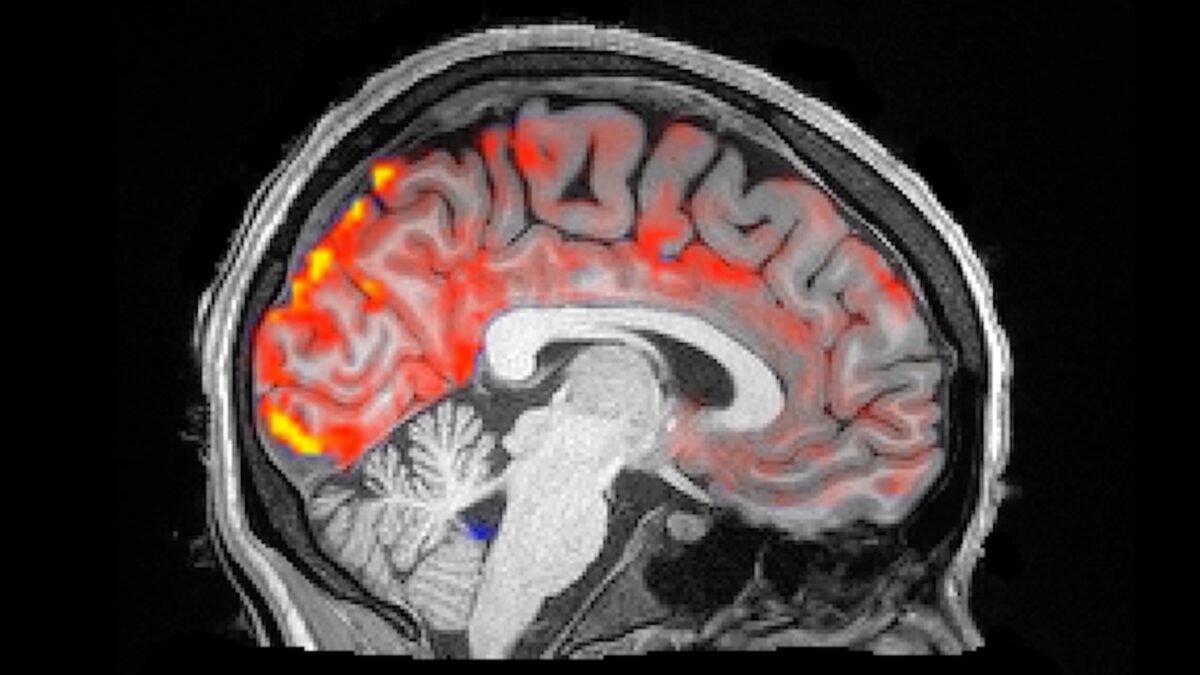
“We found that we were able to increase the size of the CSF flow wave during sleep, which as far as we know, there hasn’t been a method to do before,” says MIT neuroscientist Laura Lewis.
It’s a significant discovery, as before this it wasn’t clear whether there was a causal link between the neural slow waves and CSF flow.
Thanks to these results, we know there is, and what’s more, we know the relationship can be manipulated to increase the strength of the flow.
“Now that we can enhance CSF flow during sleep in healthy adults, we’re really excited to bring this technology to clinical populations to see what effects we can have,” Lewis says.
It’s worth clarifying that while the study demonstrates CSF flow can be increased, this was only a small experiment, and for now, we don’t know for sure whether the increased CSF flow produces actual benefits to brain health, as that wasn’t measured.
But if it does, it opens the door to all kinds of possibilities, and could possibly change the definition of a good night’s sleep.
“These results establish a causal link between neural dynamics in sleep and CSF flow and provide a technology that can now be used to modulate CSF flow and directly image the effects of closed-loop neurofeedback on the human brain,” the team explains.
“We anticipate that this approach could next be explored to understand how large-scale CSF dynamics affect brain function and to test whether this process can be modulated in aging, neurodegeneration, and sleep disorders.”
The findings are reported in Science Translational Medicine.
This article was fact-checked by Fiona MacDonald and edited by Fiona MacDonald. While we pride ourselves on our process, we are only human. If you spot a mistake, please let us know.

