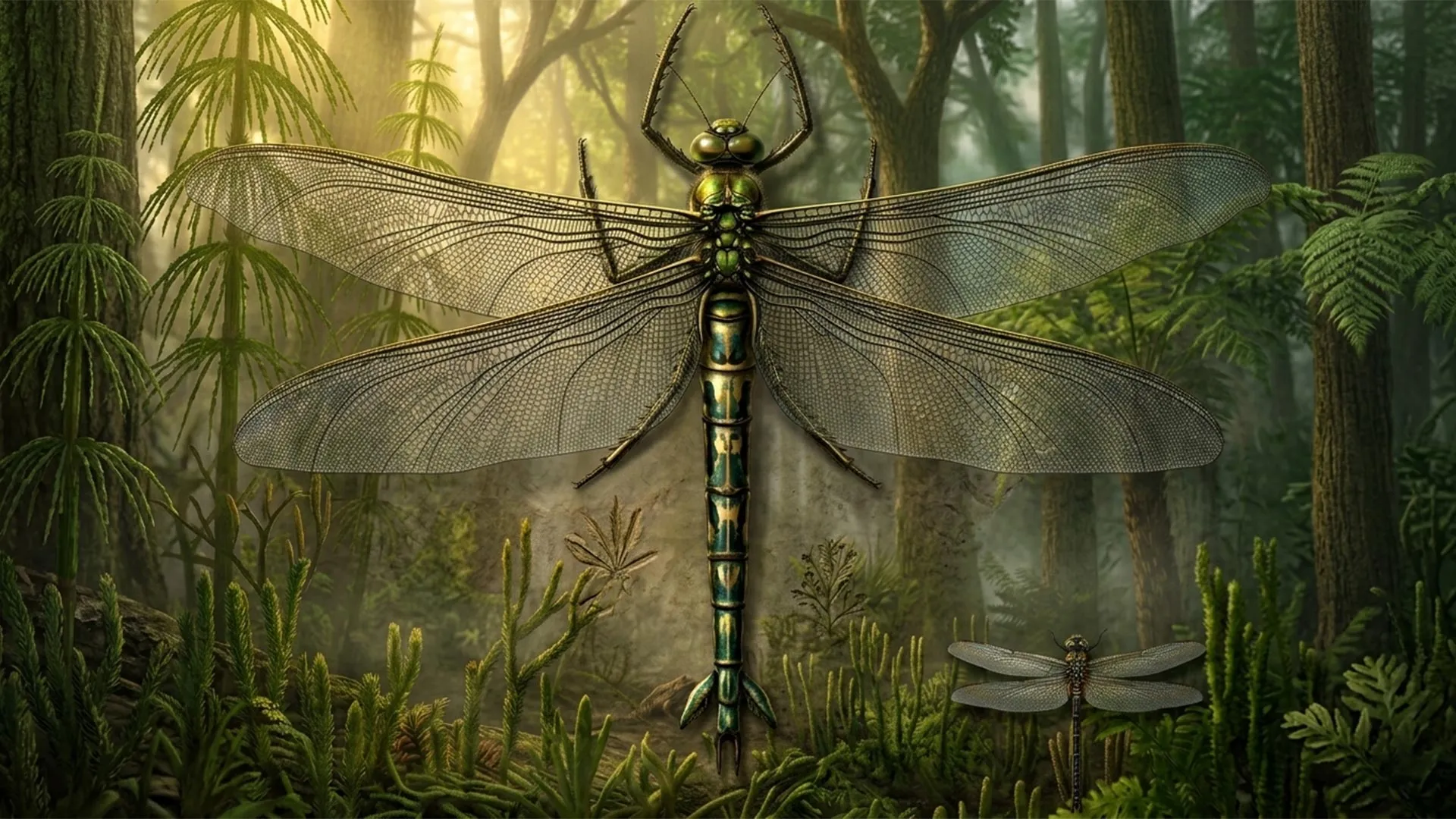
Шинэ судалгаагаар эртний аварга шавжуудын асар том биеийг агаар мандлын хүчилтөрөгчийн өндөр түвшинтэй холбосон уламжлалт онол эргэлзээтэй болж байна.
Гурван зуун сая жилийн өмнө Дэлхий дээр Пангей хэмээх асар том нэгдсэн тив оршиж, экваторын ойролцоо нүүрсний намгархаг ой тогтож байжээ. Тухайн үед агаар мандлын хүчилтөрөгчийн агууламж өнөөгийнхөөс ойролцоогоор 45 хувиар их байсан бөгөөд тэнгэрт 45 см хүртэл далавчны урттай нэг өдрийн насны шавжтай төстэй амьтад, 70 см далавчны урттай соно маягийн “гриффинфлай” хэмээх аварга шавжууд нисэн өнгөрдөг байжээ.
1995 онд Nature сэтгүүлд хэвлэгдсэн судалгаагаар эдгээр аварга шавжууд зөвхөн хүчилтөрөгчийн өндөр түвшний ачаар оршин тогтнож чадсан гэж дүгнэжээ. Шавж уушги биш, харин трахей систем хэмээх агаараар дүүрэн хоолойн сүлжээгээр амьсгалдаг бөгөөд хүчилтөрөгч нь трахеол гэх жижиг хоолойгоор диффузын аргаар нислэгийн булчинд хүрдэг. Диффузын үр ашиг зайнаас хамаарч буурдаг тул орчин үеийн хүчилтөрөгчийн түвшинд тийм том нисдэг шавжийг тэжээх боломжгүй гэж эрдэмтэд үздэг байв.
Претория их сургуулийн Эдвард (Нэд) Снеллингийн удирдсан баг өндөр хүчин чадлын электрон микроскоп ашиглан шавжны биеийн хэмжээ ба нислэгийн булчин дахь трахеолуудын тоо хоорондын хамаарлыг судалжээ. Үр дүн нь ихэнх шавжид трахеолууд нислэгийн булчингийн нийт эзлэхүүний дөнгөж 1 ба түүнээс доош хувийг эзэлдгийг харуулсан байна. Энэ харьцааг 300 сая жилийн өмнөх аварга гриффинфлайнуудад тооцоход ч мөн жижиг хэвээр үлддэг тул нислэгийн булчин хүчилтөрөгчийн хүртээмжээр хязгаарлагддаггүй болохыг илтгэж байна.
Аделайдын их сургуулийн профессор Рожер Сеймурын тэмдэглэснээр шувуу, хөхтөн амьтдын зүрхний булчингийн хялгасан судаснууд нь шавжны нислэгийн булчингийн трахеолоос ойролцоогоор арав дахин их зайг эзэлдэг. Энэ нь хэрэв хүчилтөрөгчийн дамжуулалт үнэхээр биеийн хэмжээг хязгаарладаг байсан бол шавжид трахеолын тоог нэмэгдүүлэх асар их хувьслын боломж байсныг харуулна.
Хүчилтөрөгчийн нөлөө биеийн бусад хэсэг эсвэл амьсгалын өөр үе шатанд хадгалагдсан хэвээр байж болох ч нислэгийн булчингийн трахеол доторх диффуз нь хязгаарлагч хүчин зүйл биш нь тогтоогдсон байна. Иймд эрдэмтэд шавжны асар томрох болсон шалтгааныг сээр нуруутан махчин амьтдын дарамт, эсвэл хитин бүрхүүлийн физик хязгаарлалт зэрэг өөр хүчин зүйлээс хайх шаардлагатай болж байна.
Дэлгэрэнгүйг эх сурвалжаас харах
↓Эх сурвалжийг нээх ↓
Three hundred million years ago, Earth looked nothing like it does today. The continents were joined together in a massive supercontinent called Pangaea. Near the equator, vast coal-swamp forests stretched across the landscape. Oxygen levels in the atmosphere were much higher than today, and wildfires were frequent.
Life was abundant in every environment. Oceans were filled with fish, while land was home to amphibians, early reptiles, crawling arthropods, and even giant cockroaches. Overhead, the skies belonged to insects, some of which reached astonishing sizes.
Dragonflies With Massive Wingspans
Among these prehistoric insects were mayfly-like species with wingspans of 17 inch (45-cm) and dragonfly-like creatures that reached 27 inch (70-cm). These giant insects, often called “griffinflies,” were first identified from fossil impressions found in fine-grained sedimentary rock in Kansas nearly a century ago.
For decades, scientists believed these enormous insects could only exist because oxygen levels in the atmosphere were about 45% higher than they are today. A new study now challenges that long-standing idea.
The Oxygen Theory Behind Giant Insects
In the 1980s, researchers developed techniques that allowed them to reconstruct the composition of ancient atmospheres. Their results showed that oxygen levels peaked around 300 million years ago.
Building on this discovery, a 1995 study published in Nature linked that oxygen-rich period to the presence of giant insects. Scientists proposed that larger insects required more oxygen, and that higher atmospheric oxygen made their size possible.
This explanation was based on how insects breathe. Instead of lungs, insects rely on a network of air-filled tubes called a tracheal system. These tubes branch throughout the body and end in tiny structures called tracheoles. Oxygen moves through these tracheoles by diffusion, traveling down concentration gradients to reach the flight muscles.
Because diffusion becomes less efficient over longer distances, researchers concluded that modern oxygen levels would not be sufficient to support the energy demands of extremely large flying insects.
New Study Challenges Long-Held Assumptions
A new study published in Nature offers a different perspective. Led by Edward (Ned) Snelling of the University of Pretoria, the research team used high-power electron microscopy to examine how insect body size relates to the number of tracheoles in flight muscle.
Their findings showed that tracheoles typically occupy only about 1% or less of the flight muscle in most insect species. Even when this relationship is applied to the massive griffinflies that lived 300 million years ago, the proportion remains small.
This suggests that insect flight muscles are not limited by oxygen availability. Because tracheoles take up so little space, insects could theoretically increase their number without major structural constraints.
Evidence From Modern Insects
“If atmospheric oxygen really sets a limit on the maximum body size of insects, then there ought to be evidence of compensation at the level of the tracheoles,” said lead author Edward (Ned) Snelling, associate professor, and Faculty of Veterinary Science at the University of Pretoria. “There is some compensation occurring in larger insects, but it is trivial in the grand scheme of things.”
Further supporting this idea, researchers compared insects with vertebrates. In birds and mammals, capillaries in heart muscle occupy about ten times more space than tracheoles do in insect flight muscle.
“By comparison, capillaries in the cardiac muscle of birds and mammals occupy about ten-times the relative space than tracheoles occupy in the flight muscle of insects, so there must be great evolutionary potential to ramp up investment of tracheoles if oxygen transport were really limiting body size,” said professor Roger Seymour of Adelaide University.
The Mystery of Giant Insect Size Remains
Some scientists caution that oxygen might still play a role in limiting insect size, particularly in other parts of the body or earlier stages of oxygen transport. As a result, the idea that oxygen constrains insect size has not been completely ruled out.
However, the new findings clearly show that oxygen diffusion within flight muscle tracheoles is not the limiting factor. This means researchers must explore other explanations for why insects once grew so large.
Possible factors include increased predation from vertebrates or physical limitations of the insect exoskeleton. For now, the true reason behind the rise and disappearance of giant insects remains an open question.

