
Вирусын капсид уургийг саатуулах замаар халдварыг хянах чадвартай VH-499 эмийн хүний биед хийсэн анхны эмнэлзүйн туршилт эерэг үр дүн үзүүллээ.
Эрдэмтдийн баг VH-499 хэмээх шинэ антиретровирусын эмийн үр нөлөөг судлах 2а үе шатны эмнэлзүйн туршилтыг явууллаа. Энэхүү эм нь вирусын уургийн бүрхүүл буюу капсидын үүсэлтийг саатуулснаар HIV-1 вирусын олшролтыг зогсоох механизмтай юм. Туршилтад антиретровирусын эмчилгээ эхлээгүй, өндөр вирус ачаалалтай 23 оролцогчийг хамруулсан бөгөөд 20 оролцогчид VH-499 эмийг 25, 100, 250 мг тунгаар, үлдсэн хэсэгт нь плацебо өгчээ.
Туршилтын 11 дэх өдөр гэхэд VH-499 эм уусан бүх оролцогчийн цусан дахь вирусын ачаалал буурсан байна. Судалгааны баг уг эм нь гаж нөлөө багатай, аюулгүй байдлын хувьд таатай үзүүлэлттэй болохыг тэмдэглэжээ. Түүнчлэн, уг эм нь CYP3A4 ферментэд нөлөөлдөггүй тул бусад олон төрлийн эмтэй хавсран хэрэглэхэд тохиромжтой байж болзошгүй гэж үзэж байна.
ViiV Healthcare болон GSK-ийн санхүүжилтээр хийгдсэн энэхүү судалгааны үр дүнг Clinical Infectious Diseases сэтгүүлд хэвлүүлжээ. Одоогоор уг эмийг одоогийн эмчилгээний аргуудтай харьцуулах болон илүү олон хүнийг хамруулах 3 дугаар үе шатны туршилт шаардлагатай байгаа юм. Судлаачид VH-499 нь HIV-1 халдварыг хянах, дамжуулалтыг зогсоох зорилгод хувь нэмэр оруулах боломжтой гэж дүгнэв.
Дэлгэрэнгүйг эх сурвалжаас харах
↓Эх сурвалжийг нээх ↓
Scientists have just announced the results from the first clinical trial in people with HIV-1 of a new antiretroviral drug, which suggests it could be a very useful new tool in treating the virus.
The drug is currently known as ‘VH-499’ (that’s short for VH4011499), and it works by inhibiting the virus’s capsid protein, without which HIV cannot proliferate to harmful or transmissible levels.
“Advancements in care and prevention have transformed HIV-1 into a manageable chronic condition and reduced transmission rates,” write clinical pharmacologist Rulan Griesel and team in a paper announcing the clinical trial results.
“While many individuals achieve durable suppression with current [antiretroviral] regimens, some continue to face challenges related to drug-drug interactions, adherence, tolerability, stigma, and access.”
VH-499, a drug that passed its lab-based preclinical trials with flying colors, works by interfering with the virus’s ability to produce its proteinaceous shell, known as a capsid.
Those preclinical trials described its ability to stop HIV-1 from replicating as ‘potent’.
Now, a randomized, double-blind, placebo-controlled phase 2a trial has suggested this is a drug worth seeing through.
It’s important to note this research was funded by ViiV Healthcare, a British pharmaceutical company and a joint venture of Pfizer and GSK, so there is some vested interest in profiting from the development of this drug.
Some members of the research team are employees of ViiV Healthcare and GSK.
However, the clinical trial findings have been independently verified as part of the scientific peer-review process, before being published in the Infectious Diseases Society of America‘s journal Clinical Infectious Diseases.
VH-499 was first tested in adults without HIV-1 in results presented in 2024 by a team led by GSK.
That phase 1 trial determined that the drug was well-tolerated by adults without HIV-1, but this next step is where we can really start seeing its potential.
For the phase 2a trial, twenty-three adults with HIV-1 who had not started any kind of antiretroviral therapy participated.
On day 1 of the trial, 20 of the participants were given VH-499 as an oral pill at a dose of either 25, 100, or 250 mg; three were given a placebo. They repeated these doses on day 6.
Then, at day 11, all participants started a standard antiretroviral therapy regimen.
Before starting the treatment, all participants had more than 3,000 copies of the virus per milliliter (mL) of blood plasma: what is considered a high viral load.
By day 11, everyone who took VH-499 during the study saw their viral loads drop.
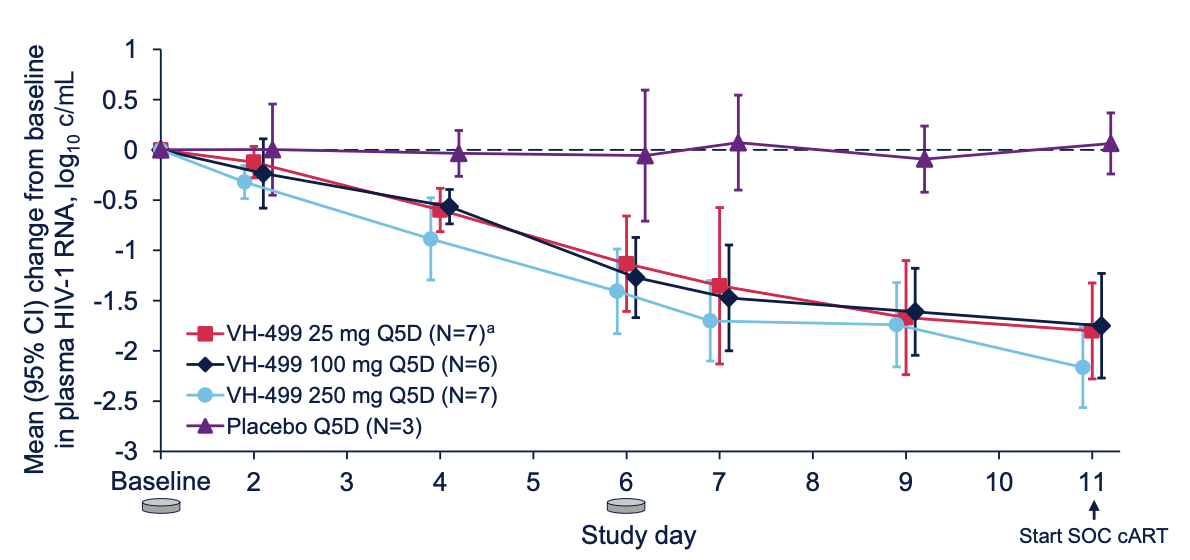
You might notice those decreases were somewhat dose-dependent, meaning people who took a higher dose of VH-499 saw the greatest effects.
Meanwhile, people in the placebo group saw almost no change in their viral load.
“We show that VH‑499 had highly potent antiviral activity, was well tolerated, and had a favorable safety profile in adults with HIV‑1 who were naive to ART,” the study’s authors conclude.
The new trial also confirms the drug does not significantly interfere with the enzyme CYP3A4.
That’s a perk, because CYP3A4 is often caught in the crossfire of unwanted drug interactions when it comes to HIV treatments.
Lenacapavir, marketed under the brand name Yeztugo, is another HIV treatment and prevention medication.
It is most often administered as a shot every six months, lasting the whole way through, so it certainly still has the edge on VH-499 and other capsid inhibitors in terms of coverage.
It was even named 2024 “Breakthrough of the Year” by Science magazine.
You might be wondering how VH-499 stands any chance against this golden boy.

Well, lenacapavir has a downside: it’s known to affect that enzyme, CYP3A4, which means it may be less ideal for people dealing with multiple health issues for which they are taking many different medications.
Depending on what those other medications are, lenacapavir may be contraindicated (i.e., the combination of drugs is known to cause harm in some way) or affect dosage.
The new study’s authors suggest VH-499 may therefore be “advantageous for people with comorbidities or complex polypharmacy”.
Preclinical trials that pitted VH-499 against a collection of laboratory strains and chimeric viruses showed the drug “potently inhibited both early and late stages of HIV-1 replication and had resistance profiles similar to lenacapavir”.
Related: 7th HIV Remission Raises Hope of Long-Lasting Treatment For More People
But we won’t know what VH-499 really has to offer until the phase 3 trials, when the drug is given to a much larger group of people, and researchers formally compare it against existing treatments.
It’s only after phase 3 trials that drugs will be put to market.
“Our findings support the potential of VH-499 to diversify long-acting therapies, offering promise for advancing progress toward the UNAIDS 2030 goal of ending HIV-1 transmission as a public health threat,” the authors conclude.
The research is published in Clinical Infectious Diseases.
This article was fact-checked by Rachel Garner and edited by Peter Dockrill. While we pride ourselves on our process, we are only human. If you spot a mistake, please let us know.

