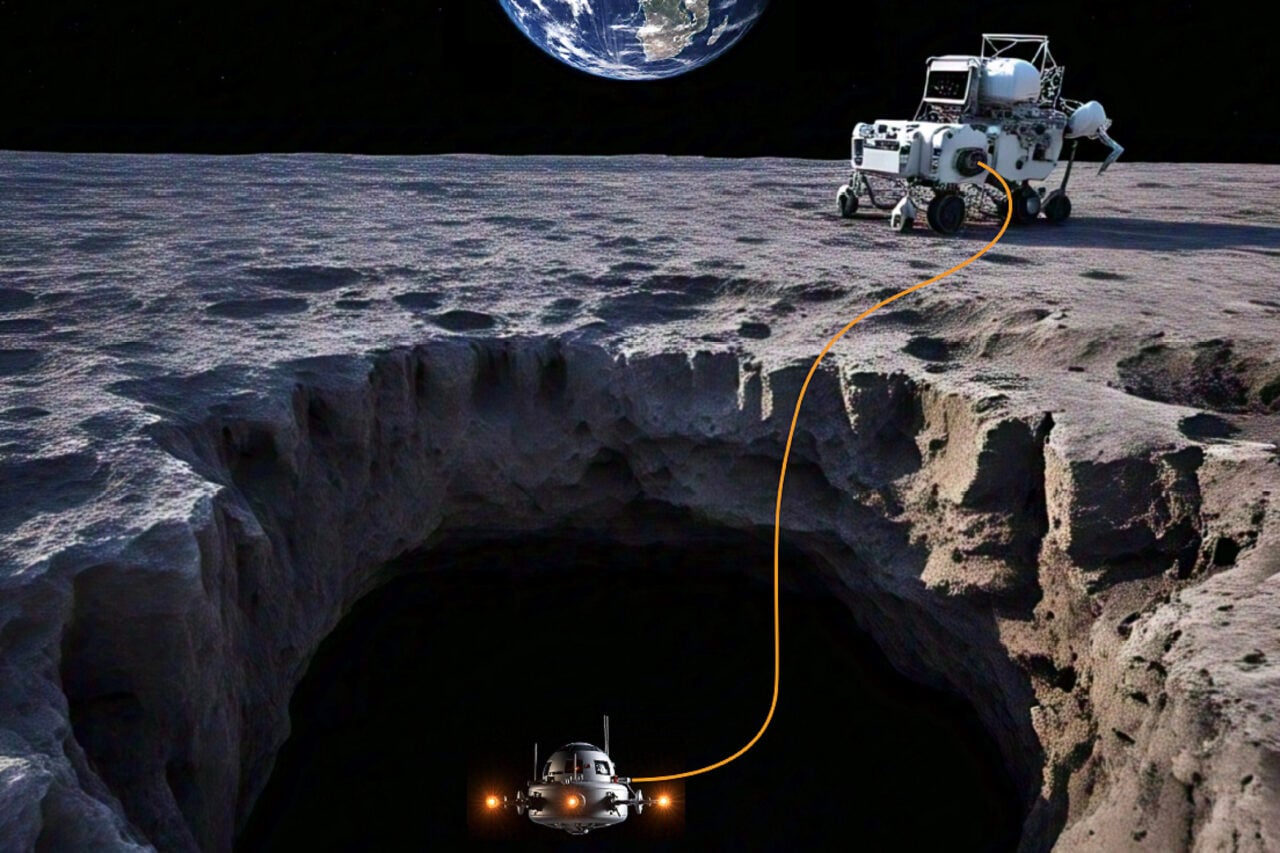
Насанд хүрсэн хоёр хөлбөмбөгийн талбайтай тэнцэх хэмжээний сарны гүн дэх агуйд нэвтрэх лазераар ажилладаг дроны судалгааг NASA санхүүжүүлэхээр болжээ.
NASA агентлаг сарны гадарга доорх асар том лаавын хоолой, агуйг судлах зорилгоор Техас мужийн Остин хотод төв байрлатай “Stone Aerospace, Inc.” компанид судалгааны санхүүжилт олгохоор болсныг мэдэгдлээ. Энэхүү судалгаагаар сарны гадаргуу дээрх роуботоос фибер оптик утсаар холбогдож, лазер гэрлээр эрчим хүчээ авдаг татлагатай дрон бүтээх аж.
Уг технологи нь өндөр хурдны дата дамжуулах, дроныг цахилгаанаар хангах, бохирдол үүсгэхгүйгээр хийн түлшээр хөдөлгөх зэрэг гурван чухал үүргийг нэгэн зэрэг гүйцэтгэх юм. Төслийг санаачлагчдын зүгээс энэ нь Дэлхийгээс өөр гараг эрхсийн агуй руу нэвтэрсэн анхны судалгаа болно гэж үзэж байна.
Судлаачдын төлөвлөж буй Луувангийн болон бусад судалгааны хүрээнд робот дрон нь Аполло-11 хөлөг газардаж байсан цэгээс 400 км орчим зайтай орших 133 метрийн гүнтэй “Mare Tranquillitatis” нүхэн хоолой руу буух аж. Италийн геологчдын 2024 онд дүн шинжилгээ хийсэн уг агуйн сүлжээ нь сансрын цацраг туяанаас байгалийн замаар хамгаалагдсан тул ирээдүйд саран дээр судалгааны бааз байгуулах хамгийн тохиромжтой газар гэж эрдэмтэд үздэг.
Уг судалгааг эхлүүлэх зорилгоор NASA энэ оны долдугаар сард NIAC хөтөлбөрийн хүрээнд 175,000 ам.долларын санхүүжилт олгожээ. Энэхүү технологи нь цаашид Ангараг гараг болон бусад сансрын биетүүдийн гүнийг судлах өргөн боломж нээнэ гэж судлаачид үзэж байна.
Дэлгэрэнгүйг эх сурвалжаас харах
Эх сурвалжийг нээх ↓
Just under the surface of the Moon, subterranean caverns stretch out thousands of feet (hundreds of meters) in diameter—some as much as 1,000 times more vast than similar lava tubes carved out by volcanic activity here on Earth. Scientists have long schemed about refurbishing these lunar caves into sites for exploratory bases on the Moon, given the caves’ natural protection from cosmic radiation beneath thick layers of regolith and cooled magma.
And now, after decades of more speculative and long-distance research, it looks like NASA is putting its money where its mouth is. The U.S. space agency announced that it will fund research by Austin-based Stone Aerospace, Inc. to develop a tethered lunar-spelunking drone—powered via laser light that will be beamed through a system of fiber optic cables conjoining it to a lunar rover on the Moon’s surface.
This power-over-fiber (PoF) design, according to NASA’s announcement, will manage the neat trick of meeting three critical needs for this mission: It will act as a typical broadband fiber-optic cable, assuring high-speed data transmission around otherwise impenetrable rock; it will provide onboard electrical power; and it will provide laser-enhanced thrust for the drone’s “non-polluting cold-gas propulsion system.”
“The proposed study could enable the first off-world cave exploration,” Stone Aerospace’s physics lead Gilly Elor noted in a statement. “Additionally, our technology has broad dual-use potential for terrestrial applications, enabling long-range continuous optical power transmission to mobile platforms on land, in air, or underwater.”
Pitch black
Like Earth’s lava tubes—including those recently studied by NASA astrobiologists in Hawaii—the Moon’s version of these geological formations were created as ancient rivers of lava plowed through the lunar landscape, cooling faster near the surface and leaving behind long, hollow tunnels.
As part of the proposed Lunar Underground eXplorer (LUX) mission, Stone Aerospace’s hovering robotic explorer will descend into the Mare Tranquillitatis lunar skylight, a yawning chasm about the size of two football fields roughly 250 miles (400 kilometers) away from where Apollo 11 landed. The Mare Tranquillitatis skylight is known to be about 436 feet (133 meters) deep and was only recently discovered to be the portal to a cave network, thanks to radar data collected by NASA’s Lunar Reconnaissance Orbiter in 2010 but only just analyzed by Italian geologists in 2024.
Elor—who was once a visiting research scientist at Lawrence Berkeley National Laboratory and a veteran explorer of deep caves like Sistema Cheve in Oaxaca, Mexico—emphasized that there would be “serious challenges” navigating the depths of Mare Tranquillitatis.
“[It] will be energetically demanding (due to complete darkness),” Elor wrote. There will be no GPS navigation to assist with the “completely un-mapped” 3D environment, she added. And, on top of that, “the system must be non-polluting so as to not affect sensor measurements of the pristine environment,” she said.
The descent
NASA awarded Elor’s team $175,000 for preliminary research into this mission as part of the $3.2 million in total that it dispersed via its NASA Innovative Advanced Concepts (NIAC) Phase I awards this July.
“NASA has outlined an ambitious vision for the future of space exploration, we’re returning the Moon to stay, advancing to Mars, and pushing to deepen our understanding of space,” NASA’s director of its Advanced Research and Technology division, Greg Stover, said in a statement.
“Achieving that will require more than incremental technological advancement,” Stover said. “It means we need great leaps. These awards are the kinds of innovation the world needs NASA to help foster.”
According to Elor, Stone Aerospace’s PoF drone designs will prove capable as NASA missions advance onward to the Red Planet as well.
“While other lunar lava tube mission proposals exist, none have the unique combinations of enabling elements of our concept,” Elor said. “Taken together we posit that these will significantly enhance the range, duration, and quality of science and exploration for subsurface lunar (and eventually Martian) exploration.”

