Агаарын тээврийн компаниуд нислэгийн үеэр зорчигчдод зориулсан энэхүү өвөрмөц шийдлийг эдийн засгийн үр ашгийг дээшлүүлэх зорилгоор нэг жилийн дотор халжээ
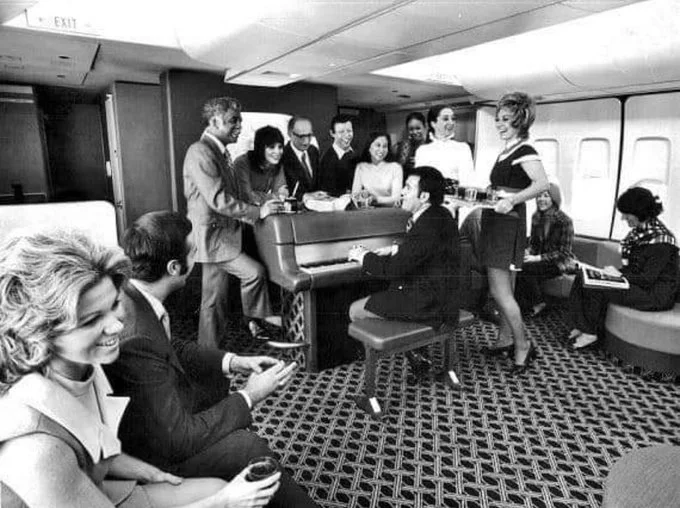
1971 онд Air Canada компани Торонто болон Европыг холбосон трансатлантын нислэгтээ Boeing 747 онгоцны дээд давхрыг бүжгийн талбай болон амралтын бүс болгон тохижуулж байв. Тус талбай нь толь бүхий ханатай байсан бөгөөд зорчигчид агаарт байх хугацаандаа бусадтай харилцаж, бүжиглэх боломжтой байсан тухай тус компанийн нислэгийн багийн гишүүн асан Хизер Трегаскес дурссан байна.
Boeing 747 онгоц 1970 онд арилжааны нислэгт анх гарах үед агаарын тээврийн компаниуд түүний өвөрмөц дээд давхрыг лоунж, баар, ресторан болгон ашиглаж байсан ч Air Canada үүнийг бүжгийн талбайгаар баяжуулсан юм. Түүхч Росс Смитийн тэмдэглэснээр, маркетингийн баг уг талбайг “Mile High Club” гэж нэрлэхээр судалж байсан ч нэр томьёоны өөр утга санааг харгалзан үзэж больсон түүхтэй.
Гэсэн хэдий ч 1970-аад оны дунд үеэс түлшний үнэ өсөж, агаарын тээврийн компаниуд зардлаа хэмнэхийн тулд онгоцны бүхээгийн талбай бүрийг зорчигчийн суудал болгон ашиглах нь илүү ашигтай гэдгийг ухаарсан юм. Үүнтэй холбоотойгоор бүжгийн талбай болон бусад тансаг тохижилтууд арилжааны нисэх онгоцноос аажмаар хасагдаж, зорчигчийн суудлын тоог нэмэгдүүлснээр нислэгийн үйлчилгээ илүү үр ашигтай байдалд шилжсэн байна.
Дэлгэрэнгүйг эх сурвалжаас харах
↓Эх сурвалжийг нээх ↓
Air Canada Boeing 747s had dancefloors in their jets in the 1970s, meaning passengers could literally dance in the sky during long-haul flights.
The upper deck of the enormous aircraft was transformed into a nightclub complete with a mirrored wall and enough space to bust out some seriously questionable moves.
It sounds like the kind of thing that would make flying today infinitely more exciting, but the party didn’t last very long.
Air Canada eventually discovered a very boring reason why putting paying passengers in seats made a lot more sense than giving them a dancefloor.
Air Canada’s Boeing 747s really had dancefloors
When Boeing’s 747 airplane entered commercial service in 1970, its distinctive upper deck gave airlines a strange new piece of real estate to play with.
Instead of immediately filling it with rows of seats, some airlines turned the space into lounges, bars and restaurants.
Air Canada went one step further.
In 1971, the airline introduced a dancefloor on the upper deck of its Boeing 747s flying transatlantic routes between Toronto and Europe.
The space reportedly featured a mirrored wall and dancefloors, giving passengers the chance to get up, socialize and dance while thousands of feet above the ground.
And this wasn’t just a case of passengers putting on some music through their headphones and awkwardly dancing beside their seats.
A former Air Canada flight attendant, Heather Tregaskes, recalled that the airline’s stewardesses would sometimes even dance with customers.
It was basically a nightclub in the sky, back when flying was still treated as a glamorous experience rather than something involving a battle for the armrest and a desperate attempt to fit a carry-on into an overhead bin.
There was even a rather unfortunate naming idea floating around.
According to aviation historian Ross Smyth, Air Canada’s marketing department reportedly considered calling the space the “Mile High Club” before realizing that the phrase already had a very different and decidedly more risqué meaning.
Some early planes even had upright pianos and live bands.
Like all good things, the disco had to come to an end
Sadly, the airborne disco wasn’t destined to become a permanent part of commercial aviation.
The dancefloors reportedly lasted for only about a year after the 747 entered Air Canada’s fleet before it was scrapped.
And the reason was much less exciting than the idea itself.
Airlines eventually realized that every square foot of cabin space had the potential to generate revenue if it contained a paying passenger seat – a dancefloor could make the experience more memorable, but it couldn’t sell another ticket.
That same realization affected other airlines experimenting with the 747’s upper deck: Pan Am famously used the space as a first-class restaurant, while Qantas created a lounge known as the Captain’s Club.
But as airlines became increasingly focused on efficiency and maximizing passenger capacity, those glamorous lounges largely disappeared in favor of seats.
The timing also wasn’t particularly helpful for extravagant airline gimmicks as the 1970s brought major increases in fuel prices, making airlines increasingly conscious of operating costs and the economics of every part of their aircraft.
So, while today’s passengers are squeezing themselves into increasingly optimized cabins, there was once a time when flying across the Atlantic could involve grabbing a drink, heading upstairs and dancing with a stranger.
The Boeing 747’s upper-deck nightclub may have been short-lived, but it remains very important in our hearts.