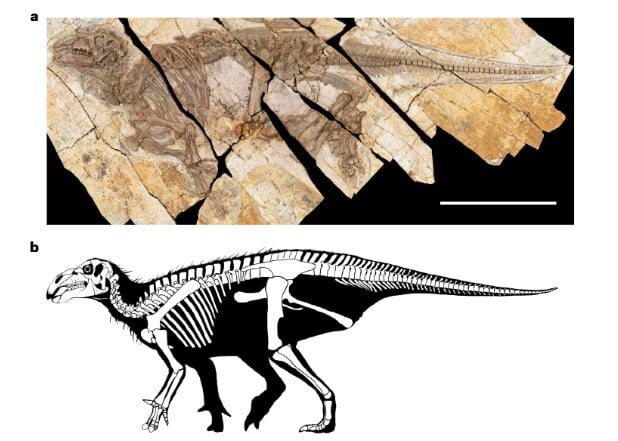
Эрдэмтэд 125 сая жилийн настай өвсөн тэжээлт үлэг гүрвэлийн арьсан дээрх өвөрмөц өргөсүүдийг судалснаар палеонтологийн салбарт шинэ нээлт хийв.
Хятадын нутаг дэвсгэрээс олдсон Haolong dongi хэмээх нэрлэгдсэн залуу үлэг гүрвэлийн чулуужсан олдвор нь өмнө нь огт бүртгэгдэж байгаагүй арьсны бүтэцтэй болохыг тогтоожээ. Уг амьтны биеийг бүрхсэн хөндий, зарааны өргөстэй төстэй бүтэц нь яснаас бус, арьснаас шууд хөгжсөн байна. Судалгааны үр дүнг 2026 оны хоёрдугаар сарын 6-нд Nature Ecology & Evolution сэтгүүлд нийтэлжээ.
CNRS болон хамтрагч байгууллагуудын судлаачид рентген сканнер болон эдийн өндөр нарийвчлалтай шинжилгээний аргаар уг олдворыг судалсан байна. Үүний үр дүнд 125 сая жилийн настай арьсны эсүүд маш сайн хадгалагдан үлдсэнийг илрүүлжээ. Энэхүү олдвор нь Iguanodontia бүлгийн үлэг гүрвэлүүдийн хувьслын түүхэнд цоо шинэ мэдээлэл нэмж байна.
Судлаачид эдгээр өргөс нь махчин амьтнаас хамгаалах, биеийн дулааныг зохицуулах эсвэл хүрээлэн буй орчны өөрчлөлтийг мэдрэх мэдрэхүйн үүрэгтэй байж болзошгүй гэсэн таамаглал дэвшүүлж байна. Эдгээр функцүүд нь бие биеэ үгүйсгэхгүй бөгөөд цаашид нарийвчлан судлах шаардлагатай юм.
Олдвор нь залуу насны үлэг гүрвэлд хамаарах тул насанд хүрсэн амьтанд уг өргөсүүд хэвээр байдаг эсэх, эсвэл нас ахих тусам өөрчлөгддөг эсэх нь одоогоор тодорхойгүй байна. Энэхүү нээлт нь амьтны анатомийн бүтэц болон хувьслын явцыг ойлгоход чухал ач холбогдолтой юм.
Дэлгэрэнгүйг эх сурвалжаас харах
↓Эх сурвалжийг нээх ↓
A 125-million-year-old fossil unearthed in China has upended what scientists thought they knew about dinosaur anatomy. The juvenile plant-eater, now named Haolong dongi, was covered in hollow, porcupine-like spikes rising straight from its skin, a structure never before documented in any dinosaur. Adding to the intrigue, the fossil’s skin is preserved with such precision that individual cells remain visible after more than a hundred million years.
The discovery concerns Iguanodontia, a group of beaked, strong-legged herbivores that paleontologists have been studying since the early 1800s. Despite two centuries of research into this branch of the dinosaur family tree, it has just gained a member unlike anything documented before.
What sets this specimen apart isn’t only its skeleton but its soft tissue. Soft tissue almost never survives the fossilization process intact, let alone at a microscopic level, which makes this find valuable well beyond the discovery of a single new species.
A Fossil Preserved Down to the Cell
Researchers from CNRS and partner institutions relied on X-ray scanning and high-resolution histological analysis, a technique that examines ultra-thin tissue slices under a microscope, to study the fossil at a cellular level.
This approach allowed scientists to confirm that individual skin cells had survived for approximately 125 million years, representing an extraordinary level of preservation even among exceptionally preserved fossils.
It was this microscopic detail that made it possible to reconstruct the internal architecture of the unusual spikes covering much of the animal’s body. According to the study, these structures are classified as cutaneous, meaning they developed directly from the skin rather than from bone, unlike horns or bony plates that originate from the skeleton.
“These spikes differ structurally from known protofeathers in non-avian dinosaurs and scaly spines in extant squamates, suggesting a distinct evolutionary origin,” stated the authors.
Quills, Body Heat, or Something Else Entirely
Why would a plant-eating dinosaur be covered in hollow spines? Researchers point to several possibilities, and they aren’t mutually exclusive. The most intuitive explanation is defense. Haolong dongi lived during the Early Cretaceous, sharing its ecosystem with small carnivorous dinosaurs, and the spikes may have worked much like a porcupine’s quills, discouraging predators from getting too close.

But defense may only be part of the story. The research, published in Nature Ecology & Evolution on February 6, 2026, also raised the possibility that the spikes played a role in thermoregulation, since structures that increase surface area can help an animal shed or retain heat. A third possibility is sensory: the spikes might have helped the animal detect movement or changes in its surroundings, functioning somewhat like a tactile early-warning system.
A New Name, and an Open Question About Adulthood
The species has been named Haolong dongi in honor of Dong Zhiming, a well-known Chinese paleontologist who has spent decades studying dinosaurs and helping reveal China’s incredible fossil record. The name is a fitting tribute, especially since this new species was discovered in the same country where Dong made many of his important contributions to dinosaur research.
One detail is keeping scientists cautious for now: the fossil belongs to a juvenile. Because the specimen was still young, researchers cannot yet say whether adult Haolong dongi also had the same hollow spikes or if these unusual structures disappeared as the animal grew. More fossils will be needed to find out how this feature changed throughout the species’ life.

Enjoyed this article? Subscribe to our free newsletter for engaging stories, exclusive content, and the latest news.


