Японы Shimizu Corporation компани сарны гадаргууг нарны зай хураагуураар бүрхэж, цуглуулсан эрчим хүчийг Дэлхий рүү дамжуулах “Luna Ring” хэмээх шинэлэг концепцийг боловсруулжээ.
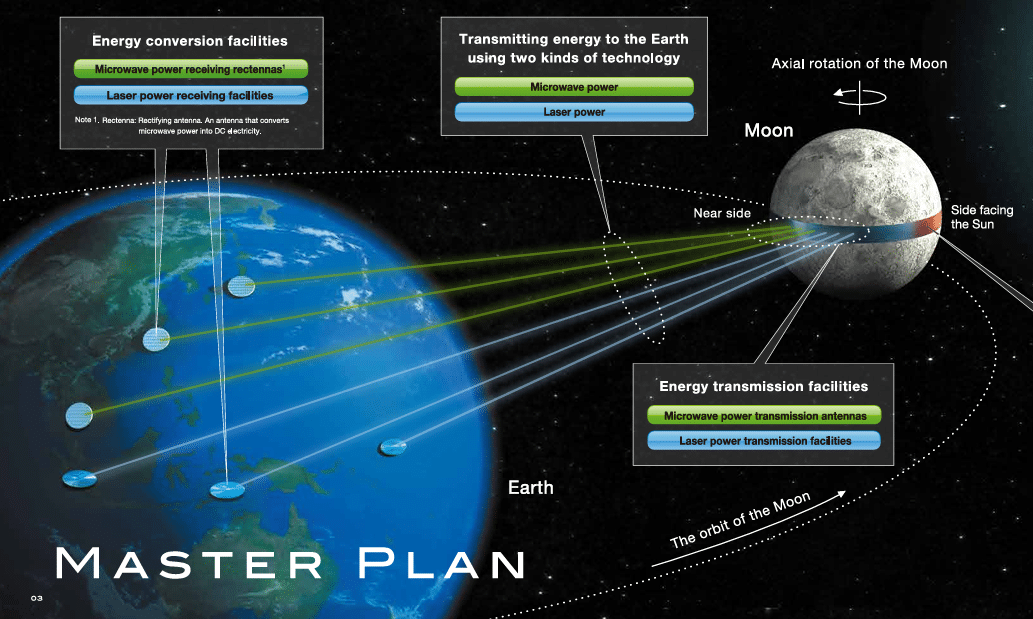
Энэхүү төсөл нь сарны экваторыг тойруулан 11,000 км урт, 400 км хүртэлх өргөн нарны зай хураагуурын бүс байгуулах зорилготой юм. Цуглуулсан цахилгаан эрчим хүчийг богино долгион болон лазерын туяа ашиглан Дэлхий дээрх хүлээн авах станцууд руу дамжуулах бөгөөд ингэснээр цаг уурын нөлөөлөлгүйгээр тасралтгүй эрчим хүч гарган авах боломжтой гэж үзэж байна.
Бүтээн байгуулалтын ажлыг алсаас удирдах роботууд болон сарны хөрсний нөөцийг ашиглан гүйцэтгэхээр төлөвлөж байгаа бөгөөд саран дээр бетон, шил, нарны зай хураагуур үйлдвэрлэх үйлдвэрүүдийг байгуулах юм. Shimizu Corporation-ийн гаргасан урт хугацааны төлөвлөгөөнд 2035 оноос бүтээн байгуулалтыг эхлүүлэхээр тусгасан хэдий ч санхүүжилт болон нарийвчилсан хуваарь нь одоогоор тодорхойгүй байна.
Энэхүү үзэл баримтлал нь 2011 оны Фүкүшимагийн цөмийн цахилгаан станцын ослын дараа эрчим хүчний аюулгүй байдлын асуудал хурцаар тавигдсанаар олон нийтийн анхаарлыг илүүтэй татах болсон. Гэсэн хэдий ч шинжээчид уг төслийг одоогоор зөвхөн судалгааны шатанд байгаа төдийгүй эдийн засгийн хувьд хэрэгжих боломжтой эсэх нь эргэлзээтэй байгааг онцолж байна.
Дэлгэрэнгүйг эх сурвалжаас харах
↓Эх сурвалжийг нээх ↓
A band of solar cells would circle the Moon’s equator for about 11,000 kilometers, or 6,800 miles, widening in places to 400 kilometers. Power collected there would travel to Earth as microwaves and laser beams.
Japanese construction company Shimizu Corporation calls the concept the Luna Ring. Its design includes lunar solar cells, power cables, transmission stations, receiving facilities on Earth and robotic construction systems.
Shimizu’s Luna Ring concept and project brochure describe a long-term development roadmap that placed the start of construction in 2035. In July 2011, Tetsuji Yoshida, then president of space consulting group CSP Japan, a Shimizu subsidiary, told ABC News that he had unveiled the concept the previous year.
Solar Belt Would Stretch Around the Moon’s Equator
Shimizu’s design places solar cells around the Moon’s entire equator, with the belt ranging from a few kilometers wide to 400 kilometers at its widest point. Power cables would run alongside the array.
Electricity would move through those cables to transmission facilities on the Moon’s near side, which continually faces Earth. Shimizu designed the system for continuous solar generation without interference from terrestrial weather.
The transmission system would use both microwaves and lasers. Shimizu specifies microwave antennas 20 kilometers in diameter, guided by beacons on Earth intended to keep the beams accurately directed at receiving facilities. A separate laser system would also rely on an Earth-based guidance beacon.
On Earth, rectennas would receive the microwave power and convert it to direct-current electricity. Laser receiving facilities would perform a similar conversion for laser energy. Shimizu says the electricity could feed power grids or be used to produce hydrogen for fuel and storage.
Yoshida told ABC News in 2011 that terrestrial solar panels could generate only one-twentieth as much energy as their counterparts in space under ideal conditions. He attributed the difference to constant sunlight in space and the absence of clouds and bad weather.
Robots and Lunar Resources Form the Construction Plan
Shimizu’s proposal calls for using lunar soil to produce ceramics, concrete, glass and solar cells, as well as oxygen and water. Hydrogen brought from Earth would be used in processes for producing water from lunar material.
Robots operated remotely from Earth around the clock would handle much of the construction, including ground preparation and excavation. A small number of astronauts would work on the lunar surface alongside the robotic systems.
Other equipment would be transported from Earth, assembled in space and then lowered to the Moon. Along the equator, Shimizu envisions a transportation route with power cables installed beneath it. Self-propelled production plants would move along the route while manufacturing solar cells from lunar resources and installing them.

The company’s brochure assigned experiments and technology development to the 2010s and pilot demonstrations on Earth and the lunar surface to the 2020s. Preparation for Luna Ring construction was placed in the 2030s, followed by the proposed 2035 construction start.
Funding and Cost Remain Undefined in the Published Timetable
ABC News reported in 2011 that Yoshida did not have a concrete estimate for the Luna Ring’s cost or an exact construction schedule. He said construction could begin by 2035 if Shimizu obtained the necessary funding.
Masanori Komori of Japan’s Institute of Energy Economics questioned the economics of lunar solar generation in the same report and argued that Japan should focus on alternatives that could be developed more readily. “The problem with lunar solar energy is that it’s still in the research phase,” Komori told ABC News.
Interest in the Luna Ring increased after the March 11, 2011 earthquake and tsunami damaged reactors at the Fukushima Daiichi nuclear power plant. ABC reported at the time that Japan had 54 nuclear reactors producing 30 percent of the country’s energy supply, with more than half idle because of safety concerns. Yoshida said his lunar concept drew much greater interest after about a year of relative quiet.
Shimizu’s published Luna Ring design specifies an equatorial solar belt about 11,000 kilometers long, ranging from a few kilometers to 400 kilometers wide, with 20-kilometer-diameter microwave antennas and a separate laser transmission system directed toward receiving facilities on Earth.
Enjoyed this article? Subscribe to our free newsletter for engaging stories, exclusive content, and the latest news.

