Палеонтологчид өмнө нь андуурч ангилсан олдворуудыг дахин судалснаар Мексикээс олддог төрөл зүйлтэй ижил төстэй далайн мөлхөгчийг Германы нутгаас нээв
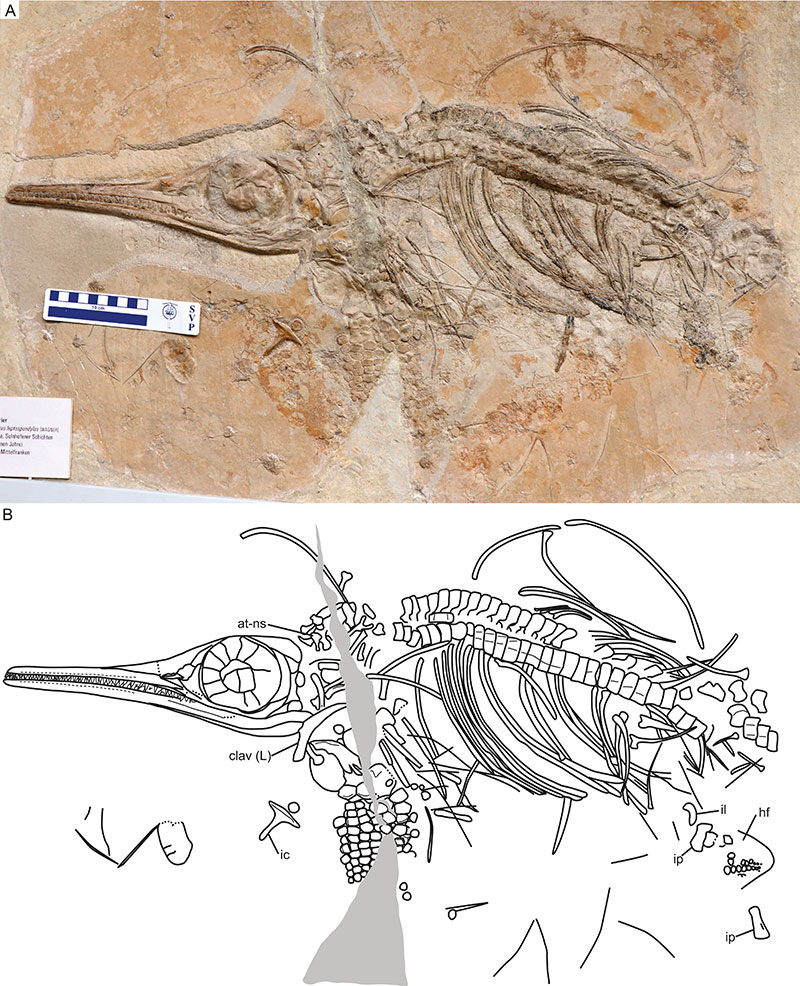
Штутгартын Байгалийн түүхийн музейн доктор Эрин Максвеллээр удирдуулсан судалгааны баг Германы Платтенкалк шохойн чулуун давхаргаас олдсон ихтиозаврын үлдэгдлийг шинээр ангиллаа. Уг олдворыг өмнө нь “Aegirosaurus” хэмээн андуурч байсан бол судалгааны дүнд “Jabalisaurus tethyensis” хэмээх цоо шинэ зүйл болохыг тогтоожээ. Энэхүү далайн мөлхөгч нь 150 сая жилийн өмнөх Юрийн галавын үед амьдарч байсан бөгөөд 2-2.9 метр урттай, нарийн галбир бүхий гавлын яс, шүдний бүтэцтэй байсан нь түүнийг жижиг загасаар хооллодог байсныг илтгэж байна.
Энэхүү нээлт нь Юрийн галавын үеийн далайн мөлхөгчдийн төрөл зүйл өмнө нь төсөөлж байснаас илүү олон янз байсныг харуулж байна. Судлаачид уг амьтны хамгийн ойрын төрөл зүйл нь 9,000 орчим километрийн зайд орших Мексикийн нутгаас олддог болохыг тогтоосон нь тухайн үед далайн амьтад Тэтис далай болон Карибын тэнгисийн сав газарт өргөн хүрээтэй тархаж байсныг гэрчилж байна.
“Palaeontologia Electronica” сэтгүүлд нийтлэгдсэн уг судалгаа нь музейн цуглуулгад олон арван жил хадгалагдсан олдворуудыг орчин үеийн аргаар дахин шинжлэх нь шинжлэх ухаанд чухал ач холбогдолтой болохыг нотоллоо. Түүнчлэн уг олдвор нь тухайн бүс нутгийн ихтиозаврын төрөл зүйлийн тоог хоёр дахин нэмэгдүүлж, эртний далайн амьтдын тархалт, хувьслын түүхийг илүү тодорхой болгож байна. Өмнө нь эдгээр амьтныг зөвхөн тодорхой бүс нутагт нутагшсан гэж үздэг байсан бол шинэ судалгаагаар тэдгээр нь халуун бүсийн далайн өргөн уудам нутгаар тархан амьдарч байсныг харуулж байна.
Дэлгэрэнгүйг эх сурвалжаас харах
↓Эх сурвалжийг нээх ↓
For more than a hundred years, one sea creature was thought to define the story of ichthyosaurs in southern Germany’s Plattenkalk limestone. That assumption has now collapsed. Paleontologists have identified a second species, Jabalisaurus tethyensis, hiding in plain sight among specimens long misclassified in museum collections, and its closest relatives, surprisingly, are found nearly 9,000 kilometers away in Mexico.
The Plattenkalk deposits of southern Germany are no ordinary rock formation. This fine-grained limestone is the same fossil-rich layer that produced Archaeopteryx, the fossil bird that reshaped scientific understanding of the transition between dinosaurs and birds. For more than a century, researchers studying these deposits believed that only Aegirosaurus leptospondylus represented the ichthyosaurs that inhabited this ancient sea.
That single-species interpretation also influenced broader views of Late Jurassic ichthyosaurs. Scientists traditionally considered these marine reptiles less diverse than they had been during earlier stages of their evolution.
An Overlooked Creature Hiding In Museum Collections
The discovery team, led by Dr. Erin Maxwell of the Staatliches Museum für Naturkunde Stuttgart, did not find a new fossil site. Instead, they identified a new species among specimens already stored in museum collections and previously classified as Aegirosaurus.
The main creature is a small, immature skeleton housed at the Bavarian State Collection for Palaeontology and Geology in Munich. It was originally collected from the Geisberg quarry near Apfelthal, Bavaria. Two additional specimens were assigned to the species: one from the Staatliches Museum für Naturkunde Stuttgart and another from the Jura-Museum Eichstätt, where the fossil preserves its complete soft-tissue outline.
Jabalisaurus tethyensis was a mid-sized ophthalmosaurian ichthyosaur, reaching an estimated length of 2 to 2.9 meters (6.6 to 9.5 feet). As described by the study, published in in the journal Palaeontologia Electronica, it had a slender, high-crowned skull and finely ridged teeth, suggesting that it likely fed on small bony fish. Its skin appears to have been smooth, matching observations from other ichthyosaurs belonging to the same lineage. The animal lived in the warm waters of the Tethys Ocean around 150 million years ago during the Late Jurassic.
Jurassic Ichthyosaurs Were More Diverse Than Thought
In their study, Dr. Maxwell and her colleagues placed the creature within the longer evolutionary history of ichthyosaurs. According to the researchers, these Mesozoic marine reptiles first appeared in the fossil record during the Early Triassic and survived until the early Late Cretaceous.
The group reached its highest diversity and anatomical variation during the first 8.7 million years of its evolution, a period associated with rapid adaptation to different marine environments and food sources.
“By the Jurassic, and especially by the end of the Aalenian (early Middle Jurassic), ichthyosaurs occupied a reduced range of ecomorphotypes, and historically were viewed as being correspondingly reduced in taxonomic diversity,” explained the authors.

The identification of Jabalisaurus tethyensis changes the picture. The discovery doubles the number of known ichthyosaur species in Germany’s Plattenkalk deposits, showing that more of these ancient sea creatures were living there than scientists previously realized. Some had simply gone unnoticed because their fossils were classified differently in the past.
A Newly Studied Genus Reveals A Lost Jurassic Sea Connection
The most surprising aspect of the discovery is not only the species itself, but also the geographic history of this ancient marine creature. Until now, Jabalisaurus had been known only from the Gulf of Mexico region. Its presence in Bavaria reveals that this ichthyosaur creature lived across a much broader area of the ancient Tethys Ocean and connected proto-Caribbean seas.
The researchers identified two closely related species pairs distributed across these regions: Jabalisaurus meztli and Jabalisaurus tethyensis, as well as Parrassaurus yacahuitztli and Aegirosaurus leptospondylus.
“Despite the apparent high Late Jurassic marine habitat connectivity, the Late Jurassic ichthyosaurian fauna from the proto-Gulf of Mexico has been interpreted as being highly endemic,” noted the paper.

Instead, the study indicate that these ichthyosaurs were spread across a much wider area, from the northwestern Tethys to the proto-Caribbean. Populations in different regions may have developed into separate species while remaining part of the same broader tropical and warm-water fauna.
This picture is different from what researchers have found in cooler waters. Ichthyosaurs discovered in places such as the United Kingdom, Svalbard, Eastern Europe, and Argentina belonged to more temperate or polar communities.
Enjoyed this article? Subscribe to our free newsletter for engaging stories, exclusive content, and the latest news.

