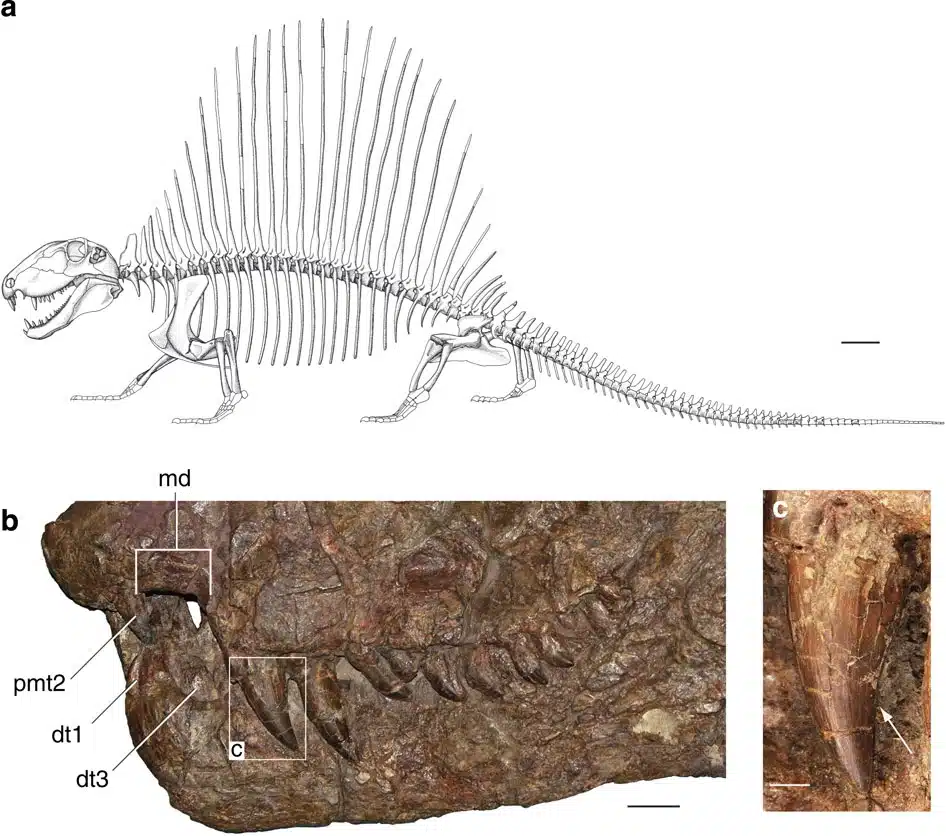
Палеонтологийн судалгаагаар Пермийн галавын үед амьдарч байсан энэхүү махчин амьтныг үлэг гүрвэлийн бүлэгт хамааруулдаг байсан анхны таамаглал буруу болохыг тогтоожээ.
Одоогоос 300 орчим сая жилийн тэртээ амьдарч байсан Диметродон нь Пермийн галавын хамгийн том махчин амьтан байсан бөгөөд гадаад төрхөөрөө мөлхөгч амьтдыг санагдуулдаг ч үнэн хэрэгтээ хөхтөн амьтдын өвөг дээдэс рүү хөтлөх “синапсид” бүлэгт хамаардаг байна. Анх 1845 онд Принц Эдвардын арлаас олдсон эрүүний ясыг эртний үлэг гүрвэлийнх гэж андуурч байсан бол орчин үеийн палеонтологийн судалгаагаар уг амьтан нь үлэг гүрвэл, шувууд болон орчин цагийн мөлхөгчдөөс ялгаатай хувьслын салбар болохыг тогтоожээ. Манитобагийн их сургуулийн палеонтологич Кирстин Бринк болон түүний багийнхан уг олдворыг ангилал зүйн хувьд дахин бүртгэж, Диметродон нь хөхтөн амьтдад бусад мөлхөгчдөөс илүү ойр холбоотой болохыг тайлбарлав.
Диметродоны нуруун дээрх далбаа хэлбэрийн том бүтцийн зориулалт нь одоог хүртэл эрдэмтдийн дунд маргаантай хэвээр байна. Уг бүтцийг биеийн дулаан зохицуулалтад ашигладаг байсан гэх таамаглал байдаг боловч чулуужсан олдворт цусны судасны ул мөр илрээгүй нь энэхүү онолыг эргэлзээтэй болгож байна. Судлаачид уг далбааг өнгө будаг, сүрдүүлэг эсвэл бэлгийн дохио зангаа зэрэгт ашигладаг байсан байж болзошгүй гэж таамаглаж байгаа ч нарийн учир шалтгаан нь тодорхойгүй байна.
Шүдний бүтцийн судалгаагаар Диметродоны хооллолтын онцлогийг тодруулсан нь тэднийг тухайн үеийн экосистемд хэрхэн давамгайлж байсныг харуулдаг. Nature Communications сэтгүүлд нийтлэгдсэн судалгаагаар, тэдний шүд нь ир шиг хэлбэртэй бөгөөд зарим олдворуудад шүдний ирмэг нь шүдлэг хэлбэртэй байгаа нь тэднийг төрөл бүрийн амьтдаар хооллодог байсныг гэрчилж байна. Эдгээр махчин амьтад Пермийн галавын сүүлчээр, дэлхийн түүхэн дэх хамгийн том сүйрэл гэгддэг 252 сая жилийн өмнөх мөхлийн үйл явцын өмнө бүрмөсөн устаж үгүй болжээ.
Дэлгэрэнгүйг эх сурвалжаас харах
↓Эх сурвалжийг нээх ↓
Nearly 300 million years ago, Dimetrodon was the largest predator of its time, hunting giant amphibians and other animals during the Early Permian. Despite its reptile-like appearance and familiar sail, this prehistoric carnivore was not a dinosaur. It belonged to the synapsids, the evolutionary group that eventually gave rise to mammals.
That distinction overturns a misconception with roots in the earliest discoveries of the animal. Dimetrodon was once associated with dinosaurs, but paleontological research eventually placed it on a very different branch of the vertebrate family tree.
The animal is also notable for what scientists still do not fully understand. Its large dorsal sail has generated competing explanations, while studies of its teeth have provided a clearer picture of how this predator fed. “They were eating basically whatever they wanted,” Kirstin Brink, a paleontologist at the University of Manitoba, said of these Permian hunters.
A Supposed Dinosaur That Turned Out To Be Something Else
The history of Dimetrodon classification stretches back to 1845, when part of an upper jaw was discovered on Prince Edward Island. The specimen, named Bathygnathus borealis, was initially believed to represent one of the oldest dinosaurs ever found. That identification did not survive later scrutiny. Dinosaurs, birds and modern reptiles belong to the sauropsids, while this predator belongs to the synapsids. Brink and her colleagues helped reclassify Bathygnathus borealis accordingly.
“We are actually closer related to Dimetrodon than any other reptile is,” Brink said, although Dimetrodon was probably not a direct ancestor of mammals.
According to a 2015 study in the Canadian Journal of Earth Sciences, the study team proposed renaming the fossil Dimetrodon borealis. The researchers argued for an unusual reversal of taxonomic precedence to preserve the familiar Dimetrodon name and maintain universality. At least 14 species have been discovered, Brink said, although their classification remains “still a bit of a mess.” Some specimens identified as separate species could actually be juveniles belonging to others.
Its Giant Sail Still Has No Simple Explanation
The most recognizable feature is also among its most puzzling. Species possessed large, sail-like structures extending approximately from the neck to the base of the tail. Unlike the fins of modern basilisk lizards or sailfin dragons, these crests were not flexible. One explanation has been thermoregulation. Under that hypothesis, the predator could have positioned its sail toward the Sun and used it to absorb heat while basking.
Yet anatomical evidence created problems for the idea. Researchers who cut into fossilized sails did not find the spaces for blood vessels that would be needed for the structure to work effectively as a warming device. Brink also noted that the related Sphenacodon had similar body proportions but lacked a sail.
“It maybe suggests that they weren’t using it just for thermoregulation,” she said.
Other researchers have suggested the sails could have been colorful and served in camouflage, sexual signaling or intimidation for the predator. No surviving color pigments provide a definitive answer. As Brink put it:
“The sail was definitely confusing, and I think it still is confusing.”
Teeth Reveal How a Permian Predator Fed
This ancient predator could grow to substantial dimensions. The largest member mentioned in the source, Dimetrodon grandis, probably exceeded 2 meters in length. All Dimetrodon species were carnivorous, although smaller animals may have been insectivorous.
Their teeth provide particularly useful evidence about feeding. Brink’s study, published in Nature Communications, explained that the teeth were mostly blade-shaped, while some more recent fossils had teeth extending farther into the gums and displaying serrated edges. Early ones lived in ecosystems where it preyed on other carnivores. Potential prey included creatures such as Diplocaulus, an early amphibian, and Eryops. As the Permian progressed, the emergence of the first herbivorous vertebrates provided Dimetrodon with another source of prey.

Its dominance eventually ended. The fossil record places the genus’s disappearance around the end of the Cisuralian epoch of the Permian. Dimetrodon was certainly gone by the end-Permian extinction 252 million years ago, an event described by Britannica as perhaps the largest extinction of life on Earth.

Enjoyed this article? Subscribe to our free newsletter for engaging stories, exclusive content, and the latest news.

