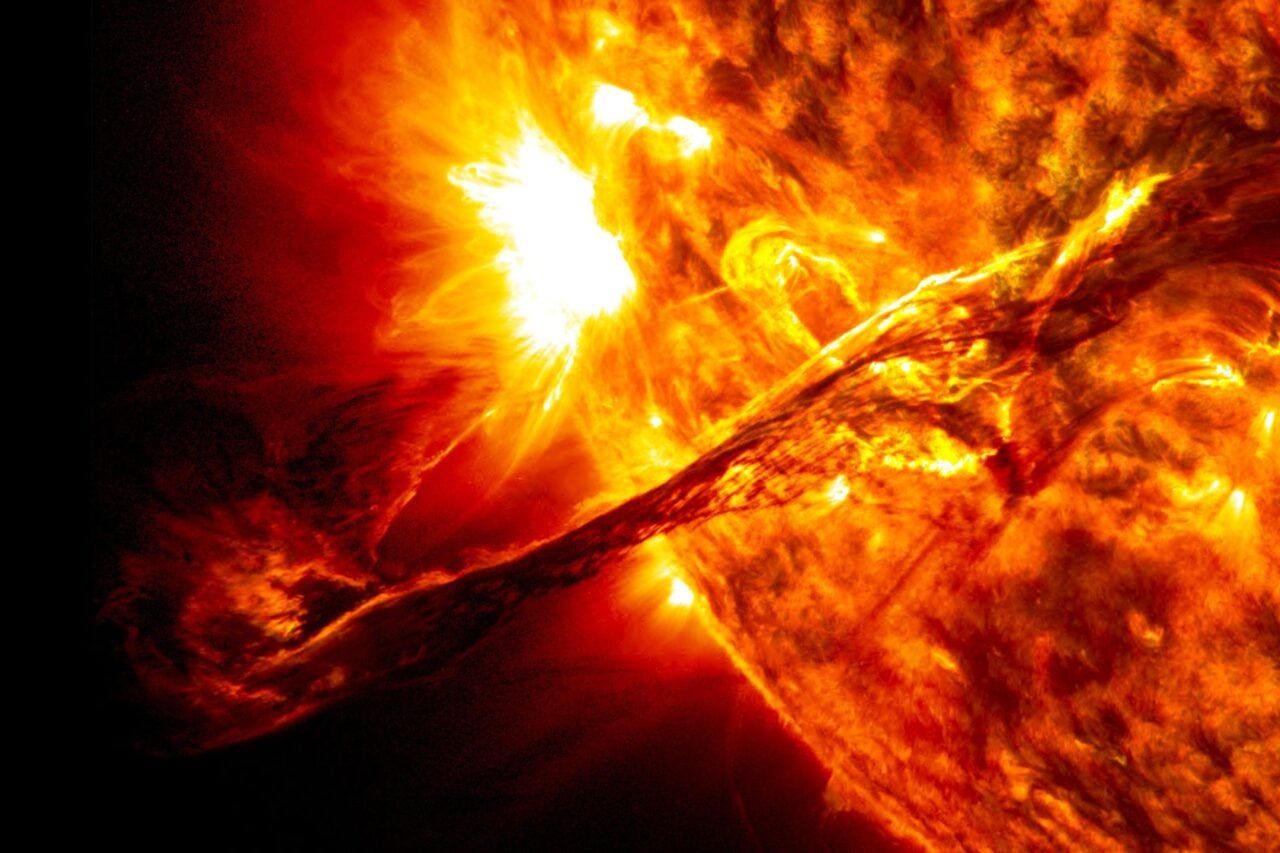
Сансрын хөлгүүдийн хамтарсан ажиглалтаар Нарны титмийн ялгаруулалт нь урьдчилан таамаглаагүй чиглэлд тархдаг болохыг тогтоожээ.
NASA-гийн “Europa Clipper” сансрын хөлөг 2024 оны арванхоёрдугаар сарын 19-нд Ангараг гараг руу чиглэн явахдаа ер бусын плазмын дохиог бүртгэжээ. Уг хөлгийн соронзон орныг хэмжих багаж (PIMS) нь хэвийн үеийнхээс илүү халуун, нягт багатай нарны салхины урсгалыг илрүүлсэн нь Нарны титмийн ялгаруулалттай (CME) холбоотой байв.
Судлаачид дотоод нарны аймгийн 17 өөр сансрын хөлгүүдийн мэдээллийг нэгтгэн дүн шинжилгээ хийснээр тус дэлбэрэлт нь бөмбөрцөг хэлбэрээр жигд тархахын оронд маш тогтворгүй, тэгш бус хэлбэртэй байсныг тогтоожээ. Дэлхийгээс харахад уг дэлбэрэлт манай гарагийг тойрч өнгөрөхөөр байсан ч STEREO-A хөлгийн ажиглалт нь түүний нэг хэсэг нь Дэлхий рүү чиглэж байсныг илрүүлсэн байна.
Энэхүү олдвор нь сансрын цаг агаарын урьдчилсан таамаглалд чухал цоорхой байгааг харууллаа. Нарны титмийн ийм гэнэтийн ялгаруулалт нь сансрын хөлгийн систем, харилцаа холбоог тасалдуулах, улмаар сансрын нисгэгчдийн цацраг идэвхт туяанд өртөх эрсдэлийг нэмэгдүүлдэг.
Судлаачдын үзэж буйгаар, Нар ба Дэлхий хоёрын шууд шугамаас гадуур байрлах сансрын хөлгүүд нь ирээдүйд хүн төрөлхтөн нарны аймагт гүнзгий нэвтрэх үед сансрын цаг агаарыг илүү нарийвчлалтай хянах боломжийг олгох юм. Одоогоор эрдэмтэд ийм гажилттай дэлбэрэлтүүд ховор тохиолддог уу, эсвэл хангалттай ажиглалтын цэг байхгүйгээс үл анзаарагддаг уу гэдгийг судлахаар төлөвлөж байна.
Дэлгэрэнгүйг эх сурвалжаас харах
Эх сурвалжийг нээх ↓
NASA’s Europa Clipper, a spacecraft on its way to conduct the first detailed study of Jupiter’s moon Europa, detected something strange on December 19, 2024. It had been about two months since the orbiter launched from Kennedy Space Center, and the mission team was performing a routine checkout of its Plasma Instrument for Magnetic Sounding (PIMS). It turned out to be anything but routine.
PIMS, designed to study the density, temperature, and flow of plasma near Europa, picked up on a fast-moving solar wind with plasma that was hotter and less dense than usual, prompting the team to take a closer look.
“At that point in the mission, one of our main goals was simply to make sure the instrument was behaving the way it was supposed to,” Adrienn Luspay-Kuti, principal investigator for PIMS, told Gizmodo. “So, when we saw an unexpected plasma signal, we needed to understand it well enough to be confident that PIMS was really measuring the space environment and not some artifact of the instrument or spacecraft.”
After confirming that PIMS was detecting a signal from the space environment, Luspay-Kuti led an investigation to figure out what, exactly, Europa Clipper had passed through. The findings, published today in the journal Science Advances, are based on observations from 17 different spacecraft across the inner solar system and reveal a potential blindspot in space weather forecasting that could endanger future crewed missions.
Solving a solar mystery
When Europa Clipper’s PIMS detected this unexpected signal, the probe was heading toward Mars and positioned roughly in-line with Earth. The spacecraft was more than 17 million miles from the Sun, and the plasma characteristics PIMS measured were atypical for solar wind at that distance. They are, however, commonly associated with structures produced by coronal mass ejections (CMEs).
CMEs are huge expulsions of plasma and magnetic field from the Sun’s corona, the outermost layer of its atmosphere. When directed toward Earth, they can trigger disturbances in the planet’s magnetosphere called geomagnetic storms. Space weather forecasters monitor the Sun’s activity to predict these storms, as they can disrupt power grids, scramble satellite communications, cause radio blackouts, and pose radiation risks to astronauts in orbit.
“Once we knew the PIMS signal was real, we started looking backward in time to figure out where it came from,” Luspay-Kuti explained. “We found a large filament eruption on the Sun a few days earlier that produced a CME, and then we looked at observations from spacecraft in different locations across the inner solar system.”
The researchers used these 17 spacecraft as a giant network of observation points to map the CME’s shape and size, track its movement, and measure its physical properties. This wealth of data revealed that it was more complex than a typical CME. Rather than behaving like a bubble expanding out from the Sun evenly in all directions, it had developed a very irregular shape.
From Earth’s view of the Sun, the main part of the CME appeared to be moving south and away from our planet, so space weather forecasters expected it to miss us. But NASA’s STEREO-A solar orbiter viewed the eruption from the side.
That vantage point allowed it to spot another part of the CME heading toward Earth—something that wasn’t visible from our planet. This is what triggered the unusual PIMS detection. Scientists couldn’t have predicted this part of the CME without observations from spacecraft positioned away from the direct line between Earth and the Sun, revealing a concerning limitation in space weather forecasting.
Planetary missions can cover the blind spot
This Earth-directed component of the CME also reached Mars. NASA’s MAVEN orbiter, which studied the Red Planet’s atmosphere from 2014 to late 2025, picked up on its signal.
The researchers do not report any damage to Europa Clipper or MAVEN caused by this part of the CME, but “the important point is that Europa Clipper was traveling through the region between Earth and Mars where future astronauts could someday be traveling,” Luspay-Kuti said. “It gave us a real example of the kind of space-weather environment a crewed mission could encounter, and why getting the forecast right matters.”
The biggest risk to astronauts would be a sudden increase in radiation exposure. “Fast CMEs can drive shock waves that accelerate charged particles to very high energies,” Luspay-Kuti explained. “Those particles can penetrate spacecraft shielding and pose a serious radiation hazard to astronauts once they’re outside Earth’s protective magnetic field.” CMEs can also disrupt spacecraft systems and communications.
Advanced warning of an oncoming CME would give the crew time to shelter inside a better-shielded part of the spacecraft, adjust operations, or take other steps to protect themselves. “If the event isn’t forecast, you lose that preparation time,” Luspay-Kuti said.
Next, she and her colleagues hope to investigate whether strongly distorted CMEs are rare or simply overlooked because scientists haven’t had enough observation points to detect them. This will help them understand how much of a threat they might pose to future missions. They also want to see if current forecasting models can reproduce this kind of CME behavior.
“This study highlights the role planetary missions can play in the space-weather observing network,” Luspay-Kuti said. Spacecraft positioned away from the Sun-Earth line could fill in observational gaps. This will prove especially valuable as humanity ventures deeper into the solar system.


