Шинэ судалгаагаар микрогравитацийн нөхцөлд хүний нүдний доод зовхи дээшлэх үзэгдэл ажиглагдсан нь харааны чадварт сөргөөр нөлөөлж болзошгүй байна.
Олон улсын эрдэмтдийн баг “Eye & ENT Research” сэтгүүлд нийтлүүлсэн судалгаагаараа сансрын нисгэгчдийн бие махбодод, ялангуяа нүдний доод зовхинд микрогравитаци хэрхэн нөлөөлдгийг судалжээ. Судлаачид NASA-гийн 13 сансрын нисгэгчийн 115 гэрэл зургийг шинжилснээр, эвэрлэгийн төвөөс доод зовхи хүртэлх зай дунджаар 1 мм-ээр багассаныг тогтоосон байна. Энэхүү үзэгдэл нь доод зовхи хэвийн бус өндөрт байрлах “урвуу птоз” хэмээх ховор нөхцөлийг үүсгэдэг бөгөөд судалгаанд хамрагдсан нисгэгчдийн 62 хувьд нь 1 мм-ээс их өөрчлөлт ажиглагджээ.
Эрдэмтдийн таамаглаж буйгаар, энэхүү өөрчлөлт нь хоёр үндсэн шалтгаантай байж болох юм. Нэгдүгээрт, бичил таталцлын улмаас хүний биеийн шингэн толгой руу шилжиж, нүдний орчмын эд эс хавдсанаар доод зовхийг дээш түлхдэг байна. Хоёрдугаарт, Дэлхий дээр таталцлын хүчээр доош татагддаг нүүрний эдүүд сансарт таталцлын нөлөө багассанаар уян хатан чанараараа дээш сулрах эсвэл байрлалаа өөрчлөх боломжтой ажээ.
Энэхүү үзэгдэл нь сансрын нисгэгчдийн харааны талбар болон эвэрлэгийн хэлбэрт нөлөөлж, харааны чадвар буурахад хүргэж болзошгүй тул эрдэмтэд санаа зовниж байна. Хэдийгээр тус судалгаа нь микрогравитаци болон нисгэгчдийн тайлагнасан бусад шинж тэмдгийн хооронд шууд холбоо тогтоогоогүй ч ирээдүйн урт хугацааны нислэгүүдэд эрүүл мэндийн эрсдэлийг тооцох шаардлагатайг харуулж байна. Цаашид Сар, Ангараг гараг руу чиглэсэн номлолуудад нүдний эрүүл мэндийг хамгаалахын тулд дүрслэлийн стандартчилсан протоколуудыг боловсруулах шаардлагатай гэж судлаачид үзэж байна.
Дэлгэрэнгүйг эх сурвалжаас харах
Эх сурвалжийг нээх ↓
It’s no secret that spending time in space takes a toll on the human body. Thanks to decades of research from spaceflight programs and the International Space Station (ISS), it is known that extended periods in microgravity lead to muscle atrophy, bone density loss, and changes in organ function, eyesight, and the central nervous system. But in a recent study, researchers examined the effects microgravity has on one specific part of human physiology: the lower eyelids.
The team consisted of researchers from the School of Medicine at Western Sydney University (WSU) in Australia, the Center for Space Medicine and Extreme Environments Berlin, the Aotearoa New Zealand National Eye Center, Otago University, and the Saarland University Medical Center in Germany. The study, titled “The effect of short-term microgravity and hypergravity on eyelid and brow position,” was published in the journal Eye & ENT Research.
During spaceflight, the lower eyelids naturally rise in response to the absence of gravity. Over time, this can lead to “reverse ptosis,” a rare condition where the lower eyelid sits abnormally high, covering part of the lower edge of the cornea. While studying 115 NASA photographs from 13 astronauts, the research team found that the distance from the center of the cornea to the lower eyelid (MRD2) decreased by an average of 1 mm.
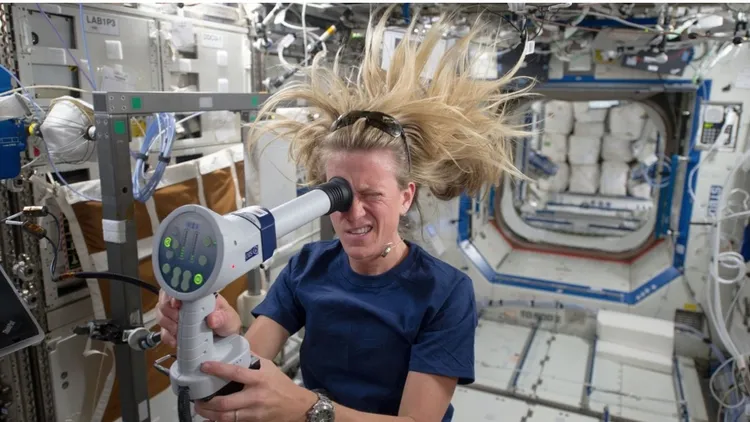
European Space Agency (ESA) astronaut Alexander Gerst takes optical measurements on board the International Space Station. Credit: NASA
This effectively means that all the astronauts surveyed exhibited signs of reverse ptosis, with 62% showing a change greater than 1 mm. These results are comparable to those observed in astronauts after short-term parabolic flights, suggesting that the phenomenon occurs rapidly and persists throughout longer missions. The results also concern scientists because reverse ptosis can lead to changes in the cornea’s shape, a reduced visual field, and diminished visual acuity.
To explain these changes, the authors proposed two main mechanisms. First, when astronauts are exposed to microgravity, they experience what’s known as cephalad fluid shift, where about 2 liters (1.32 gallons) of fluid moves towards the head. Approximately 50 ml (~1.7 oz) of this fluid is redistributed into head and neck tissues, causing swelling in the pretarsal area of the eye, forcing the lower eyelid up.
The second possibility was the elastic recoil facial tissues experience during spaceflight. On Earth, gravity pulls tissues downward, but in microgravity, elastic forces reposition them to minimize tension, leading to upward displacement. The changes observed were similar to those seen in parabolic flights, consistent with reports of swelling around the eyes throughout spaceflight.
While the study does not establish a direct link between microgravity and the symptoms reported by about 30% of astronauts, it does open the door to future studies. As the authors state, these should include standardized imaging protocols to clarify the mechanisms involved and the possible health implications for extended missions to the Moon, Mars, and beyond.
Further Reading: EurekaAlert!, Eye & ENT Research

