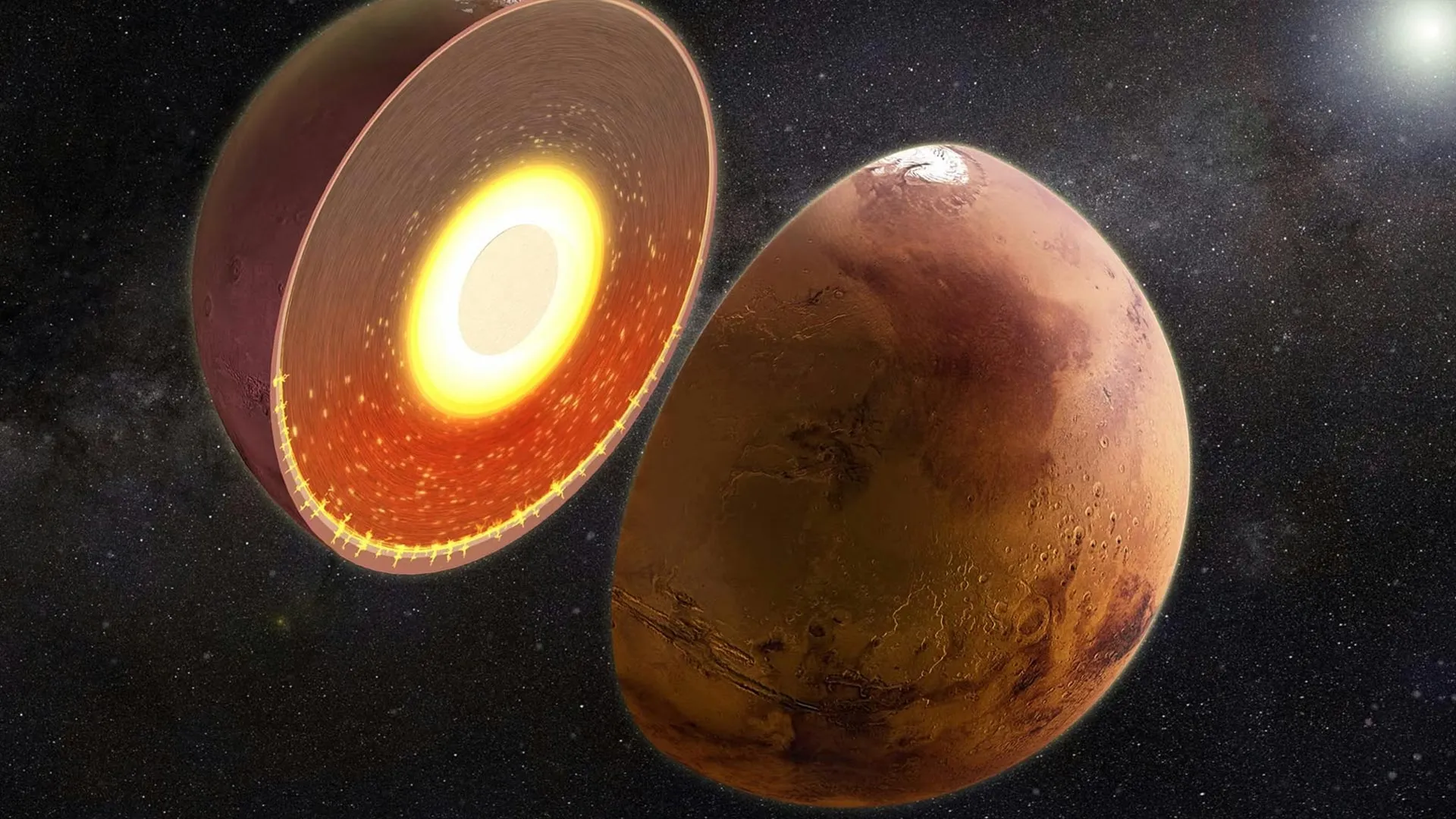
Судлаачид Ангараг гарагийн өмнөд хагас бөмбөрцгийн гүнд хойд хэсгээсээ илүү өндөр температуртай, хэсэгчлэн хайлсан төлөвт байж болзошгүй бүс байгааг тогтоожээ.
Аризонагийн их сургуулийн судлаач Александр Бэрнэ болон түүний баг “Nature” сэтгүүлд наймдугаар сарын 27-нд нийтэлсэн судалгаандаа Ангараг гарагийн таталцлын хүчний өөрчлөлтийг ашиглан дотоод бүтцийг нь шинжилжээ. Тэд Mars Global Surveyor, Mars Odyssey, болон Mars Reconnaissance Orbiter сансрын хөлгүүдийн олон жилийн ажиглалтын мэдээлэлд “tidal tomography” буюу түрлэгийн томографийн аргыг ашиглан гарагийн дотоод давхаргын температурын ялгааг тооцоолсон байна.
Судалгаагаар Ангараг гарагийн өмнөд хэсгийн дотоод дулаан нь хойд хэсгээсээ 200-400 хэмээр илүү байгааг илрүүлжээ. Энэхүү дулааны тэнцвэргүй байдал нь Ангараг гарагийн өмнөд хагас бөмбөрцөгт ажиглагддаг соронзон орны онцлог шинж чанар болон газар хөдлөлтийн долгионы эрчим сулрах үзэгдлийг тайлбарлах боломжтой юм.
Эрдэмтэд энэхүү дулааны гажиг үүссэн шалтгааныг одоогоор тодорхойлоогүй байгаа бөгөөд хэд хэдэн таамаглалыг дэвшүүлж байна. Үүнд аварга том мөргөлдөөнөөс үүдэлтэй дулаан ялгаралт, мантийн доторх аяндаа үүссэн конвекцийн урсгал, эсхүл геологийн зузаан бүтэц нь дулааныг гадагшлуулахгүй хадгалж үлдсэн байх магадлалтай гэж үзжээ.
Энэхүү нээлт нь Ангараг гарагийн геологийн түүх, тухайлбал шингэн ус оршин байсан үеийн нөхцөл байдал болон гарагийн хувьслыг ойлгоход чухал ач холбогдолтой юм. Цаашид энэ мэт судалгаа нь Ангараг гараг дээрх амьдрал оршин тогтнох боломжтой байсан эсэхийг илүү нарийвчлан судлах боломжийг бүрдүүлнэ.
Дэлгэрэнгүйг эх сурвалжаас харах
↓Эх сурвалжийг нээх ↓
Researchers have uncovered a major temperature imbalance deep inside Mars, with the planet’s southern interior appearing significantly hotter than its northern half.
Gravity measurements suggest that the interior beneath Mars’s southern hemisphere is about 200 to 400 degrees Celsius warmer than the north and may be partially molten. The finding offers a new window into the Red Planet’s geologic history, including periods when Mars may have had environments capable of supporting life.
The study was led by Caltech alumnus Alexander Berne (PhD ’26), now a postdoctoral associate at the University of Arizona. The results were published August 27 in Nature.
Mapping Mars From Gravity
While completing his graduate work at Caltech, Berne developed a model that uses subtle variations in gravity to estimate the internal structure of a planetary body. He and his colleagues later applied that approach to Mars.
The researchers analyzed decades of observations from three Mars missions: Mars Global Surveyor, Mars Odyssey, and Mars Reconnaissance Orbiter. By tracking extremely small changes in the spacecrafts’ velocities, the team was able to reconstruct the gravitational field surrounding Mars.
The Sun’s gravitational pull on Mars changes over the course of the planet’s seasons because Mars travels along a slightly elliptical orbit and rotates on a tilted axis. The researchers used a method known as tidal tomography to study how these gravitational signatures change over time and to build a model of the planet’s interior.
“Scientists usually assume that the interiors of planetary bodies are generally spherically symmetric, but this is not necessarily true,” Berne says. “As we get more gravity data, we can determine the three-dimensional intricacies of a planet’s interior structure. These inferences in turn give us a blueprint for designing future missions and scientific exploration of these worlds. Understanding the interior structure of planetary bodies helps us unravel the processes that shaped their formation and evolution.”
A Deep North-South Divide
Mars has long been known to look very different across its two hemispheres. The southern surface is dominated by tall mountains and heavily cratered terrain, while the northern hemisphere consists largely of broad, low-lying plains.
The new results show that this contrast may extend far below the surface. Researchers were surprised to find that Mars is also thermally uneven inside, with the southern interior hundreds of degrees hotter than the north.
That hidden heat could help explain several other puzzling features of Mars.
Scientists have detected unusual magnetic signatures in iron-rich minerals in the southern hemisphere. A hotter southern mantle could indicate that Mars once had a magnetic field strong enough to produce differences in magnetism between the two hemispheres.
NASA’s InSight mission also previously found that seismic waves lose energy more quickly in the south. Higher temperatures in the region could help account for that behavior.
Clues to Mars’s Watery Past
“The dichotomy that we see between north and south is important to understand because it gives information about processes that may have influenced the hydrology of Mars, including the formation of basins that may have held water,” says Amirhossein Bagheri, a postdoctoral scholar at Caltech and co-author on the paper. Bagheri is also a former member of the InSight team.
Understanding the temperature difference could therefore provide new clues about how Mars evolved and how its landscape developed during periods when liquid water may have existed on the surface.
Researchers do not yet know what caused the thermal anomaly. Several possibilities remain under consideration.
One hypothesis is that a giant impact released heat from the north. Another suggests that spontaneous convection may once have occurred within the southern Martian mantle. A third possibility is that thick geological structures in the south trapped heat and prevented it from escaping efficiently.
A New View of Mars’s Interior
The paper is titled “Tidal Tomography Reveals a Thermal Anomaly Beneath Mars’s Crustal Dichotomy.”
In addition to Berne and Bagheri, co-authors include Nicholas Wagner and Harriet Lau of Brown University, Isamu Matsuyama and Angela Marusiak of the University of Arizona, Sander Goossens of NASA Goddard Space Flight Center, Karwai Cheng of the Institute of Astronomy and Astrophysics at Academia Sinica in Taiwan, Antonio Genova of the University of Rome in Italy, Marc Rovira-Navarro of the Delft University of Technology in the Netherlands, Chuan Qin of UCLA, Douglas Hemingway of the University of Texas at Austin, Shijie Zhong of the University of Colorado Boulder, and Francis Nimmo of UC Santa Cruz.
The research was funded by NASA.

