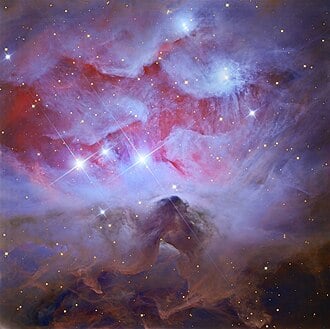
Охайогийн их сургуулийн одон орон судлаачид манган элементийг ашиглан сансар огторгуйн хувьслын түүх болон оддын үүслийг хэмжих шинэ хэлбэрийн “хэмжүүр” бүтээжээ.
Одон орон судлаачид манганы иончлогдсон хийн хэлбэр болох [Mn III]-ийг ашиглан галактикийн насыг тодорхойлох боломжтойг тогтоов. Энэхүү элемент нь төмрийн төрлийнх боловч байгальд харьцангуй ховор тохиолддог бөгөөд хэт ягаан туяаны спектрийн шугамаар дамжин илэрдэг тул дэлхийн гадаргуугаас ажиглахад хүндрэлтэй байдаг.
Судлаачид тооцоолон бодох хүчирхэг систем ашиглан манганы 1,421 өөр энергийн түвшин болон электрон мөргөлдөх 703 боломжит хувилбарыг тооцоолжээ. Эдгээр өгөгдөл нь супернова дэлбэрэлтийн дараах үе шатуудад манган хэрхэн гэрэлтдэгийг тайлбарлах бөгөөд энэ нь эртний галактикуудын насыг тогтоох шинжлэх ухааны чухал хэрэгсэл болох юм.
Ялангуяа Type Ia супернова дэлбэрэлтийн үед манган хурдтай үүсэж, төмөртэй харьцах харьцаа нь цаг хугацааны явцад өсдөг байна. Энэхүү харьцааг хэмжсэнээр эрдэмтэд галактикийн хувьслыг нарийвчлан судлах боломжтой болно.
Энэхүү судалгааны үр дүн нь James Webb Space Telescope-ийн хэт улаан туяаны ажиглалттай төгс нийцэж байгаа юм. Шинэ мэдээллийн сан нь сансрын гүн рүү өнгийх хүчирхэг дурангуудын тусламжтайгаар эртний ертөнцийн бүтцийг танин мэдэхэд чухал нэмэр болох ажээ.
Дэлгэрэнгүйг эх сурвалжаас харах
Эх сурвалжийг нээх ↓
Keeping track of time in the universe is a difficult task. It’s constantly evolving and changing, and studying events that happened billions of years ago, while possible, isn’t exactly easy. A recent paper in the Monthly Notices of the Royal Astronomical Society from astronomers at The Ohio State University has unlocked a whole new way to tell time in space by using a new, perhaps unexpected element – manganese.
That’s not to say astronomers are tracking chunks of the silvery ferrous metal floating around in the universe. They are looking specifically at the ionized, gaseous form of the relatively common element, known in the scientific literature as [Mn III]. So why is it so useful in acting as a “chronometer” for the universe?
Manganese itself is part of the iron family, but it is 100 times less common than its more famous cousin, who happens to have an entire epoch of human civilization named after it. Manganese also doesn’t show up well in traditional spectral lines, shining brightly in ultraviolet light that is difficult to detect from the surface of the Earth. Therefore, scientists have rarely used it to study the remnants of supernovae, or “space clouds” of gas and dust known as H II regions.
Fraser discusses the differences in Type I and Type II supernovae.
But they knew that at a fundamental physics level, they could. At least according to theory, manganese would glow during the late stages of a supernova remnant. But no one had ever bothered to figure out the physics behind using that glow as a scientific tool.
To understand why they would be useful as a scientific tool, it’s best to first start with understanding where they came from. As Carl Sagan famously said, we are all made of star stuff – and manganese, which does play a critical role in human biology, is no exception. There are two types of supernovae that form “heavy” elements with atomic numbers larger than iron. A Type II Supernovae happens when supermassive, short-lived stars explode only millions of years after their birth. Type Ia Supernovae, on the other hand, happen billions of years following the deaths of much more stable stars.
Manganese forms much faster in Type Ia supernovae, meaning that, as time goes on, there is more and more being formed. Specifically, this changes the ratio of manganese with iron – increasing as time goes on. Measuring this ratio back in the early history of the universe allows scientists to use manganese as “chronometer” to track the history of galaxy evolution and star formation – assuming they can actually see the spectral lines that are so hard to absorb from Earth.
Fraser talks about the details of Type Ia supernovae, which create much of the Manganese in the universe.
That’s where the paper comes in. The researchers turned to some heavy duty computational systems to calculate 1,421 distinct energy levels of manganese, checking them against existing atomic databases maintained by the National Institutes for Standards and Technology (NIST). They then calculated 703 different ways electrons collided with manganese atoms, and what the resultant light would look like from those collisions. Extending that out to the temperatures and densities found in space, the paper provides a data set of what astronomers could expect to find when looking for manganese in the early universe.
Just in time too, as some of the spectral lines noted in the paper are in the infrared and near-infrared – exactly the spectra that the James Webb Space Telescope (JWST) is adept at capturing. Combining data collected on manganese with other universal “chronometers” can provide another data point to confirm scientist’s measurements of the age of a given structure in the early universe. And as we get more and more powerful new telescopes peering even farther back into the reaches of time, those age measuring sticks will become ever more critical. It’s nice to include the spectral lines of a seemingly normal element to our toolkit for that effort.
Learn More:
OSU – New chemical clues shine a light on galactic evolution
Z. Samak, S.N. Nahar & A.K. Pradhan – Emissivity line ratios for [Mn iii] and spectral diagnostics of H ii regions
UT – The Chemicals That Make Up Exploding Stars Could Help Explain Away Dark Energy

