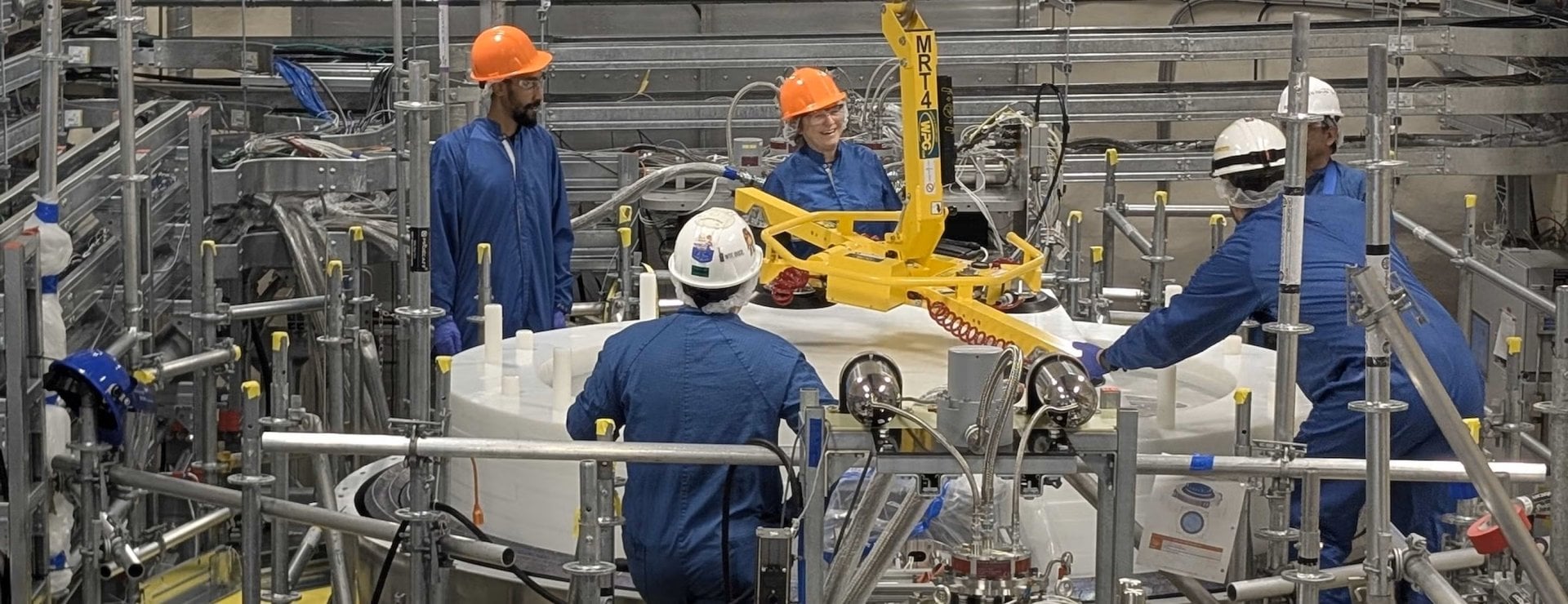
Онтарио дахь гүний лабораторид байрлах шинэ илрүүлэгч төхөөрөмж нь “хөнгөн” жинтэй харанхуй материйн анхны шууд нотолгоог олохоор ажиллаж байна.
Канадын Онтарио муж дахь Vale Creighton уурхайн 1.6 км гүнд байрлах SuperCDMS (Super Cryogenic Dark Matter Search) лаборатори шинжлэх ухааны туршилтаа албан ёсоор эхлүүллээ. 2018 оноос хойш бүтээн байгуулалтын шатанд байсан тус төсөл нь одоогоор “эрт үеийн шинжлэх ухааны” судалгааны хүрээнд өгөгдөл цуглуулж эхлээд байна. Уг төхөөрөмжийг ирэх гурван жилийн хугацаанд ажиллуулахаар төлөвлөж байгаа бөгөөд үр дүн сайн байвал ашиглалтын хугацааг сунгах боломжтой юм.
Судалгааны баг ердийн бодистой бараг харилцан үйлчлэлцдэггүй, маш бага масстай “хөнгөн” харанхуй материйн бөөмсийг илрүүлэхийг зорьж байна. Илрүүлэгч нь хоккей тоглох үед ашигладаг дискний хэмжээтэй, хэт цэвэршүүлсэн цахиур болон германий 24 талстаас бүрддэг. Эдгээр талстыг үнэмлэхүй тэг хэмд дөхөх хүйтэн нөхцөлд байрлуулснаар харанхуй материйн бөөмс мөргөлдөх үед үүсэх маш сул чичиргээ болон цахилгаан дохиог бүртгэх боломжтой болдог.
Гаднаас ирэх хөндлөнгийн цацраг болон чимээг багасгахын тулд төхөөрөмжийг зэс, полиэтилен болон радон хийнээс хамгаалах давхаргуудаар бүрхжээ. Тусгай хамгаалалтын зориулалтаар Ромын эртний хөлөг онгоцны сэгээс олдсон, олон мянган жилийн турш цацраг идэвхт чанараа алдсан маш цэвэр тугалгыг ашигласан нь судалгааны ажлын онцлох үйл явдал болсон юм.
Одоогийн байдлаар баг судалгааны багажаа тохируулах эхний шатыг хэрэгжүүлж байгаа бөгөөд 2027 онд бүрэн хүчин чадлаараа ажиллах төлөвтэй байна. 28 өөр байгууллагын хамтын ажиллагаагаар бүтсэн энэхүү төсөл нь орчлон ертөнцийн нууцлаг бүрэлдэхүүн хэсгийг нээх эсвэл харанхуй материйн шинж чанарыг тодорхойлох шинэ хязгаар тогтооход тусална хэмээн эрдэмтэд үзэж байна.
Дэлгэрэнгүйг эх сурвалжаас харах
Эх сурвалжийг нээх ↓
The search for dark matter has reached another milestone – in this case the start of science for one of the world’s newest detectors. The Super Cryogenic Dark Matter Search (SuperCDMS) SNOLAB just began its scientific operations in Ontario, and over the course of the next few years, hope to find direct evidence of “light” dark matter for the first time.
SNOLAB has been undergoing active construction (following earlier design and planning phases) since 2018, and has reached the point of “early-science” where the project team officially turns on the detectors to start to collect data with them. The plan is to run the facility for three years, though there is the possibility of extending that lifespan if operations go well.
“Going well” in this case likely means finding direct evidence of dark matter. SuperCDMS is designed to detect “light” dark matter – which, in a wonderful twist of the English language, isn’t an oxymoron, as in this case the word “light” doesn’t mean the opposite of “dark”, simply the opposite of “heavy”. These hypothetical particles are so light that they barely interact with ordinary matter at all, and when they do they only leave behind the faintest traces that they did.
Fraser discusses how we know dark matter exists.
Enter every particle physicist’s favorite playbook for dark matter detectors – cold, dark places inside our planet. SuperCDMS is located inside an active mine, known as the Vale Creighton mine, buried a 1.6km underground near Sudbury, Ontario.
The detector itself is composed of 24 ultra-purified silicon and germanium crystals about the size of a hockey puck (because that is a standard unit of measurement in Canada). Each of these crystals is placed inside a refrigerator that is cooled to temperatures approaching absolute zero – though admittedly that “cold” is imported since temperatures underground are actually warmer than on the surface in many cases.
If a particle of dark matter hits an ultra-cooled crystal, it will create a phonon – a tiny “vibration” in the crystal structure, as well as a very faint electrical signal. To catch these transient signals, each crystal is bedecked with a set of superconducting sensors, which are also chilled to enable their superconductivity. If a sensor picks up a signal, it’s a good indication that a dark matter particle might have hit one of the crystals.
Fraser goes into detail with Dr. Nicholas Hunt-Smith of the University of Adelaide about one theory on a source of dark matter – dark photons.
That’s in large part because the scientists spent a significant amount of effort shielding those crystals from everything else that might be able to induce such a signal. The entire system is wrapped in layers of copper, polyethylene, and a barrier against radon – which is particularly prevalent underground – not to mention the billions of tons of rock separating the detector from the surface of the planet.
But perhaps the most interesting shielding material is ultra-pure lead, which is a great radiation protector. However, modern ultra-pure lead is itself naturally radioactive at some level, so the machine designers turned to an unusual source – Roman shipwrecks. The ultra-pure lead found in these shipwrecks at the bottom of the Mediterranean has had thousands of years to burn through its radioactivity, making it ideal for use in a shield intended to protect a very sensitive instrument from other forms of that radioactivity.
Now that all of that shielding, and all of the hockey pucks have been set up and turned on, the science team is putting the lab through its early paces. But, according to a press release, there’s a chance that, even at this early stage when the machine itself has yet to be optimized, new and interesting science could result. Those early experiments will continue through the fall of this year, and the machine’s first “warm-up and maintenance period” will happen immediately after, running late into the year.
This all leads up to the official start of fully optimized science operations in 2027. SuperCDMS itself has been a long time in the making, with a collaborative team from 28 different institutions, and an almost decade-long build cycle. When it finally comes online, it might very well find the secret to the hidden universe. Or at the very least, it will help us put even better constraints on what that secret is.
Learn More:
SLAC – SuperCDMS SNOLAB begins preliminary phase of dark matter hunt
UT – Scientists Intrigued by a Surprising Result in the Search for Dark Matter

